Posts
-
Let's Read the 4e Monster Manual/Vault: Grimlock
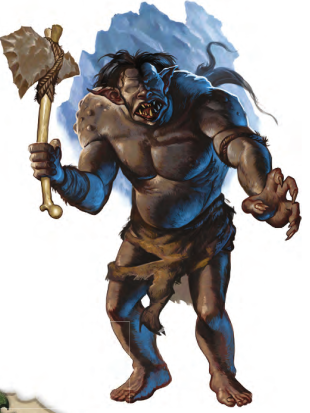
Copyright 2008 Wizards of the Coast This article is part of a series! Click here to see the other entries.
Grimlocks appeared in a Monster Manual for the first time in AD&D 2nd Edition, though it’s likely they appeared in a 1e or earlier supplement before that. I’m pretty sure they’re inspired by the Morlocks from H. G. Wells’ The Time Machine. Here they’re only on the MM.
The Lore
It seems like every “civilized” surface people has a more brutal “deep” counterpart in the Underdark. Elves have drow, dwarves have duergar, and so on. I’ve seen it argued that grimlocks are the equivalent of humans, though their dramatic role is a lot closer to that of your typical Angry Humanoid like an orc or gnoll.
Anyway, grimlocks are a humanoid people who apparently evolved in the Underdark. They have no eyes, and perceive the world through their keen senses of hearing and smell. Some sonar might also be involved here.
Grimlocks are quite strong, and their society has a Stone Age level of technology. As it’s unfortunately quite common for D&D, they’re described as stupid, savage cannibals who have a particular taste for human flesh and an Evil alignment.
That’s already quite enough to make them hostile to any given PC group, but there’s more! Grimlocks are surrounded by lots of powerful, technologically advanced evil empires, which means they often end up as slaves to drow, duergar, mind flayers, and so on. So you might end up fighting a grimlock horde either because they’re servants of the Big Bad, or just because they’re hungry.
The bit I like the most here is the statement that grimlocks evolved in the Underdark. That would make them one of the only sapient species native to the place - most others came either from the surface or from the Far Realm, as did much of the wildlife.
The Numbers
Grimlocks are Medium Natural Humanoids, which corroborates the evolution bit. Their signature traits are Blindsight 10, and the Blind keyword. This makes them immune to sight-based effects, and allows them to fight normally in full darkness or against invisible opponents.
They have no other special tricks, relying on “hard fighting” instead.
Grimlock Minion and Grimlock Follower
These are Minion Brutes, level 14 and 22 respectively. They fight with stone greataxes that do a bit more damage against bloodied targets, and otherwise hope to swarm their enemies with their huge numbers as minions often do.
You can expect to find large numbers of them in the service of some powerful Underdark villain, or if you end up raiding a grimlock settlement for some reason.
Grimlock Ambusher
A Level 11 Skirmisher with 110 HP, trained in Athletics and Endurance. It fights with a greataxe that has the High Critical property.
Its special move is the Offensive Shift, a reaction usable when an enemy moves within 2 squares and attacks an ally of the ambusher. It allows the creature to shift and make a basic attack against that enemy. This recharges when the ambusher is first bloodied.
Grimlock Berserker
This Level 13 Brute has 156 HP and seems to be visually indistinguishable from the ambusher above. It has training in the same skills.
The berserker fights with a greataxe as well, and in addition to its basic attack it can make a Power Attack that’s slightly less accurate and deals more damage. It can also make two basic attacks against a bloodied enemy.
When the berserker bloodies an enemy, it gains 10 temporary HP.
Sample Encounters and Final Impressions
The sample encounter is level 13: two berserkers, 2 hook horrors, and 1 mind flayer infiltrator who is likely the boss of this group.
I’m not really a fan of grimlocks. They fill a necessary role of mind flayer muscle but otherwise conform to all the usual Angry Humanoid stereotypes, with the words “murderous”, “savage”, “brute”, and so on appearing rather frequently as descriptors.
Mechanically they’re a bit weak, heavily affected by the damage bug due to being paragon-tier opponents. Even the berserker’s power attack falls short of what its basic damage output should be according to the new math. Fixing that is a priority if you want to use grimlocks as opposition.
-
Let's Read the 4e Monster Manual/Vault: Griffon
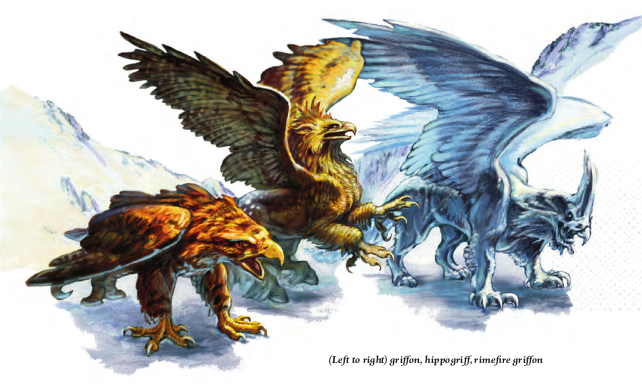
Copyright 2008 Wizards of the Coast This article is part of a series! Click here to see the other entries.
Another fantasy classic, these lion-eagle hybrids have a different spelling for their name in every source they appear in. D&D has always gone with “Griffon” and has featured them in its bestiaries since at least BECMI and AD&D 1st Edition. In Fourth Edition they appear only in the MM.
The Lore
A griffon is a large flying carnivore with the head, wings and foreclaws of a giant eagle, and the hindquarters of some non-flying beast. They’re strong enough to be used as flying mounts, though how easy they are to train depends on the exact variety you’re dealing with.
The most common variety is called simply a Griffon, and has a lion’s backside. They can’t be trained at all unless you start with a hatchling, but stories tell that some elves and eladrin can use magic to control them and ride them into battle. Griffon eggs fetch a high price on the open market (1000 GP) from people who want a shot at training them, or who think they have that eladrin magic figured out.
The ones you’re most likely to find as trained mounts are the Hippogriffs, who have horse backsides and a considerably more tractable temperament. This makes them the most common flying mount among the sapient people of the world. I’m pretty sure Nerath had whole regiments of hippogriff cavalry and that the practice survives in any post-imperial community of sufficient size.
Hippogriffs are brave enough that that they can readily be ridden into battle, and they actually breed true with normal horses as well as with each other. The offspring of a horse and a hippogriff will either be another hippogriff or a temperamental horse. They’re expensive enough to be a prime target for thieves, and there’s a thriving black market on young specimens.
Even the Elemental Chaos has its own griffon species in the form of the Rimefire Griffon, a formidable beast that the book describes as being sapient, unlike its natural cousins. It’s not exactly a genius at Int 4, but it still “allies” with ice archons or gets “pressed into service” by efreets instead of being “tamed”.
The Numbers
Griffons are Large Natural Beasts with the Mount keyword (the Rimefire Griffon is Elemental instead). They’re a bit slow on land, but are excellent fliers.
Hippogriff
The typical hippogriff is a Level 5 Skirmisher with 64 HP. It walks at speed 4 and flies at speed 10. Being a MM monster, it has a listed overland flight speed of 15, fast enough to outrun most dragons.
Its basic attack is a bite, and it can perform a Flyby Attack that works as expected: the hippogriff flies it speed, attacks at any point in the movement, and draws no opportunity attacks. It can also perform a Diving Overrun, a charge which does more damage than the bite, knocks the target prone on a hit, and lands the hippogriff adjacent to it.
As mounts, these creatures grant +1 to all of their riders’ defenses.
Hippogriff Dreadmount
An armored hippogriff that fights better on the ground. It’s a Level 5 Soldier with 66 HP and the same speed as the standard model.
Dreadmounts trade their usual agility for increased battlefield control. They fight with bites, and can do Wing Slams (Melee 1 vs. Reflex) against enemies who try to shift or move away from them. These attacks are interrupts, doing some damage and knocking enemies prone on a hit. They can’t be done while in the air.
Dreadmounts are also as stable as dwarves - they move 1 square less from forced movement effects, and can roll an immediate save to avoid being knocked prone.
Griffon
Classic griffons are Level 7 Brutes with 98 HP. They run with speed 6, and fly with speed 10.
Griffons fight with their claws, and they’re all about charging: charge attacks give them a +4 attack bonus instead of the usual +1. When acting as mounts, their charges allow them to make two claw attacks in addition to the rider’s attack.
When bloodied, griffons lose their shit: they become immune to fear, gain an extra move action, a +2 bonus to attacks, and a -2 penalty to defenses.
Rimefire Griffon
These are Level 20 Skirmishers with 186 HP. Their land speed is 5, and their flight speed 10. They have Resist 10 to both cold and fire.
Rimefire griffons have lion bits but fight more like hippogriffs, with a basic bite that does physical and cold damage and the same Flyby Attack power. They can also breathe fire (Close Blast 5 vs. Reflex), an attack that starts “uncharged” but recharges after the creature hits twice with a bite attack. When used as a mount, the rimefire griffon grants its elemental resistances to its rider.
The lore description for the fiery breath is fun: their bites absorb the target’s body heat, causing the creature’s prominent horn to glow red-hot. Once it stores up enough heat, it can release it as a blast.
Sample Encounters
The sample encounters emphasize the role of griffons as mounts:
-
Level 5: a human mage and 2 human guards riding hippogriffs.
-
Level 5: 3 warforged soldiers and their dreadmount-riding captain.
-
Level 6: 2 eladrin fey knights on griffons.
-
Level 20: 1 Ghaele of Winter riding a rimefire griffon, accompanied by a quartet of fire and ice archons.
I like them, particularly the emphasis on them being mounts. I get the feeling that investing in horses in D&D’s implied setting is a fool’s game. You have boar-riding dwarves, griffon-riding elves, human knights on hippogriffs, and I’m sure there’s a ridable drake somewhere. Warhorses are so last edition.
-
-
Let's Read the 4e Monster Manual/Vault: Grick
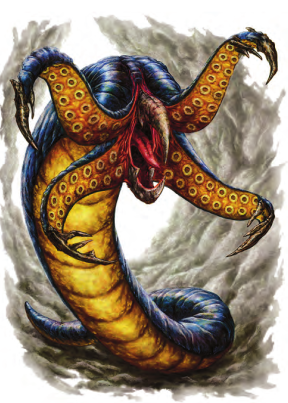
Copyright 2008 Wizards of the Coast This article is part of a series! Click here to see the other entries.
I remember seeing Gricks for the first time in 3.0, but I wouldn’t be surprised if they appear earlier than that. In this edition they’re only on the MM.
The Lore
In the previous post about Grells I complained that a lone grell was indistinguishable from any of the many other tentacled underground predators. Well, Gricks are one of those, and the main sources of my confusion. They even have tentacles, a beak, and a short name that starts with GR.
The main differences are that gricks are nonsapient and have worm-like bodies instead of being floating brains. They live in caves and in the upper reaches of the Underdark. There’s pretty much no chance for the PCs to have a nonviolent interaction with these beasts (aside from sneaking around them, I guess). Gricks are always either hungry and hunting, or hanging around their nests, which they protect with murderous ferocity.
I note they don’t seem to have a burrowing speed, so they either need to stick to premade caves and tunnels, or they burrow too slowly to make a difference in combat. When food turns scarce in the grick’s preferred environment, they’ll venture out to the surface to hunt at night, returning home before sunrise to avoid burning out their tiny cave-adapted eyes.
Gricks are pack hunters and have excellent instincts for surrounding their intended prey. They’re also really tough and hard to hurt. I wonder if bullettes and gricks prety on each other, like sperm whales and giant squid.
The Numbers
We get two stat blocks here.
Grick
The default model is a Medium Aberrant Beast and a Level 7 Brute with 96 HP. It has Resist 5 against all effects that target AC, moves with speed 6, and climbs with speed 4. It also has darkvision.
Its basic attack is a Tentacle Rake (Melee 1 vs. AC) that does both immediate and ongoing damage on a hit (save ends).
It also has a trait named Expert Flanker that grants it a +2 attack bonus against a target it’s flanking. That does stack with the standard +2 from combat advantage, for a total of +4.
Grick Alpha
A bigger, badder version leading a pack. It’s a Large Aberrant Beast and a Level 9 Brute (Leader) with 116 HP. It has the same damage resistance, senses, and climb speed as the base grick, but its ground speed is 7.
The tentacle rake attack is almost identical, but has Reach 2 and also grabs the target. The alpha can then use its standard actions to perform a Vicious Bite on the grabbed target, doing automatic damage that’s a bit weaker than that of the tentacles.
Why would it bother with that? Because it grants its allies a +2 attack bonus against the grabbed victim. So while being chewed on by the alpha, the hapless PC will also be attacked by the smaller gricks with a total bonus of +6: 2 from CA, 2 from Expert Flanker, and 2 from this ability.
Of course, the alpha is an Expert Flanker itself.
Sample Encounters
Gricks obviously don’t socialize with anyone outside their packs, but sometimes an opportunistic predator will join a grick fight hoping to score some scraps. They can also be enslaved by certain aberrant creatures, which seem to be the only ones that can make any use out of these ornery worms.
Thus we get our two sample encounters:
-
Level 8: 1 grick alpha, 3 standard gricks, 2 dire stirges.
-
Level 9: 2 alphas, 1 gibbering mouther, and a trio of foulspawn.
Final Impressions
I like their mechanics, but the lore doesn’t inspire me all that much. They work well enough as an incidental encounter for “natural cave” dungeons, I suppose.
-
-
Let's Read the 4e Monster Manual/Vault: Grell
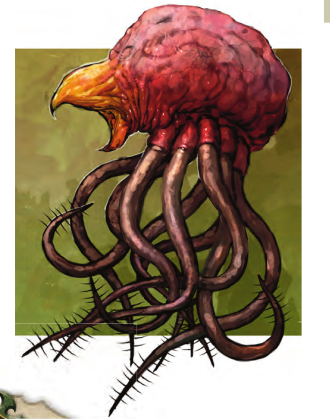
Copyright 2008 Wizards of the Coast This article is part of a series! Click here to see the other entries.
Grells have been around since at least the 2e Monstrous Manual. In Fourth, they’re only on the MM, but they got an update in Dungeon 192.
The Lore
These beaked, tentacled brain-things live and hunt in the Underdark. Like a lot of monsters in this book they’re carnivores who don’t mind if their prey is sapient. Though blind, they perceive the world through their latent psychic powers.
Grells are sapient, but lone grells tend to lead a feral existence and behave pretty much like clever pretadors. Those tend to be exceptions, though. Grell most often organize themselves in hive-like colonies with dozens of individuals, led by the most intelligent and powerful among them. These colonies are expansionist, though they tend to see their territory more as a hunting ground than as any sort of empire. Grell colonies don’t go for subtle manipulation, either.
Grells have a venomous bite, and venomous spines on the tips of their tentacles. Their leaders are called Philosophers, and have stronger psychic powers on top of that.
One interesting fact added by the Dungeon update is that brains are poisonous to grells! They’ll eat every other bit of their victims, but will either discard the brains or keep them in reserve for trade if there’s a mind flayer colony near their territory.
The Numbers
Grells are Medium Aberrant Magical Beasts who lack eyes and thus are immune to gaze attacks. They have Blindsight 12 and fly with speed 6 (hover). A grounded grell is reduced to a ground speed of 1 (clumsy). They’re Evil, communicate via Deep Speech, and are trained in Stealth and Perception.
Grell
The basic model is a Level 7 Elite Soldier with 156 HP. Its basic attack is a Tentacle Rake (Melee 2 vs. AC) using those spines, and while it does the damage expected by the new math that’s only because the designers went with the “one double-damage attack” approach for this elite monster. In addition to doing damage, the tentacles slow the target and give it a -2 penalty to attacks (save ends both).
Instead of raking, the grell can attempt a Tentacle Grab (Melee 2 vs. Fortitude) which does a bit less damage than the rake and grabs the target. The grell can only grab one victim at a time, and enjoys a +2 bonus to AC while it’s grabbing someone.
As a 1/round minor action, the grell can use its Venomous Bite (vs. AC) against a grabbed victim, dealing a bit of physical damage and stunning them (save ends).
You can expect a grell to be able to keep one PC stunlocked and the rest of them slowed. The update gives them two attacks per turn, each of which can be a Tentacle Rake or a Tentacle Grab. They retain their stunning bite, but the stun also ends when the grab does in addition to being (save ends).
Grell Philosopher
Philosophers are Level 11 Elite Controllers with 224 HP. They have Resist 20 Lightning on top of the common grell’s traits. Their basic attack is still the tentacle rake, whose damage is only 1 point higher than that of a standard grell.
They have a ranged attack in the form of a Lightning Lance (Ranged 10 vs. Reflex) which does lightning damage and blinds (save ends). If there are a lot of PCs nearby they can instead use their Venomous Mind (Close Burst 3 vs. Will, enemies only) which does psychic damage and forces its victims to choose random targets for any melee attacks they make (save ends). I love these unique conditions.
Occasionally the philosopher will be able to cause a Psychic Storm (Area Burst 2 within 10 vs. Will; recharge 6) which does psychic damage and dazes (save ends). The storm lingers as a zone until the end of the encounter, dazing anyone caught within (save ends).
Psychic storm is always available at the beginning of the fight, so that’s going to be the opener almost every time. It’s not a “friendly” area, so some care is required in its placement. Venomous mind is an excellent power to use on the PCs stunlocked by the philosopher’s underlings.
The dungeon update left them pretty much identical, aside from the usual damage improvements.
Sample Encounter and Final Impressions
There’s one grell encounter here, which is level 11: a philosopher, 2 standard grells, and 4 troglodyte minions. The lore didn’t give me the impression grells would work alongside anyone else, but the troglodyte association here is interesting. This works as a good boss battle for level 8-9 characters.
I think grells are a lot more interesting when they’re in colonies. As lone feral predators they’re interchangeable with a lot of other tentacled Underdark beasties.
One thing I noticed is that 2e seems to have described them as having a higher level of technology: they worn spear-tips on their tentacles, used magic items, and the Lightning Lance was an actual weapon instead of a psychic power. I wonder how much stress this caused GMs whose players looted a bunch of +5 rings and rayguns from a group of grells. So in that way it’s a good thing that these things are no longer in the game. Still, if you’re looking for some treasure to assign to a grell encounter, these items might be a good inspiration.
2e used to also have Grell Patriarchs as the “tier” above Philosophers. Patriarchs were large sapient masses of flesh that acted as the core of spelljammer vessels. If you’re including spelljamming in your campaign you could bring them back.
-
Let's Read the 4e Monster Manual/Vault: Gorgon
Copyright 2008 Wizards of the Coast This article is part of a series! Click here to see the other entries.
In Greek mythology, the Gorgons are a trio of sisters whose bodies were partly composed of snakes and whose visage could turn people to stone. Medusa was one of the Gorgons (the other were Stheno and Euryale). If you say the word “Gorgon” to anyone, they’ll probably think of Medusa, unless they’re D&D players.
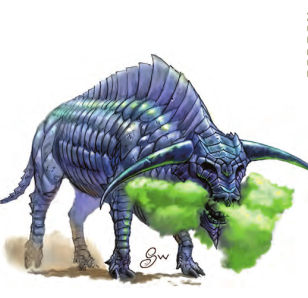
D&D uses the word “Medusa” as a species name for the snake-haired ladies, and “Gorgon” for these carapaced cows with a poison breath. They, in turn, are based on a monster from medieval European folklore whose poison gas came out of the other end. They appear only on the Monster Manual.
The Lore
There isn’t much to go on here. Gorgons are elemental beasts known for their foul temper and deadly breath weapons. In the wild they roam in small herds of 3-7 individuals made up of one bull and his harem of cows. Young males acquire a herd by challenging and defeating its current bull. Those who fail at this roam alone or in pairs and are likely even more aggressive than usual.
Taming gorgons is quite hard, but it happens. Those who most often succed at it are other elemental creatures, particularly giants.
The Numbers
Gorgons are Large Elemental Beasts whose signature traits are Truesight and a complete immunity to forced movement and being knocked prone. They also have a breath weapon of some sort, though its effect varies with the stat block.
Iron Gorgon
This is the one that’s closest to the “classic” D&D gorgon of editions past. It’s a Level 11 Soldier with 120 HP and the common traits listed above. It has the Earth keyword, runs at Speed 6 with Earth Walk, and is immune to petrification.
The iron gorgon’s basic attack is a Gore, though I imagine it will most often Trample instead. This allows it to move its speed, go through enemy spaces, and perform an attack against any enemy whose space they go through. This is a little weaker than the gore but will likely target multiple PCs. The movement draws opportunity attacks as normal.
Ocasionally, the iron gorgon will perform an Earthshaking Charge (recharge 5-6), which does more damage than the basic attack and pushes a Medium or smaller target 3 squares, also knocking it prone.
Finally, it can use the Petrifying Breath that made it famous (Close blast 3 vs. Fortitude; recharge 6). It does poison damage, dazes and slows (save ends). This worsens to immobilized on the first failed saved, and to permanent petrification on the second. Other gorgons are immune to this breath weapon, which means they don’t have to worry about friendly fire when you fight the whole herd.
Storm Gorgon
Explicitly called out as the favorite herd animal of storm titans, the mighty storm gorgon is a Level 26 Skirmisher with 248 HP and all traits listed above. To them it adds a Tempest’s Fury aura (size 5) that does 20 lightning damage to anyone caught inside, which is impressive even for an epic creature. It also has 20 lightning and thunder resistance, runs at Speed 8 and flies at Speed 10 with hover capability.
Its basic gore attack does a mix of physical and thunder damage, and also always pushes the target 2 squares and knocks it prone on a hit. It can use that as part of a Mobile Melee Attack where it moves its speed without drawing opportunity attacks and makes an attack at any point in this movement. They can also Trample like iron gorgons if they want to spread the hurt more widely.
Their breath is a storm (Close Blast 5 vs. Fortitude), which does a whole bunch of lignthing and thunder damage but doesn’t have any riders.
Sample Encounter and Final Impressions
The sample encounter here is level 27: 2 storm gorgons, 1 storm titan, and 2 dragonborn champions. I imagine this is a lord taking a walk with his favored pets and their minders. Yes, the Dragonborn Champions are pet minders - anyone less tough would be killed by those storm auras.
Confusing naming conventions aside, I quite like these deadly bovines. They’re in dire need of a damage fix, of course, and I would probably shift the conditions on the iron gorgon’s petrifying breath around. Something like slowed -> immobilized and dazed -> petrified.
How about some fan-made gorgon lore? I imagine they’re native to the Elemental Chaos, and were brought to the world by the giants way back when. Wild specimens can be found in both planes, descended from escaped members of giant herds who went back to nature.
While storm gorgons (below) are explicitly called out as being a favorite of storm titans, I imagine hill giants would be just as fond of iron gorgons. Those groups who grow adept at gorgon ranching have less reason to raid neighboring settlements for food. Their territories might be full of giant-sized statues left over from the process of becoming adept at gorgon-ranching too.
You know who else might be good at herding gorgons? The githzerai. They’d have to be if they use animal products at all. Normal cattle would have trouble surviving in the Elemental Chaos.
subscribe via RSS