Posts
-
Let's Read the 4e Monster Manual/Vault: Helmed Horror
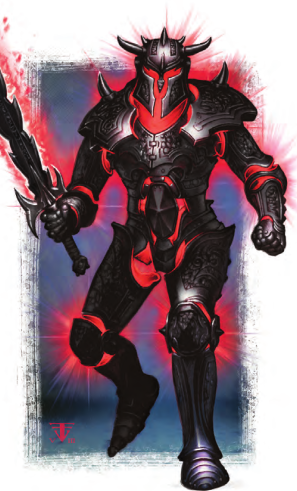
Copyright 2008 Wizards of the Coast This article is part of a series! Click here to see the other entries.
I first remember seeing Helmed Horrors in Neverwinter Nights, which used the 3e rule set. It’s quite possible they’ve been in the game since AD&D, though. Here, they’re only on the MM.
The Lore
Helmed Horrors are one of the many constructs-that-are-not-golems. They’re created by means of an ancient ritual just like golems, but have several practical differences.
First, the ratio of matter to elemental energy is different. The physical body of a helmed horror is a suit of plate armor, not a solid statue. This suit is filled with a much greater amount of energy pulled from the Elemental Chaos, enough to give the horror a coruscating aura and to infuse its weapon attacks with elemental damage. This also gives them the ability to regenerate.
Mentally, Helmed Horrors are smarter and have a bit more personality, though they’re still completely loyal to their creators. They can speak, and they have excellent senses (including both darkvision and truesight). They’re typically given greatswords as weapons, and are used for much the same purposes as a golem: guardians, bodyguards, or remorseless muscle.
Given their greatly enhanced senses and their trained skills, I imagine it’s also possible for a helmed horror to be used as a bounty hunter or city guard, possibly accompanied by organics who handle the more delicate social tasks.
The Numbers
We get two helmed horror stat blocks here. Both are Medium Elemental Animates (constructs) with training in Perception and Insight, plus Darkvision and Truesight. They speak Common and Primordial, and have human-level intelligence (one has 10, the other 12).
Helmed Horrors are immune to charm, disease, fear, poison and sleep, a greater suite of immunities than even some golems get. They also have varying levels of Regeneration and the ability to fly at the same speed they walk, though they do so clumsily.
Helmed Horror
The basic model is a Level 13 Soldier with 131 HP and all common traits above. Its regeneration is 5, and its speed is 6 both on the ground and in the air.
The horror’s Elemental Greatsword does a mix of physical damage and one of cold, fire, lightning or thunder, chosen before each attack is rolled. Its damage is “naturalistic”, but the bonus elemental damage manages to get to just a couple of points less than its correct value.
Once per encounter the horror can perform a Blade Sweep to attack two different targets, and it has a Tactical Step ability that allows it to shift 2 squares when it hits with an opportunity attack.
Greater Helmed Horror
This is a Level 18 Elite Soldier with 348 HP, which at first glance looks like it puts it on a roughly even footing with stone or iron golems. However, that’s not quite true.
The Greater Helmed Horror is basically a leveled-up version of the basic model. Its Regeneration is 10, its speed 8 in all movement modes, its Tactical Step shifts it 3 squares instead of 2.
It still gets only one greatsword attack, which due to “naturalistic” design only does 1 point of damage more than the basic model’s. It can also do a Blade Sweep, but still only once per encounter.
It does get a new attack in the form of Elemental Burst (Close Burst 5 vs. Reflex; Recharge 5-6), which does a bit less damage than the sword and has the same damage type options.
Greater Helmed Horrors require a bit more work to bring up to the standards of the new math - their damage needs a boost, and I’d also make their Blade Sweep an at-will action. That would put them in the same footing as a golem.
Sample Encounter and Final Impressions
We get one sample encounter here. Level 14, 2 helmed horrors, 1 mummy lord and 3 firelasher elementals. I’m guessing the mummy was the thing’s original creator, and summoned the elementals too.
We’ve already seen at least three different “families” of constructs that are created via ancient rituals and end up getting used for roughly the same purposes: golems, guardians, and helmed horrors. That makes me think of a setting where construct-making spellcasters are a bit like programmers. Each follows a specific school of thought and employs a different “language”, and they bicker constantly about whose is best. And unlike real-world programmers, these people can have their creations beat each other up when their arguments get really heated.
-
Let's Read the 4e Monster Manual/Vault: Harpy
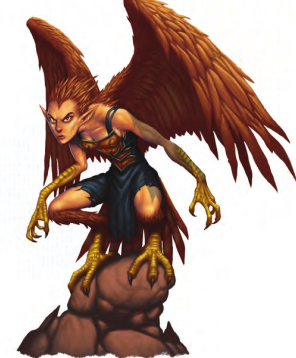
Copyright 2008 Wizards of the Coast This article is part of a series! Click here to see the other entries.
D&D Harpies are inspired by the harpies from Greek mythology, with a bit of siren mixed in. They’ve been in the game since pretty much the beginning. Here, they are on the Monster Manual only.
The Lore
In ancient times there was an evil elf witch queen. She and her unscrupulous children often took the form of golden eagles to spy on their subjects. A mighty hero defeated them and drove them into exile, breaking the queen’s magic crown in the process. It was the crown that gave them the power to change shape, and when it broke the evil family became stuck as part-bird, part-elf beings. These were the first harpies.
Modern harpies roost in dismal places where few others can live: swamps, badlands, ruins, coastal cliffs. They fly out to hunt or to attack travelers, pacifying their victims with their magic-imbued songs and tearing them apart with their claws.
Both male and female harpies exist, but they usually only spend enough time together to produce a batch of eggs. Once the female lays her eggs, the male takes off. Because of this is quite rare for PCs to find a mixed-gender group of harpies.
The Numbers
Harpies are Medium Fey Humanoids and have human-level intelligence. This means there’s nothing stopping your setting from containing settlements of unaligned or friendly harpies, but the ones we get here are Evil bandit-types.
Harpies walk with speed 6 and fly with speed 8 (clumsy), which means they mostly fight on the ground when using their claws, or from some high perch when using their ranged special powers. If you want them to be better fliers, removing the Clumsy keyword is a good start.
Unlike the elves they used to be, harpies have no special ability to see in the dark.
Harpy
The classic model is a Level 6 Controller with 71 HP and the common traits listed above. It also has Resist 10 Thunder.
Harpies fight in melee with their claws, and prefer to do so from the ground since they’re clumsy fliers.
Their main special ability is the afore-mentioned Alluring Song (Close Burst 10 vs. Will), which can affect any non-deaf enemy in range. A hit pulls the target 3 squares and immobilizes them (save ends). The harpy can use a minor action in subsequent turns to sustain the power and pull anyone who hasn’t saved yet another 3 squares.
Once their enemies are all nice and bunched up, the harpy can let loose a Deadly Screech (Close Burst 4 vs. Fortitude; recharge 5-6), which does thunder damage and dazes (save ends).
Both of the harpy’s damaging attacks are in serious need of a damage boost. This, and removing the Clumsy keyword from their flight speed, should be enough to bring them up to MV standards. The Alluring Song is particularly dangerous in a battlefield full of cliffs or other hazards.
Bloodfire Harpy
This one doesn’t bother with nice songs, it just kills you with fire.
A Bloodfire Harpy is a Level 9 Soldier with 100 HP. It has Resist 10 Fire and sings a Burning Song (aura 20) that slowly boils the blood of anyone in range who can hear it, dealing 5 fire damage at the start of their turns.
This harpy also fights with claws, which are red-hot and do a mix of physical and fire damage. It can also disgorge a Cloud of Ash (Close Blast 3 vs. Fortitude; recharge 4-6) which does fire damage and blinds (save ends).
These fiery things could use the same damage boost as the basic model, but they work fine otherwise.
Sample Encounters and Final Impressions
Judging by the sample encounters in the book, harpies tend to keep some fine company:
-
Level 6: 3 harpies, 2 spined devils. They have a lot in common when you think about it.
-
Level 8: 1 bloodfire harpy, 3 gnoll marauders, 2 cacklefiend hyenas. Just a bunch of bros hanging out, doing some light pillaging and burning.
-
Level 8: 2 harpies, 1 sahuagin priest, 3 sahuagin raiders. Better plug your crew’s ears before you get too close to this reef.
I like harpies! Mythological monsters are always fun, and these ones have some interesting song effects. It’s also not too hard to come up with new varieties, like a skirmisher harpy with better agility and Flyby Attack, or one that can put people to sleep with their song.
-
-
Let's Read the 4e Monster Manual/Vault: Halfling
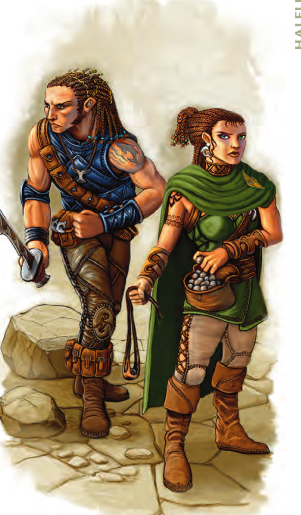
Copyright 2008 Wizards of the Coast This article is part of a series! Click here to see the other entries.
Halflings have existed since the beginning of D&D. Though they don’t appear among the original classes, IIRC they were introduced in a very early supplement. Their original inspiration is of course Tolkien’s hobbits. Early halflings were exactly like hobbits, though this changed as editions went on.
In 4e they appear as a playable race in the PHB, and have entries both in the Monster Manual and Monster Vault.
The Lore
Like the halflings of most other editions, those in the implied setting of Fourth have no nation to call their own. The big difference here is that they’re not alone in this, as it’s also true of a lot of others.
Halflings most often live in other people’s cities. Their own settlements are always built on the margins of rivers, and make extensive use of them for both food and transportation.
Barges full of nomadic halfling traders are a common sight in any city near a river, which tend to treat them like a mixed blessing because those caravans are also the source of the halfling’s reputation for petty larceny in addition to the usual goods and news from afar.
Halfling culture places great value in facing the world with a smile. A halfling will present a friendly demeanor when faced even with the most intimidating behavior, and will try to talk their way out of trouble if at all possible. When things get more serious than that, though, so do they. Despite their small size, they’re clever and fearless fighters.
Judging from the art in the books, halfling fashion tends to diagonal patterns in their clothes and armor. They wear their hair long and often braided, and may sport tatoos with water or fish motifs.
The Numbers
Halflings are Small Natural Humanoids with Speed 6. Their signature traits as “monsters” are the same ones for the PC version: a +5 bonus to saves against fear, and a trait called Nimble Reaction which gives them +2 to AC against opportunity attacks. They also get the PC version’s +2 bonus to Acrobatics and Thievery.
The MM halflings also get the same Second Chance encounter power as PCs, a reaction which forces an attacker that just hit them to reroll their attack and go with the second result. MV halflings lack this.
The stat blocks we get here all seem to represent rogue-types, with mobile combat styles focused on precision strikes with light blades. As usual for playable races, the ones in the MM have an alignment of Any, and the ones in the MV are Unaligned.
Halfling Slinger (MM)
Slingers are Level 1 Artillery with 22 HP and all common MM halfling traits. They’re trained in a bevy of skills: Perception, Stealth and Thievery.
They fight in melee with a dagger but prefer ranged combat with their slings. Every once in a while they can fire off a Stone Rain (recharge 5-6) which allows them to make three sling attacks at a -2 penalty.
They deal “sneak attack” damage on ranged attacks if they have combat advantage, and have a Sniper trait that allows them to remain hidden if they miss a ranged attack from hiding.
A unit of slingers will try even harder to hide itself than a unit of elven archers, and they’ll all open up with Stone Rain from hiding. Combat advantage will mean they attack without penalty and do extra damage if they hit, and Sniper will mean they stay hidden if all attacks miss.
Halfling Stout (MM)
This isn’t a type of ale, but rather a Level 2 Minion Skirmisher armed with a short sword and a sling. It has all halfling signature traits, and likely represents an average halfling citizen taking up arms to defend their home.
Halfling Thief (Both)
The source of that reputation for petty larceny, or just a veteran combatant from the Stout ranks. Halfling Thieves are Level 2 Skirmishers with 34 HP and all signature traits. It’s trained in Acrobatics, Stealth and Thievery.
They fight with daggers both in melee and at range, and can execute a Mobile Melee attack that allows them to move without drawing opportunity attacks and attack at any point along the movement. The MM version moves 3 squares in this way, and the MV one moves 4.
The MM version can perform sneak attacks in melee, and the MV version can perform them both in melee and at range.
Halfling Trickster (MV)
This Level 3 Lurker has 35 HP and all MV signature traits. It’s trained in Acrobatics, Athletics, Bluff, and Thievery.
Tricksters fight with a shortsword, which does roughly two and a half times more damage if the halfling is hidden from the target when it attacks. If the trickster ends a turn in which it didn’t attack with partial cover of concealment from a creature, it automatically hides from that creature for a turn. That sets up its lurker routine.
If no cover or concealment is readily available, the trickster can make its own with an at-will Smoke Pellet (Area Burst 1 Within 10; minor action) that lightly obscures the targeted area for a turn.
Halfling Prowler (MM)
A seriously elite thief, this is a Level 6 Lurker with 52 HP who should really be a skirmisher. It has all MM signature traits and training in pretty much all thiefy skills.
The prowler fights with a short sword and a hand crossbow, both of which have secondary attacks against Fortitude that deal ongoing poison damage and slow (save ends both).
It also has two additional passive traits: Catfall to reduce the height of any fall by an effective 20 feet, and Crowd Shield to give it AC and Reflex bonuses when adjacent to one or more creatures: +2 if only one, +4 if two or more.
I think the intent here is that the prowler doesn’t get the bonus if the only creature adjacent to it is the attacker, but play it however you want.
Sample Encounters and Final Impressions
We have no less than three sample encounters:
-
Level 2: 4 halfling stouts, halfling thief, 2 guard drakes, 1 needlefang drake swarm. A patrol protecting the village… or the hideout.
-
Level 2: 2 slingers, 2 thieves, 2 guard drakes. Another one.
-
Level 6: 4 prowlers, 2 human berserkers.
I like these halflings. They have enough kender in them to be different from your usual Tolkien hobbits, but not enough to become annoying. Most notably they are not compelled to steal from the party and have enough sense to recognize dangerous situations and avoid drawing themselves or the party into them. It won’t prevent a bad player from doing those things anyway, but they can’t hide behind the “I’m just playing my character!” excuse.
-
-
Let's Read the 4e Monster Manual/Vault: Hag
This article is part of a series! Click here to see the other entries.
Hags have been in the game since the days of AD&D at least. Here they are present in both books.
The Lore
Hags are fairytale witches. It seems that the more traditional types of D&D hags were each inspired by a specific tale (Black Annis, Jenny Greenteeth and so on), but even the new ones all share in that same aesthetic.
The original fairy tales aren’t always clear on whether their witches are human or not, but in D&D they explicitly not human. Hags are a type of fey that happen to resemble horrible women. They’re thematically linked to nature’s ugliness, in much the same way dryads are linked to its beauty.
As befits fairytale witches, hags live in places inhospitable to humans such as haunted forests, dismal swamps or lonely mountain-tops castigated by storms. Their use magic to build lairs fitting their particular sense of aesthetics: huts that walk on chicken feet, giant trees shaped like crucified corpses, and probably the occasional gingerbread house located where a lost child might stumble upon it.
While I suppose you might find an Unaligned hag that just wants to be left alone, the books present them as typically Evil. They’re greedy, selfish, and dislike beautiful things. These hags usually have one or more sinister schemes going on, which they advance through social manipulation and the use of magic. Their end goals might be a simple as accumulating more treasure, or as esoteric as weakening the metaphysical concept of beauty in the world. Or maybe it’s something in between like exacting revenge on a mortal family for a centuries-old slight.
All hags see each other as sisters and keep in touch, though mostly to bicker and argue. It’s likely at least some of a hag’s schemes are aimed at her own “family” instead of at unsuspecting mortals.
As far as evil D&D monsters go, hags are surprisingly amenable to parley. They’ll gladly negotiate with PCs and even give gifts if that would advance their long-term plans. The MV mentions more heroes were ultimately defeated by a hag’s kindness than by their claws.
The Numbers
There’s quite a bit of variation between different hag stat blocks, but they do share some common themes and abilities. They’re all Medium Fey Humanoids, and each one is trained in several skills: Bluff is universal, as is either Nature or Arcana. Stealth and Insight are very common as well.
In 4e effects not directly relevant to combat tend to stay out of a monster’s stat block, so even though every hag is a powerful spellcaster with knowledge of rituals long lost to mortals, in combat they mostly rely on their superhuman strength, claws, and perhaps one or two magical abilities.
One such ability all hags have is Change Shape. This usually allows them to take the form of a woman of any humanoid race, and lasts until the hag uses the ability again or dies. Some of them have additional restrictions on what forms they can take, but in the end they can always appear as civilians to mortal eyes.
Like doppelgangers, hags might disguise themselves as specific individuals they’ve observed, in which case spotting the disguise requires beating them in an opposed Insight vs. Bluff check where the hag has a +20 bonus. The MV versions instead give fixed DCs which are a bit more forgiving, but still quite hard.
Howling Hag (MM)
This Level 7 Controller has 83 HP, low-light vision, and a lot of sound-based powers. It moves at Speed 6, has Resist 10 Thunder, and constantly mutters a series of Baleful Whispers (Aura 5) which cause a bit of psychic damage to anyone in range.
The howling hag fights with a quarterstaff in melee, and attacks at range with a Howl (Close Blast 5 vs. Fortitude) for thunder damage. It can intensify that into a Shriek of Pain that does more damage, and recharges when the hag is bloodied. The second, bloodied shriek will do even more damage.
For support skills, it can Change Shape as above to assume the form of an old crone of any Medium humanoid species. It can also use a Fey Step once per encounter to teleport up to 10 squares.
Unfortunately, this hag’s damage is all over the place. The staff and basic howl attacks suffer from “naturalistic” design and are most in need of repair. The Shriek is closer to appropriate but still needs a tiny boost.
Bog Hag (Both)
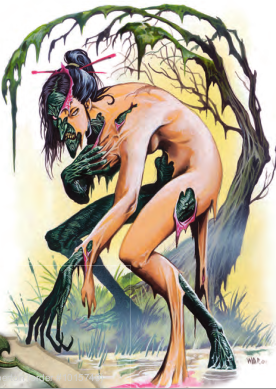
Copyright 2008 Wizards of the Coast Bog Hags are Level 10 Skirmishers with 107 HP, low-light vision and Speed 8 on both land and water. They’re Aquatic and have Swamp-Walk, ignoring swamp-based difficult terrain. Their Unwholesome Presence (Aura 3) causes enemies in range to only recover half the usual HP from spending healing surges.
The MV version is the best one. Its basic attack is a Claw that does damage and allows the hag to shift 2 squares as an effect. It also has a Rending Claws special attack, which allows it to use Claw twice (including the shift) and to do 5 extra damage if both attacks hit the same target. This recharges once the hag is first bloodied.
When the hag charges, its Evasive Charge ability allows it to shift 2 squares immediately after the charge.
The MM version is the same, but its damage suffers from the early math flaw and it doesn’t have a shift effect on its basic attack.
In both versions, the hag can Change Shape into a young human, elf or eladrin woman.
Green Hag (MV)
Green Hags have a more classically witchy stat block than the previous two. They’re Level 12 Controllers with 124 HP, and all the same senses and movement modes as the Bog Hag plus Forest Walk. All of their attacks are earth- or plant-themed spells.
Their basic melee attack is Hurl Through the Earth, which does damage and teleports the target 3 squares.
Their at-will ranged attack is Grasping Roots (Area Burst 2 Within 5 vs. Reflex) which does no damage but restrains on a hit (save ends). On a miss, the targets are slowed for a turn instead.
Once per encounter they can use Rampant Growth (Area Burst 2 Within 5 vs. Reflex), which must be centered on someone restrained by Grasping Roots. This does damage and creates a zone that lasts the whole encounter, which counts as damaging difficult terrain for anyone without forest walk.
Slightly more often it can cast Stagnant Miasma (Area Burst 2 Within 5 vs. Fortitude; recharge 5-6), which does poison damage and creates a damaging poison zone that lasts a turn.
The green hag’s Change Shape power allows it to assume the form of a young woman or a crone of any Medium humanoid race.
Night Hag (Both)
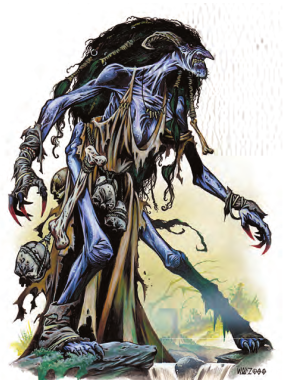
Copyright 2008 Wizards of the Coast Terrifying haunters of dreams, Night Hags are Level 14 Lurkers with 109 HP and Speed 8. They have darkvision, and surround themselves in a Shroud of Night that makes all illumination one step darker in its area of effect: bright light becomes dim, dim light becomes darkness. This is an Aura 5 in the MM, 10 in the MV.
Their basic claw attack also stuns the target (save ends) if the hag has combat advantage. They can also cast a Wave of Sleep (Close Blast 5 vs. Will) that does psychic damage and dazes (save ends). This worsens to unconsciousness (save ends) after the first failed save.
Once the hag has a target stunned or unconscious, it can use its supreme technique: Dream Haunting (Melee 1 vs. Will). This does an initial chunk of psychic damage on a hit, and allows the hag to enter the target’s dreams. It vanishes from play and begins dealing psychic damage to the target automatically on its turn. The hag stays there until the target is no longer stunned or unconscious, or until it dies! Once either of these happens, the hag reappears on an adjacent square, insubstantial for a turn.
This is the combat version of the power. You can of course still have adventures where a night hag sneaks into the PC’s dreams in a more subtle manner.
Night Hags can Change Shape to appear as old crones of any Medium humanoid species.
Death Hag (MM)
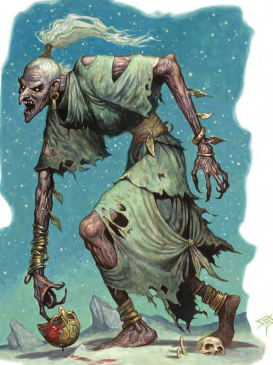
Copyright 2008 Wizards of the Coast Here’s your basic Baba Yaga wannabe. Death hags are Level 18 Soldiers with 171 HP, Speed 6, low-light vision and Resist 10 Necrotic.
Monstrously strong, they attack with claws that mark and prevent any healing from working on the target for a turn. They can also employ life-draining blasts (Close Blast 3 vs. Fortitude; recharge 3-6) that deal necrotic damage and heal the hag for 5 HP for every target hit. Their Change Shape is the most flexible variety detailed at the start of the article.
Sample Encounters and Final Impressions
We have two of those in the Monster Manual:
-
Level 9: 2 howling hags, 2 gnoll demonic scourges and 2 barlguras. These hags are up to even nastier tricks than usual.
-
Level 10: 1 bog hag, 1 venom-eye basilisk, 2 shambling mounds, 2 trolls. And this one has quite the entourage.
I like the concept fairytale witches that you can talk to and (cautiously!) deal with. I’m a bit more inclined than the books to make hags Unaligned, though. Like, they’re deeply into their own business and will definitely curse you or kill you if you’re an ass to them, but if you’re courteous and respectful they’ll give you genuine help. So a bit more like a Russian fairytale than a German one.
Mechanically they end up being a bit simpler and quite a bit more physical than they used to be in previous editions. This is not necessarily a bad thing if it means you no longer have to memorize the effects and frequencies of 14 spell-like abilities. As I said above, ritual casting accounts for most of a hag’s magic now - they certainly have the skills for it.
-
-
Let's Read the 4e Monster Manual/Vault: Guardian
Copyright 2008 Wizards of the Coast This article is part of a series! Click here to see the other entries.
I remember first reading about Shield Guardians in 3e, which is when you start getting a lot of new constructs that are not golems. I’m not sure if they appeared earlier than that or not. Guardians appear only on the MM here.
The Lore
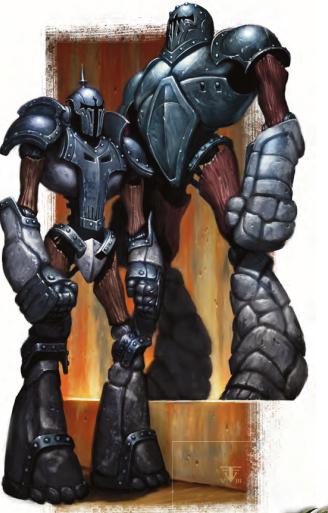
A Guardian is a type of construct more specialized than a golem: it’s meant to act as a bodyguard. They’re smarter and more flexible than golems at this task, and easier to create. Unlike a golem, guardians are made of multiple materials: metal, wood, and stone. Every guardian is linked to an amulet that gets created alongside itself, and considers the holder of that amulet to be its master.
Guardians are good at detecting and intercepting threats to their master, and will also obey the master’s orders about as well as a generic golem. They can also be “programmed” to perform certain actions at specific times or when a specified condition is met.
When a guardian’s master dies it will keep performing its last orders, until someone else claims the amulet and becomes their new master.
The Numbers
We get two different stat blocks here. Both are Large Natural Animates with the Construct keyword, darkvision and Perception training. They’re also immune to charm, disease, fear, poison and sleep, which makes them sturdier than most golems in those areas.
Shield Guardian
The classic model is a Level 14 Soldier with 138 HP and all traits listed above. It walks at a plodding speed of 4 and attacks with Reach 2 Slams.
The main feature of a shield guardian is the Shield Other aura. It has a 2-square radius, and as long as the master is within it gives the master a +2 bonus to all defenses. The guardian also absorbs half the damage taken by the master while inside the aura.
The main job of a shield guardian is to stick close to its master, and punch any enemy who comes close. It’s equipped to do that and little else, but it’s good at its job.
Battle Guardian
Battle Guardians are the sort of bodyguard that runs out to engage the master’s enemies and cover their escape. They’re Level 17 Controllers with 163 HP and the common traits listed above. Their speed is a much more respectable 8.
The battle guardian’s basic slam does damage and immobilizes on a hit (save ends). While it remains adjacent to its master, the master’s movement doesn’t provoke opportunity attacks.
If an enemy ends the movement portion of a charge within 8 squares of the guardian (which will happen if they try to charge the master, for example), the guardian can use Block Charge as an interrupt. This is basically a counter-charge, taking place before the enemy can actually attack. If the battle guardian’s slam hits the enemy, they’re also knocked prone.
Sample Encounter and Final Impressions
The sample encounter is level 14: 1 shield guardian, 1 githzerai mindmage, and 4 gray slaads. The githzerai is obviously the master here, and it’s either a villain who consorts with slaads or a potential ally who is fighting the slads when the PCs meet them and has to be talked down before they’ll see the PCs as allies.
Guardians are OK, I suppose. Mechanically they do their jobs as designed, increasing the survivability of their master.
Narratively, they might seem a bit redundant given how crowded the design space is these days. It makes sense that artificers and wizards would come up with several different ways to make a loyal construct, given that they all want one and none of them is fond of sharing secrets. Having a huge variety of constructs detracts from their uniqueness while shining the spotlight on the idiosyncrasies of their creators, so it’s up to you which way you want to go.
subscribe via RSS