Posts
-
Alternative Dungeon Fantasy Reward Systems
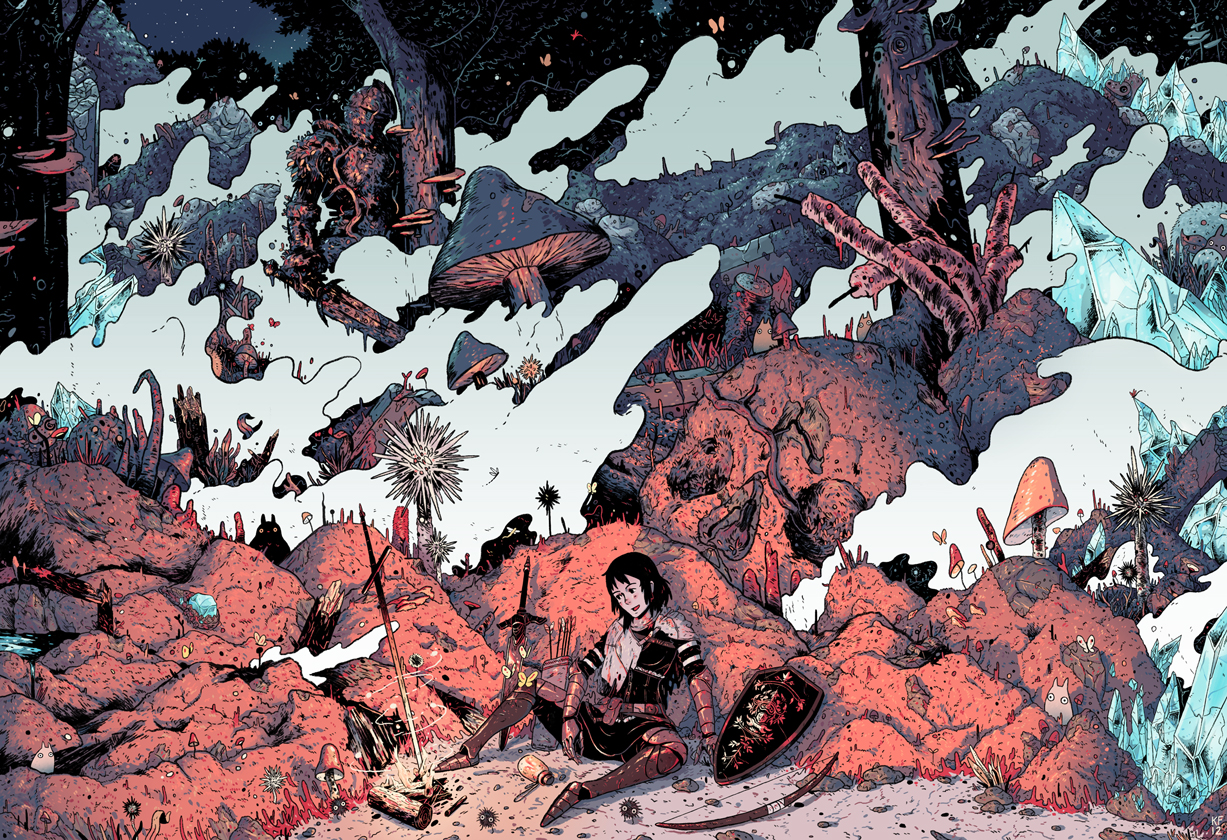
Illustration by Kyle Fewell. For a lot of players, a big part of the fun of playing in the Dungeon Fantasy genre comes from the rewards their characters acquire in play. And these in turn fall into two main categories: treasure and experience.
In GURPS, “experience” means Character Points, which are usually obtained for successfully completing adventure goals and can be directly used to improve characters. “Treasure” in a Dungeon Fantasy context can be split into magic items and “monetary” treasure (i.e, coins and stuff you end up selling in town).
By default these two reward types are mostly unrelated. Going by the experience rewards scheme on p. 92 of DF: Exploits, a party could enter a dungeon, win lots of battles, find a secret area or three, and win plenty of experience even if they never find a single coin’s worth of treasure.
Depending on the exact nature of your campaign, you might want to mess with this reward scheme. Here are two possible ways to do that. In both, magic items remain pretty much as written, but a stronger relationship is established between experience and monetary treasure. They replace the standard system from DF: Exploits entirely.
Old School: Money Is Experience
When the party returns to town, add up the total value in $ of all the monetary treasure they acquired. As usual, coins contribute their full value. Other items contribute their sale value, but only if the PCs sell them. Those items they decide to keep should be excluded from this calculation.
This total should be divided among the PCs. If your party is an anarchist commune that keeps all money in a collective pile (like mine are!), then assume an equal split for experience purposes. Most other parties probably also split their take evenly, though if they’re really into that old-school vibe they might have a complicated scheme set up that includes henchmen with half-shares, seniority bonuses, and thieves who steal from the other PCs.
The PCs who survived the process of splitting the loot get to earn XP from it. Divide each PC’s share by $500: that’s how many points they get. This is the exact same exchange rate they’d get from converting character points to money during character creation. Depending on how much treasure your adventures feature, you might want to adjust the rate! For example, a PC in a campaign that follows Petter V. Del’Orto’s suggested house rule would earn one point for every $5000 they earned.
Example: Let’s say we have a party of 5 PCs that agree to split their loot evenly. They meet a dragon shortly after they enter a dungeon, and are forced to retreat having only found a small coin stash worth $1500. That comes out to $300 per PC, which is not enough for them to earn any points from this delve.
The PCs prepare themselves better and try again, and this time they’re able to kill the dragon and loot its hoard, which contains $25000 in monetary treasure and several magic items. The magic items don’t enter into this calculation, so each PC ends up with $5000 and earns 10 character points from it.
Dungeon Souls: Experience is Money
Some campaigns take place in settings where money is worthless. One example is the Havens and Hells setting presented in Pyramid #3/89. Another is the Dark Souls franchise. This alternate system is inspired by the latter, taking the usual “battle experience” mechanics and making them into an in-character concept.
The metaphysics of the world are such that when you defeat a monster in battle, you siphon off a little of its life force! Depending on the setting this might require killing the monster, but it could also involve simply defeating it in combat and performing a small ritual.
In either case, people in the setting can use this accumulated “soul energy” for all sorts of purposes, and it can be voluntarily transferred. So it becomes the de-facto currency in a setting that has no use for mundane money.
The simplest way to implement this is to say that victory in battle is worth 500 “soul points” for every character point it would have been worth according to p. 92 of DF: Exploits. This means a battle against a small amount of fodder is worth nothing, and a big boss fight with lots of extra henchthings thrown in might be worth 1500 SP. Again, this is the same exchange rate you use to convert points into money during character creation, and you can vary it to suit your preferred pace of advancement.
A more detailed way to model it is to use the optional rules on the It’s a Threat! article on Pyramid #3/77, and say that a slain monster is worth soul points equal to its Combat Effectiveness Rating. This method is a bit math-intensive: the article has a table with values for a few published monsters, but for anything outside of that you’ll have to calculate it.
No matter which method you’re using, an important decision you must make is whether the “soul points” from a battle must be split among the PCs or if each PC gets the full amount when the fight ends. The former setup results in much slower advancement than the system in Exploits, while the latter more or less keeps pace with it as far as combat experience is concerned. I do not recommend fully copying Dark Souls and giving soul points from a monster only to the PC who dealt the last blow: that works in a solo campaign, but nowhere else.
“Treasure” might still exist in this model in the form of dead adventurers with residual soul points still present in their remains. This could lead to entertaining scenes such as the party slaying a dragon and leaving its piles of gold behind in favor of searching for the corpses of the previous parties that failed to defeat it. And of course, if you’re using Havens and Hells then Souls-like corpse runs are totally a thing that happens in that setting.
Using soul points for advancement is a matter of converting them in town using the reverse exchange rate: 500 SP for 1 character point. They can also be used to buy stuff, in which case 1 SP is worth $1. So characters must choose between buying equipment or upgrading their abilities, which will end up slowing advancement overall and making looted gear that much more desirable. A suit of fine armor you find in the wild is one you don’t have to spend Soul Points on!
-
Let's Read the 4e Monster Manual/Vault: Hound
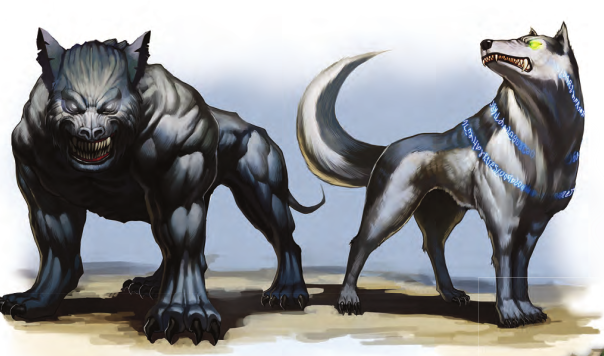
Copyright 2008 Wizards of the Coast This article is part of a series! Click here to see the other entries.
D&D has historically featured a whole bunch of dog-like monsters in its bestiaries, and Fourth Edition is no different. This Monster Manual entry collects a bunch of them.
The Lore
The monsters in these entries are basically large dogs with various supernatural powers, so you already have a good idea of what they look like and what they’re used for: pets, guard animals, trackers, and so on.
In the implied Fourth Edition setting, mundane dogs kind of compete with drakes in the roles I mentioned above. The supernatural powers of these monstrous hounds make them more powerful than a typical drake, though.
First we have Hell Hounds, who have the ability to both resist and breathe fire. Despite the name, they originate in the Elemental Chaos, being one of the early creations of the primordials. Fire giants have been breeding hellhounds for millennia, and their efforts result in larger and more powerful specimens than can be found in the wild or in the service of less experienced breeders.
Next we have Shadow Hounds, native to the Shadowfell and embodying many of the real-world myths of spooky black dogs that foretell your death or simply attack you while you’re out in the moors.
And finally, we have the Hounds of the Wild Hunt, the favorite pets of those epic-tier Eladrin and fey nobles. Their vigor is boundless, their strength unmatched, and their intelligence super-canine.
The Numbers
Though the doggies in this entry are quite diverse, they do have a couple of traits in common. They’re Medium Beasts, they generally run fast, and they have trained Perception. Everything else varies.
Hell Hound
Hell hounds are Medium Elemental Beasts (fire), and Level 7 Brutes with 96 HP. They have Resist 20 Fire, run at speed 7, and are surrounded by a fiery aura 1 that does a bit of fire damage to anyone caught inside.
Their main attack is a bite that does a mix of physical and fire damage, and they can also breathe fire (Close Blast 3 vs. Reflex, recharge 4-6).
Simple and direct creatures, you only need to fix their damage before adding them to your game. A pack of hell hounds doesn’t need to worry about friendly fire if they surround the PCs, and they can pair well with ranged monsters or with other fire-resistant frontliners.
Firebred Hell Hound
The variety bred by fire giants is also a Medium Elemental Beast (fire), but it’s considerably stronger: a Level 17 Brute with 205 HP. The fiery aura does a bit more damage, its fire resistance is 40, and its ground speed 8.
Firebred hell hounds have the same attacks as the basic model, plus a Fiery Burst (Close Burst 3 vs. Reflex, recharge 6) that gives then more options for dealing area-effect fire damage.
Shadow Hound
These are Medium Shadow Beasts, and Level 6 Skirmishers with 70 HP. They run at speed 7, and have a teleport speed of 7 as well. They’re surrounded by a Shroud of Night (aura 5) that makes all light within one step darker, and have Vulnerable 5 Radiant. Obviously, they also have darkvision.
The shadow hound’s basic attack is a bite, which does extra sneak attack damage and combat advantage if used right after the monster teleports adjacent to its target. They can bay as a minor action (Close Burst 5 vs. Will; Fear, sound-based; recharge 5-6) to inflict a -2 penalty to all defenses of anyone they affect, lasting for a turn.
In combat they’ll keep bouncing between PCs, to get that sneak attack damage, and will bay whenever possible to keep their defenses lowered.
Wild Hunt Hound
These good boys are Medium Fey Beasts, and Level 21 Skirmishers with 205 HP. They have low-light vision, speed 10 on the ground and in the air, and their Menacing Growling acts as an Aura 10 that inflicts a -2 defense penalty to all enemies within.
These hounds also get +2 defense against opportunity attacks, and cause extra “sneak attack” damage when they have combat advantage. Their bite does even more bonus physical damage against immobilized targets. The first time they hit, the target is also slowed and prevented from teleporting; the next hit after that will immobilize instead. A save can end these conditions.
Finally, Wild Hunt Hounds can execute a Mobile Melee Attack at will, moving 5 squares without provoking opportunity attacks and biting someone at any point along the movement.
These things are terrifying when accompanied by a band of epic-level wild hunters (like the Ghaele of Winter or equivalent fey).
Sample Encounters and Final Impressions
Each hound type gets a sample encounter:
-
Level 6: 2 shadow hounds, 2 shadar-kai gloomblades, 1 shadar-kai witch.
-
Level 17: 2 firebred hellhounds, 2 azer beastlords, 1 azer taskmaster.
-
Level 20: 4 wild hunt hounds, 1 bralani of autumn wilds.
Hell hounds are a classic, and I like that they took some strong mythical figures for the other entries. Despite the usual damage bugs the stat blocks themselves also seem fairly simple and effective in a fight.
-
-
Let's Read the 4e Monster Manual/Vault: Horse
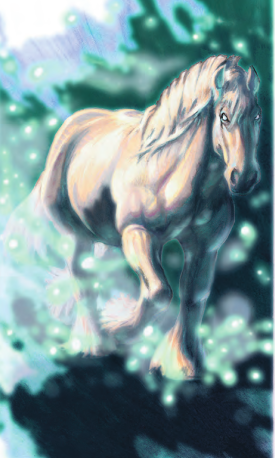
Illustration Copyright 2008 Wizards of the Coast. This is part of a series! Go here to see the other entries.
Horses are a real-world animal, so you likely have a good idea of what they’re like. They’ve been in the game since the very beginning, and here they have their own entry in the MM and are part of the animal appendix on the MV.
The Lore
They’re horses! Herbivore ungulates widely used as mounts and beasts of burden by any society that managed to develop animal domestication. You can still find wild herds running through the plains of the world and the Feywild, but most horses the PCs are likely to meet in their adventures will be acting as someone’s mount.
Unlike in the real world, horses are far from the only choice of mount for your typical D&D society. There are plenty of other, more fantastic beasts that can do the job just as well. If that job is “war mount”, they can likely do it better. Yeah, warhorses are still a thing here, but the same amount of work that goes into training one can instead get you a dire boar, hippogriff, or some kind of drake. I think this is the first setting I see where a warhorse is the animal you ride into combat when nothing better is available.
There’s a breed of horse that’s a potential exception to this: the celestial charger, which is infused with divine energy and typically used as mounts only by noble warriors and champions of justice. A Paladin PC might get one of these as a reward for service to their kingdom, for example. They’re much more powerful and intelligent than a typical horse, though they’re still animals.
The Numbers
Horses are Large Natural Beasts with the Mount keyword. They have low-light vision, trained Perception and high ground speeds. We get three different stat blocks.
Riding Horse (MM)
These are meant for transportation, not battle, and are as close to a non-combatant as you can be while still having a stat block. They’re here because they’re likely to be the first rides your PCs get in their adventuring careers.
They’re Level 1 Brutes with 36 HP and can run at speed 10. Their usual strategy when in combat is to run away! Their only attack is a basic Kick they’ll only employ when trapped or startled. The only reason these aren’t minions it’s because have your horse one-shotted out from under you is no fun.
Warhorse (MM)
A larger, stronger horse trained to be ridden into combat and fight alongside its rider.
It’s a Level 3 Brute with 58 HP and a ground speed of 8. Its basic attack is still a Kick, but it can also Trample. We saw this one before: it allows the warhorse to move its speed, go through enemy spaces (while drawing opportunity attacks) and make an attack against any enemy whose space it crosses. This attack is a bit stronger than the kick, and knocks prone on a hit.
Warhorses also have a Charger passive trait, which gives their riders a +5 damage bonus on charges.
Horse (MV)
The “generic” horse in the MV animal appendix is actually an updated warhorse despite being a Level 1 Brute with 36 HP. The damage of its attacks has been fixed, so they’re actually stronger than the MM warhorse’s despite the lower level. The Charger trait is still here, though it only gives a +3 damage bonus in this version.
Celestial Charger (MM)
Celestial Chargers are Large Immortal Beasts with the Mount keyword, instead of being Natural like other horses. They’re Level 10 Soldiers with 111 HP, a +5 bonus to saves against fear, and Speed 8.
Celestial chargers kick and trample like warhorses, though their damage could use a serious boost. They have two supernatural passive traits: Zephyr Footing allows them to ignore all difficult terrain and move across any solid or liquid surface; and Celestial Charge gives a +2d6 radiant damage bonus to their rider’s charges.
I think these might be like the magic horses from Krull, or Gandalf’s Shadowfax.
Final Impressions
No sample encounters here, but as I said almost any sapient humanoid could be found riding horses.
I would normally say you gotta have horses in your medieval-ish setting, but we’ve seen so many other awesome mounts already that I think they might actually be somewhat redundant. A setting with no horses but all sorts of other mounts might look a bit like Final Fantasy. A few other possibilities present themselves as well:
-
The setting has no horses and everyone uses other mounts, but then it gets invaded by an interdimensional army and the invaders use horses, which would make them the exotic and alien mount.
-
The setting has no mundane horses, but one or more gods send celestial chargers to their chosen champions as a sign of their favor. They’re seen as this powerful divine beast without an eartlhy equivalent, in another neat role inversion.
-
-
Let's Read the 4e Monster Manual/Vault: Hook Horror
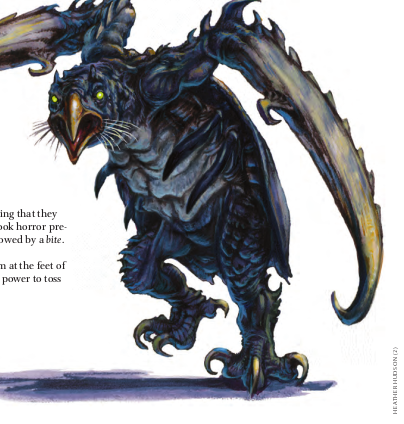
Copyright 2008 Wizards of the Coast This article is part of a series! Click here to see the other entries.
Hook horrors definitely look like something that’s been around since AD&D. My first contact with them was in Neverwinter Nights, which used a model for them that was nearly identical to that of vrock demons. The chunky fellow above is quite different from those and much easier to tell apart. They’re only on the MM.
The Lore
Hook horrors are yet another example of predatory Underdark wildlife, adapted to hunt in total darkness by clinging to a cave ceiling and dropping on its victims. Unlike a lot of other Underdark wildlife we’ve seen so far, they’re Natural, not Aberrant, which means they evolved down there on their own instead of immigrating from the Far Realm.
Hook horrors are omnivorous, but prefer meat and are rumored to like drow meat more than other kinds. They live in total darkness and use echolocation to perceive their surroundings, though they have functional eyes to see in brighter environments. The clicking noises they make are also used for communication, and smart explorers can listen for those to see if hook horrors are nearby.
A group of hook horrors is called a “clan”, and is led by its strongest egg-laying female. It ranges widely in the Underdark, with its members forming smaller packs to hunt. Drow tend to kill adult hook horrors on sight and steal their eggs to raise the hatchlings as attack animals.
The Numbers
There’s only one stat block, so we’ll get right on it. Hook Horrors are Large Natural Beasts, and Level 13 Soldiers with 137 HP. They have Blindsight 10 to represent their echolocation, and a relatively slow ground speed 4. They can also climb at speed 4.
Their basic attack uses those hooked forelimbs, dealing damage and pulling the target 1 square on a hit. They can choose to attack twice at a -2 penalty to each attack, and if both hit they deal some extra damage and grab the target until escape. They can keep making hook attacks against grabbed victims, and can also bite them as a minor action (which does slightly less damage).
They can also use their hooks to Fling a target. The book doesn’t say whether this only works on a grabbed target or on anyone. It’s an attack vs. Fortitude that rercharges on a 6, does more damage than the basic hook attack, slides the target 3 squares, and knocks them prone.
I imagine you can make different hook horrors by giving them the same blindsight as this one and a few hook-based attacks that do different things.
Sample Encounters and Final Impressions
We have two:
-
Level 13, a balhannoth and 3 hook horrors. Looks like the ninja slug is opportunistically following the horrors around.
-
Level 13, a hook horror, 2 grimlock berserkers and 1 beholder eye of flame. A beholder and its retinue.
I’m indifferent to hook horrors. I suppose a large variety of Underdark predators is good, but since they all fulfill more or less the same dramatic role they tend to leave me cold.
-
-
Let's Read the 4e Monster Manual/Vault: Homunculus
This is part of a series! Go here to see the other entries.
I think Homunculi are derived from a medieval alchemy concept, and I’m pretty sure they’ve been in the game since AD&D. Here they appear only in the Monster Manual.
The Lore
In my post on Helmed Horrors I compared construct creators to real-world programmers. Let’s stretch the analogy a bit further: if golems and greater helmed horrors are big packages of enterprise software, then homunculi are shell scripts.
These minor constructs are built for the exact same purposes as their beefier relatives: to act as tireless guardians, servants, and muscle. Being low-level, I imagine they’re a lot easier to create, and their programming includes some “shortcuts” that make them particularly adept at a specific kind of guard job.
Mentally, they’re pretty much like golems: they can understand even complex instructions from their masters perfectly, and execute them without much thought of self-preservation unless specifically ordered to avoid taking damage. Unlike golems, though, ownership of an homunculus can be transferred to someone else with a simple order (“this person is your master now”). This means they’ll often be found in the service of someone who isn’t their creator.
So a low-level aspiring golem maker can have homunculi as servants, and higher-level casters who would use actual golems as personal guards can mass-produce homunculi and assign them to their underlings. The relative weakness of an homunculus is actually an asset here! If those pesky organic underlings start getting rebelious ideas, your personal guard-bot can easily squash them.
The Numbers
We get three quite diverse stat blocks here. They’re all Natural Animates with the Construct and Homunculus keywords, training in Perception, darkvision, and immunity to disease and poison. Everything else is variable.
Different types of homunculus gain special bonuses when tasked to guard a person, object or area. For rules purposes, objects can weight up to 50 pounds and areas can be up to 5 squares on a side. We’ll see why in a minute.
Clay Scout
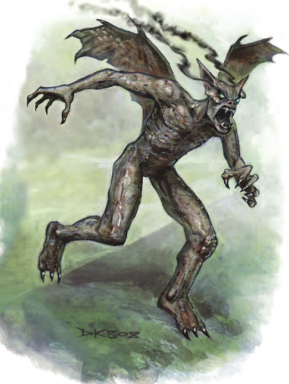
Illustration Copyright 2008 Wizards of the Coast. This Small homunculus is probably the one closest to the classic myth. It’s used for, well, scouting, or for guarding small objects. I imagine it makes an adequate menial lab assistant if well-managed.
Clay scouts are Level 2 Lurkers with 31 HP and all common homunculus traits. They’re also trained in Stealth, and can run at speed 6 or fly at speed 3 (clumsy).
Scouts attack with a weak venomous bite that allows a secondary attack against Fortitude, which slows on a hit (save ends). They can attack at range using a Mind Touch (Ranged 10 vs. Will) which does adequate psychic damage and dazes (save ends). Mind Touch is clearly their main attack, with the bite being more of an emergency measure.
When targeted by a melee or ranged attack, they can use Redirect as an interrupt. This target’s the attackers Will, and on a success forces them to redirect their attack to an adjacent creature of the homunculus’ choice. Tricky!
They cap things off with a couple of interesting passive traits: clay scouts are invisible to dazed creatures and, if tasked to guard an object, gain a +4 to attack anyone adjacent to or carrying that object.
I think they’d mostly use their attacks to prevent pursuit in case they’re discovered spying on you. They’re big enough to carry most objects they could be set to guard, too. This is the construct you use when you want to carry something to the ends of the earth so it’s never found again.
Iron Defender
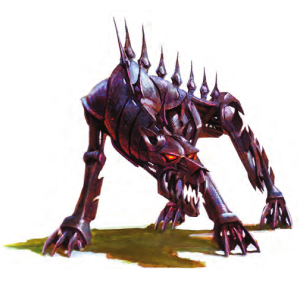
Illustration Copyright 2008 Wizards of the Coast. A metal guard dog, for when drakes aren’t enough but you don’t have the budget for a shield guardian. It’s a Level 3 Soldier with 47 HP and all common homunculus traits. It runs with speed 6.
It attacks by biting, and if tasked to guard a creature it can bite anyone who attacks that creature as a reaction. It can also shift 1 square before or after making opportunity attacks.
Iron Cobra
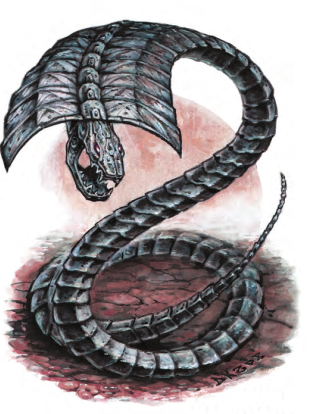
Illustration Copyright 2008 Wizards of the Coast. An homunculus named for its shape, not its role. As far as homunculi go, this is a high-end model.
It’s a Level 6 Skirmisher with 75 HP and all common homunculus traits. It slithers with speed 7, and can shift 3 squares as a move action.
They attack with a venomous bite that also does 5 ongoing poison damage (save ends), and it can poison its enemies’ minds as well.
Poison the Mind (Ranged 10 vs. Will; recharge 3-6) is an attack that can only target creatures suffering ongoing poison damage. The cobra’s bite is an obvious source of this, but if other venomous creatures are part of the same encounter their attacks also count. A hit dazes and slows the target (save ends).
When set to guard an area, iron cobras can use Poison the Mind without restriction against any creature inside that area. This means the attack effectively becomes at-will, and can target anyone in the area even if they aren’t taking poison damage.
Sample Encounters and Final Impressions
The sample encounter is Level 9: 2 iron cobras, 2 snaketongue warriors, and 1 snaketongue assassin. As expected, iron cobras are a hit with snake fanatics everywhere!
I think homunculi fulfill a necessary role for GMs who want to pit their PCs against constructs from an early point in the campaing. As we’ve seen already, golems and other similar constructs are usually too powerful to be fought by early-heroic tier characters.
I also like that their existence allows for that “construct-making as a parody of the tech industry” setting element I’ve been thinking about.
subscribe via RSS