Posts
-
Let's Read the 4e Monster Manual/Vault: Kobold
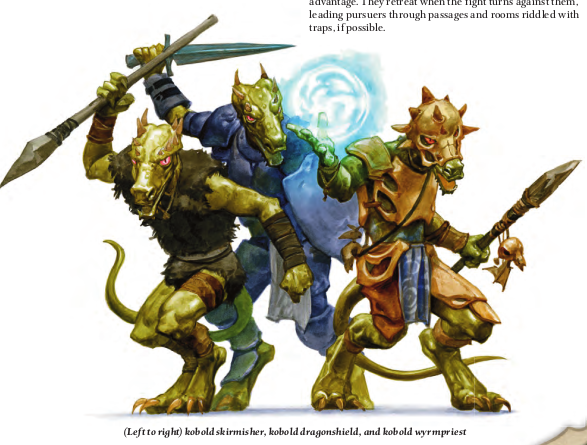
Copyright 2008 Wizards of the Coast This article is part of a series! Click here to see the other entries.
Kobolds have been in D&D since the beginning, occupying the lowest rung on the Humanoid Power Ladder below goblins. Their name is that of an underground spirit from German folklore but they’re always been quite mundane. Their appearance went from dog-like in the early days to reptilian in 3e, and has stayed that way since. In 4e, they are both in the MM and the MV.
The Lore
Kobolds are small reptilian humanoids who make their homes in underground warrens and worship dragons as if they were gods. They’re rarely on good terms with “civilized” society, which tends to view them as particularly bothersome pests.
Your typical kobold is weak and a bit dim when compared to a human, but collectively they’re quite tenacious and crafty when defending their homes, and have no qualms about engaging in banditry and theft to enrich themselves. That’s what dragons do, and dragons are awesome!
Kobold warrens are maze-like and very cramped for human-sized invaders. They’re also festooned with traps that the inhabitants themselves know how to avoid, and into which they’ll try to lead those invaders. Kobolds will also try to tame some of the local wildlife to help guarding their homes, though they’re not nearly as good as goblins at it. Other times they’ll just allow a larger monster to lair in a section of their warrens they then avoid.
If a dragon lairs close to kobold territory, the little guys will almost certainly form a cult to worship it, particularly if the dragon is chromatic. Many dragons simply ignore the nuisance outside of snack time, but some will attempt to use that cult as a tool to better dominate the region. Kobolds themselves also frequently worship Tiamat, that most awesome of dragons.
The Numbers
Kobolds are Small Natural Humanoids with the Reptile keyword. They have Speed 6 and Darkvision, and a couple of custom signature traits: Shifty allows them to shift as a minor action instead of a move; Trap Sense gives them +2 to defenses against traps. That last one is only present in the MM kobolds. I imagine you can just say kobolds never trigger their own traps instead, which is why the MV dropped it. I’d still give it to playable kobolds.
Power-wise, they cover the first half of the Heroic tier, which means the chosing between kobolds and goblins is mostly a matter of aesthetic preference in 4e. The MV kobolds are a bit more restricted in level, in what seems to be an attempt to restore the power ladder. While the MM versions do suffer from the damage bug, this barely affects them since their level is so low.
Kobold Minion (MM) and Kobold Tunneler (MV)
These are Level 1 Minion Skirmishers, and the ones to reach for if you want to pit the party against a huge mob of weak kobolds. They fight with javelins in melee or at range. They have all the usual kobold signature traits.
Shifty works very well for these kobolds, as a tidal wave of minions can keep moving through the party’s ranks by shifting 2 squares a round, eventually surrounding them all.
The MV version has an additional trait: Narrow Escape, an encounter power which allows them to shift 3 squares if missed by an attack.
Kobold Skirmisher (MM)
These are Level 1 Skirmishers with 27 HP and all kobold common traits. They made quite a splash among players in their first appearance in Keep of the Shadowfell, because 27 HP kobolds were something that went against a lot of people’s conceptions of the monster.
Anyway, kobold skirmishers fight with spears, and gain bonus sneak attack damage if they have combat advantage. They also have a Mob Attack trait that gives them a +1 attack bonus per kobold adjacent to the target. I imagine these skirmishers would mix with that minion horde and benefit from seriously boosted attacks.
Kobold Quickblade (MV)
Another Level 1 Skirmisher, this one has 29 HP and fights with a shortsword. While they’re still Shifty, they also have Fleet Feet which allow them to shift 3 squares as a move action.
Their sword attacks gain +2 damage for each square the kobold has shifted this turn, so they’ll be doing that a lot. You probably want to use these guys instead of the skirmishers from the MM if you’re assembling a small encounter group with no minions.
Kobold Slinger (Both)
Slingers are Level 1 Artillery with 24 HP and all common traits. They fight with daggers in melee, but their slings are definitely the stars of the show here.
Beyond using them for standard ranged attacks with stones or bullets, they carry three Special Shots which are little clay pots full of fun. There are three alternatives, and you can either randomly roll to see what’s inside or choose the effect before attacking.
Special shots do normal damage, and carry one of these three riders:
-
Stinkpots inflict a -2 attack penalty on the target (save ends);
-
Firepots deal a bit of ongoing fire damage (save ends);
-
Gluepots immobilize (save ends).
Both versions of the slinger are pretty much identical aside from damage tweaks and the Trap Sense thing.
Kobold Dragonshield (Both)
Brave, knightly kobolds! These stalwarts are Level 2 Soldiers with 36 HP, wearing scale armor and wielding a shortsword and a shield. They have all common kobold traits.
A dragonshield’s sword attacks mark for a turn. Both versions have a Dragonshield Tactics trait, which allows them to shift 1 square as a reaction when an adjacent enemy shifts away, or when an enemy moves adjacent to them.
The MM version has Mob Attack, but the MV version ditches that in favor of Dirty Tactics (Melee 1 vs. Reflex), an encounter power which does more damage than a basic attack and immobilizes for a turn. On a miss, it still does half damage and slows for a turn. There’s nothing in the dragonshield code of honor that forbids them from headbutting you in the nethers.
Kobold Wyrmpriest (MM)
A kobold spellcaster, who either gets powers from worshipping a dragon (or Tiamat), or who studies arcane magic to look like he does. It’s Level 3 Artillery (leader) with 36 HP.
The wyrmpriest fights with a spear in a pinch, but uses magic most of the time. Its basic ranged attack is an Energy Orb (Ranged 10 vs. Reflex) which does damage of a type based on the dragon it serves. The priest also has a couple of encounter powers:
Incite Faith (close burst 10) gives 5 temporary HP to all kobold allies in range, and allows them to shift 1 square. Dragon Breath (Close Blast 3 vs. Fortitude) deals the same damage type as Energy Orb, half on a miss.
A little less fun than the slinger as far as artillery goes, but mechanically solid.
Kobold Slyblade (MM)
The closest thing you’ll get to an elite kobold warrior, this Level 4 Lurker has 42 HP and all common kobold traits. It fights with paired short swords.
Their swords do extra damage if they have combat advantage, and CA also allows them to make two such attacks. If both hit, the target takes ongoing physical damage (save ends).
Defensively, they can employ a Sly Dodge as a reaction when attacked by a melee or ranged attack. This redirects the damage to an adjacent kobold minion!
This is another case of a lurker that should be a skirmisher, I guess. Its preferred hiding spot is among a huge crowd of minions, which act as a source of CA and as ablative armor.
Sample Encounters and Final Impressions
The MM has a whole bevy of sample encounters, mostly composed of assorted kobolds. Some of them also feature rats or drakes, giving you an idea of what sort of pet they like to use. One features a young black dragon and three dragonshields, giving you an idea of who likes to use kobolds as pets.
You can’t have D&D without kobolds! However, they’re presently in kind of an interesting situation. Over the past 20 years or so, people have started seeing kobolds in an increasingly sympathetic light, thanks to standout friendly NPCs such as Meepo from the Sunless Citadel or Deekin from Neverwinter Nights. They’ve led other authors and GMs to make kobolds in general more sympathetic.
Some D&D books insist on trying to make them look bad, describing them in terms that would be quite alarming were we talking about real world people. However, even those end up accidentally making them sympathetic! The sample adventure in the 4e DMG is Kobold Hall. The PCs are theoretically supposed to raid said Hall and kill all kobolds inside, due to some vague complaints about them getting in the way of trade. And the kobolds are just… minding their own business. A group of them are even playing ball! I guess the game was supposed to be sinister, using a skull and all, but that fails to come across in the text.
5e books continue this trend, with Volo’s Guide spilling so much vitriol about kobolds that you almost feel compelled to side with them. The presence of this awesome illustration with a bunch of kobolds pranking Elminster just makes it even more compelling.
So by all means bring on the sympathetic, misunderstood kobolds! Who knows, maybe there’s a sizable portion of them out there that lean more towards Bahamut than Tiamat, with dragonshield paladins and such.
-
-
Let's Read the 4e Monster Manual/Vault: Hyena
Copyright 2008 Wizards of the Coast This article is part of a series! Click here to see the other entries.
Hyenas are real-world animals, and have been in the game since at least AD&D 1st Edition. Here they are present in both books, though the MV only has them in its animal appendix.
The Lore
Real-world hyenas are large carnivores who hunt in packs. They live in the same areas as lions, and compete with them for prey. Their behavior is quite sophisticated and their biology fascinating, but their looks and laugh-like barks have given them a bad reputation among humans.
This reputation also exists in the implied 4e setting, and paints hyenas as filthy, cowardly, gluttonous and all-around bad news. You won’t see any nobles using hyenas in their heraldry!
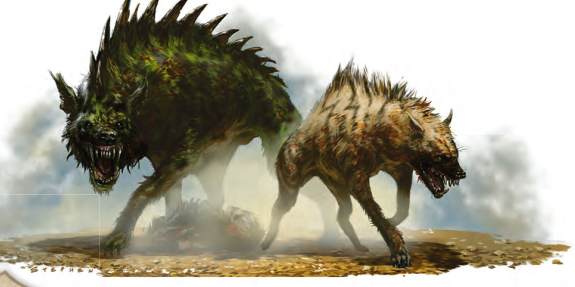
While natural hyenas are pretty much identical to their real-world counterparts, there’s a variety native to the Abyss that’s favored by Yeenoghu and a lot more deserving of their foul reputation. The demon lord likes sending these Cacklefiends to serve his favored gnoll servants in the world. Gnolls are also known to tame mundane hyenas.
The Numbers
We have two different stat blocks here. Both have trained Perception, low-light vision, and run at speed 8, all of which are pretty standard dog-monster traits.
Hyena (MM)
Mundane hyenas are Medium Natural Beasts and Level 2 Skirmishers with 37 HP. They fight with bites and have a passive Pack Attack trait that gives them a +1d6 damage bonus when two other allies are adjacent to their target. This is a little worse than the gnoll version, which adds a flat +5 damage.
Their other passive trait is Harrier: if a hyena is adjacent to an enemy, that enemy grants combat advantage to everyone, but only against melee attacks.
These traits mean a pack of hyenas will try to gang up on a single target at a time.
Cacklefiend Hyena (MM)
Cacklefiends are Large Elemental Beasts, though the argument could be made that they should be Magical Beasts instead: they have Int 6 and understand both Abyssal and Common. Anyway, they’re Level 7 Brutes with 96 HP.
Cacklefiends have the same Pack Attack and Harrier traits of a mundane hyena, and their bite deals ongoing acid damage (save ends). Their blood is also acidic: when they’re first bloodied, it spurts in a Close Burst 1 and automatically deals both immediate and ongoing acid damage (save ends).
Their cackle also has some supernatural power behind it. Fiendish Cackle (Close Burst 3 vs. Will; recharge 5-6) is a fear power that inflicts a -2 attack penalty that lasts for a turn on those it hits.
War Hyena (MV)
A mundane hyena trained for war by gnolls, and likely deployed in huge packs. This is a Level 8 Minion Soldier with a decent bite attack, the Harrier trait and a Savage Response reaction power that allows it to attack any adjacent enemy that makes an attack that doesn’t include the war hyena as a target.
Sample Encounters
The MM has one sample encounter: Level 4, 2 gnoll huntmasters and 4 hyenas.
Cacklefiends and War Hyenas are appropriate as spice for almost any gnoll encounter with little tweaking, since gnolls cluster around level 7 and 8 as well. The given encounter is about the limit of what you can do with mundane hyenas as gnoll pets, unless you level them up. They’re probably more appropriate to use on their own as wildlife.
-
Dungeoncrawl Procedures at Nature Kills
Earlier this year I published a post on “Old School Movement” with a simple set of rules I could use when GMing converted old-school D&D and AD&D dungeons in Dungeon Fantasy. Recently, the Nature Kills blog has also published their own take on the same subject in a post titled “Dungeoncrawl Procedures”.
What I find most interesting on that post, and on the sources it links, is that they see the lack of this detailed procedure in recent D&D editions as a grave omission in that system. Having a canonical procedure to crawl a dungeon or to perform any other sort of exploration is a vital pre-requisite for properly designing these dungeons and other places.
The actual procedure outlined there is similar to mine in nature, but differs in some details and adds others I didn’t cover. The ones I found most interesting are:
-
This procedure should apply to all dungeon exploration, not just to AD&D adaptations.
-
Default movement speed is double what I guessed (encumbered Move x 20m per turn).
-
Traps are only sprung 2 out of 6 times. A direct translation of an old-school mechanic that’s perfect for use when you’re not constantly using a map and miniatures.
They have convinced me to apply this mechanic to all dungeon crawls, but I disagree with enough of their details that I feel I have to revise my own procedure. That will happen some other time.
-
-
Let's Read the 4e Monster Manual/Vault: Hydra
Copyright 2008 Wizards of the Coast This article is part of a series! Click here to see the other entries.
Hydras are inspired by greek mythology, which as far as I know only had the one. In D&D, I see them on the Rules Cyclopedia, which means they’ve been around at least since the days of BECMI and probably since the beginning. They appear in both books here.
The Lore
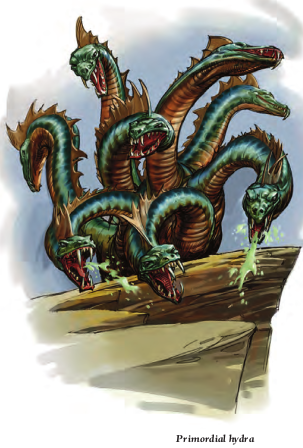
A hydra is a giant reptilian monster, with a snake-like body and a number of dragon-like heads. The first hydras sprang forth from the poisonous blood of Bryakus, one of the most powerful primordials slain during the Dawn War. They spread throughout the world and the planes and have thrived ever since. There are many species of hydras, each with a different set of abilities and a different number of heads. No species has less than four, though.
Hydras are nonsapient, but they’re still extremely dangerous predators that require a lot of food to survive. Most species are good swimmers, and though they can’t breathe underwater only one of the heads needs to surface to avoid drowning. Hydras can survive on pretty much any environment as long as they have access to food.
Despite their innate ferocity, hydras actually take quite well to training if the trainer manages to survive the turbulent early stages of the process. Giants, minotaurs and powerful spellcasters are the most frequent hydra owners, though sometimes a hydra will “adopt” someone more unexpected than that, like a goblin leader.
The mythological Hydra was notorious for its ability to regrow its severed heads, and here we have an interesting lore divergence between the two books: the Monster Manual describes this as a persistent rumor that has so far proved untrue; and the Monster Vault says it’s true after all.
The Numbers
Both books agree hydras are threats for the paragon tier and above. They also give all hydras trained Perception, All-Around Vision, and Darkvision. Hydras always have a swim speed unless it goes against the theme of their specific abilities, though they’re not Aquatic.
All hydras in both books have Threatening Reach, allowing them to make opportunity attacks out to their full reach instead of just against adjacent enemies. They also have the Many-Headed trait, which does different things in each book. In the MM, it means that a stun or daze only causes the hydra to lose one of its attacks on its next turn (though this stacks). In the MV, it means the hydra can take free actions even while dazed or stunned, which is powerful because “bite everyone in reach” is a free action for them.
The lore divergence above translates into a numbers divergence as well. MM hydras have no head-severing mechanics at all, and more powerful hydras have more heads. MV hydras always start with four heads, and lose one each at 75%, 50%, and 25% HP. At the start of the next turn after losing a head, two others grow in its place. This increases their number of attacks, but skilled PCs might prevent it from happening by means described in the hydra stat block.
MM hydras also tend to have considerably more HP for their level, since they use the old math. That’s another thing you should fix if you want to add them to your game.
Hydra (MV)
The basic model is a Large Natural Beast with the Reptile and Water keywords. It’s also a Level 10 Solo Brute with 432 HP and the common traits described above. Its land speed is 5, and it swim speed 10.
The hydra has four heads to start with, and it lose one at 324, 216, and 108 HP. Unless it takes fire or acid damage after losing a head, it will grow two new ones on its next turn.
The hydra fights by biting, and its Reach 2 bites are kinda weak to make up for the fact that there are so many of them. The Hydra Fury at-will attack allows it to bite once per head it currently has, gaining a damage bonus if it only has 2 or 1 left. As an at-will free action, the hydra can use two bites against anyone who ends their movement within reach of it.
Fen Hydra (MM)
This is the basic hydra from the MM. It’s a Large Natural Beast (reptile) with all common traits for MM hydras. A Level 12 Solo Brute with 620 HP, it’s otherwise quite similar to the MV hydra, except it lacks a head-severing mechanic. It has four heads throughout the whole fight, so its Hydra Fury always allows it to make 4 attacks.
Flamekiss Hydra (MV)
A fire-themed hydra, this is a Large Natural Beast (reptile) and a Level 12 Solo Brute with 496 HP. Flamekiss hydras have a land speed of 5 and no swim speed, but also have Resist 10 Fire. They lose heads at 372, 248 and 124 HP, and PCs can prevent them from growing more by dealing cold or acid damage before their next turn starts.
Flamekiss hydras have the same attacks as the base model, plus Flame Kiss (Close Blast 3 vs. Reflex) which deals immediate and ongoing fire damage (save ends). This recharges every time the hydra loses a head. It can be used in place of a bite during a Hydra Fury combo, and benefits from the damage bonus if only 1 or 2 heads remain.
Venom-Maw Hydra (MV)
This is the hydra that most closely resembles the mythological one, which was all about the venom. It’s a Huge Natural Beast (reptile, water) and a Level 17 Solo Brute with 672 HP and all common hydra traits. Its land speed is 7, and its swim speed remains 10.
The venom-maw hydra’s beheading thresholds are at 504, 336 and 168 HP, and it can be prevented from regrowing heads by taking acid or fire damage before the start of its next turn. Its Reach 3 bites deal 10 ongoing poison damage, or 20 if the hydra is bloodied (its blood is also poison).
This hydra can attack at range by spitting venom (Ranged 10 vs. Reflex), which deals poison damage and knocks the target prone on a hit from sheer pressure. Despite being a ranged attack, it does not provoke opportunity attacks. Either the bite or the venomous spit can be used as attacks during a Hydra Fury combo, with the usual damage bonus if only 1 or 2 heads remain.
The venom-maw hydra’s Snapping Jaws only have reach 2, which I think might be a mistake. They should be reach 3 like its normal bites.
Mordant Hydra (MM)
This Huge Natural Beast (reptile) is acid-themed. It’s a Level 18 Solo Brute with 880 HP, Resist 15 Acid, and all common hydra traits. It has a land speed of 6 and a swim speed of 12! It also has six heads.
Mordant hydras fight with Reach 3 bites and Range 10 acid spit (vs. Reflex), and its Hydra Fury allows it to make six of those attacks in any combination. All of its other tricks come from the standard MM hydra abilities.
Primordial Hydra (MM)
This one is likely one of the original hydras born from the blood of Bryakus. It’s a Gargantuan Elemental Beast (reptile), and a Level 25 Solo Brute with 1200 HP. It has eight heads, a land speed of 8 and a swim speed of 16, which makes it faster than just about any other monster in the book when in water. It has Resist 20 to Acid and Fire, and all other common hydra abilities.
The primordial hydra’s bite has Reach 4, and enjoys attack and damage bonuses when used for opportunity attacks. It attacks at range with Flaming Acid Spit (Range 10 vs. Reflex), which obviously does fire and acid damage. Its Hydra Fury gives it eight attacks which can be any combination of those two maneuvers.
All of its other tricks come from the standard abilities.
Sample Encounters and Final Impressions
We have three sample encounters in the MM:
- Level 14, a fen hydra and 3 bog hags. A covey and their pet.
- Level 19, a mordant hydra and a gibbering abomination. No idea about this one.
- Level 26, 1 primordial hydra and 2 earthwind ravager elementals. A scenic wildlife encounter for the deep Elemental Chaos.
Hydras fulfill some of the same dramatic roles as dragons, since they’re giant monsters meant to provide a memorable fight all by themselves. They’re a bit simpler to run. They’re also nonsapient, which is a good thing because it makes their explaining their presence in a location fairly uncomplicated. Dragons are sapient and have agendas; hydras are just hungry.
I love the hydra head management mechanics they came up with for the MV, since they’re a nice callback to the mythological Hydra and what Hercules had to do to kill it. They also provide some subtle ways to tweak the challenge of a fight since you could start a given hydra with more than four heads.
The simpler MM varieties still have their place, too, since you might not want every hydra to behave like the mythological one.
-
Let's Read the 4e Monster Manual/Vault: Human
Copyright 2008 Wizards of the Coast This article is part of a series! Click here to see the other entries.
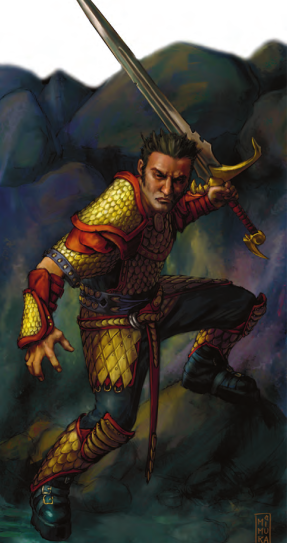
Humans are obviously inspired by the real world, and have been an integral part of the game since its very beginning. Humans as playable characters are covered by the Player’s Handbook, with both of the books we’re covering having entries for humans as opposition.
The Lore
Like in pretty much every edition of D&D, humans are described as being a very diverse lot. 4e goes a bit beyond this traditional description, though, and ascribes a few extra traits to them.
These mostly come from looking at humanity from the perspective of the other races: humans are incredibly ambitious and intense, always aiming to achieve great things in their short lifetimes. While only a few truly manage it, they tend to leave profound marks in the world and its history. Collectively, all of this passion has also led them to spread further than any other “civilized” people. You can find humans in any environment, and in greater numbers than almost anyone else. When they work together, they can easily form grand organizations or empires that vastly outlive its individual members. Nerath is only the most recent of those, and there’s at least one more: ancient Bael Turath.
This combination of ambition and the willingness to serve causes greater than any one individual also makes humans incredibly succeptible to corruption. When some elves pledge allegiance to evil and move underground, it’s an event of mythical proportions! When a group of humans does the same thing, it’s a Tuesday. Nerath fell because it became too decadent to protect itself, and we’ll get into what happened to Bael Turath later.
The Numbers
The signature human trait is that they have no signature trait! Each book has 6 stat blocks, and they have little in common aside from the words “Medium Natural Humanoid” and their native speed of 6.
As it happens with all playable races, every stat block has an alignment of “Any” or “Unaligned”, and is meant to represent either enemies or NPC allies.
Human Minions (Both)
Our minions are a bunch of schlubs with clubs. They come in two power levels: 2 and 7.
The level 2 variety is called “Human Rabble” in the MM and “Human Goon” in the MV. In either case they’re Minion Soldiers that have a basic club attack and a trait named Mob Rule, hich gives them a +2 to all defenses if they have at least two other goons are within 5 squares.
The Level 7 variety is called “Human Lackey” in the MM and “Human Thug” in the MV. Lackeys are brutes and also get Mob Rule, while Thugs are skirmishers and get Rush Into Battle: if they hit with a charge attack, their target grants combat advantage for a turn.
Basically, if the PCs manage to rile up a classic torches-and-pitchforks mob, or piss off a tavern-full of unsavory drunks, it will be made up of these people. They’re also good to represent low-ranking cultists, or peasant allies.
Human Bandit (Both)
Called a “Common Bandit” in the MV, this Level 2 Skirmisher is another classic. It has 37 HP, wears leather, and fights with a mace and a brace of throwing daggers. It’s trained in Stealth, Streetwise and Thievery.
Mace attacks allow the bandit to shift 1 square on a hit. Once per encounter they can perform a Dazing Strike that works as a mace attack and also dazes for a turn. Finally, they deal a bit of “sneak attack” damage if they have combat advantage.
Bandits are fond of ambushes and tend to retreat if bloodied. All of the usual historical considerations about why someone would become a bandit apply here. A large bandit gang will likely be mostly made up of Goons, with these guys representing their veterans.
Human Guard (Both)
Called a “Town Guard” in the MV, this is a Level 3 Soldier with 47 HP. Guards wear mail (which reduces their speed to 5) and carry both halberds and light crossbows.
Their basic halberd attack has Reach 2 and also marks the target for a turn on a hit. Every so often they can make a Powerful Strike (recharge 5-6) which does more damage and knocks prone on a hit. Their crossbows have Range 20, which is pretty good.
These stats also seem appropriate for soldiers on a battlefield. In both cases a squad made up entirely of Town Guards is a pretty versatile threat, since they can attack both at range and in melee. It could act as a sort of “pike and shot” unit, keeping a tight formation and marching towards the enemy. The front ranks would wield their polearms all the way through, and the ones towards the back would switch weapons whey the front ranks engage the enemy.
Human Berserker (MM)
Berserkers are actually an extremely traditional “monster”, with their first appearance being in OD&D. Here, they are Level 4 Brutes with 66HP. Berserkers run at speed 7, wear hide, and fight with axes.
Their greataxes are a High Crit weapon, and they can also throw handaxes if they can’t reach someone for melee combat this turn. When first bloodied, they use an attack named Battle Fury (free action; encounter), making a basic attack at a +4 attack bonus and a +1d6 damage bonus.
As expected, they are likely to fight to the death, and their tactics can be summed up as “Chaaaarge!”.
Human Mage (MM)
These spellcasters are Level 4 Artillery and have 42 HP. They wear robes and wield a staff that’s nothing special in melee, and their main weapon is magic.
As a ranged basic attack, they can cast Magic Missiles of the kind that deal a nice bit of force damage and require an attack roll (Ranged 20 vs. Reflex).
Once per encounter, they can use Dancing Lightning (Ranged 10 vs. Reflex), which targets up to three enemies and does lightning damage.
Also once per encounter, they can use Thunder Burst (Area burst 1 within 10 vs. Fortitude), which deals thunder damage and dazes (save ends).
These wizards seem to be somewhat storm-themed, but aside from this there’s no restriction on what sort of person they represent. You could find them as members of a town guard, bandit gang, sinister cult, witch coven, and so on.
Human Transmuter (MV)
This one is actually an update of the Human Hexer from the MM2, which has a bunch more human opponents of varied levels. It’s a more powerful spellcaster than the MM Mage, with a transmutation theme. This Level 7 Controller has 77 HP and the usual staff and robes outfit.
Being a MV controller, its staff actually does respectable damage in melee. The transmuter’s at-will ranged attack is Capricious Earth (Area Burst 2 within 5 vs. Will; enemies only) which does damage and slides the targets up to 3 squares. This is a charm effect, so I guess that it only makes the targets think the earth is pushing them around.
The transmuter can also resort to the Beast Curse (Ranged 5 vs. Fortitude; recharge 4-6), which turns the target into a Tiny animal like a frog or rabbit for a turn. While thus polymorphed, the target can’t use powers or attacks.
As a minor action, the transmuter can Hex someone (Close Burst 5 vs. Will; one enemy in burst). The hex lasts a turn and gives the target a -2 penalty to attack and damage rolls against the transmuter. As a move action, the transmuter can use Hex Jump once per encounter to switch places with a hexed target.
As befits a controller, the transmuter is a lot trickier than the standard mage. Ideally it will be able to keep someone squishy locked down with Beast Curse and use Capricious Earth to prevent the fighters from forming up properly. Hex should be applied to someone as far away as possible to allow an easy escape from being surrounded.
Human Duelist (MV)
This one seems to be entirely new. Duelists are Level 8 Soldiers with 85 HP, wearing leather and carrying a longsword.
Their longsword attacks mark for a turn, and Advantageous Jab allows them to attack as an interrupt anyone who attempts to ignore the mark. Hit or miss, the target takes a -2 penalty to their attack.
Duelists also have a trait named Duelist’s Poise that gives their attacks an “immobilization for a turn” rider if they have combat advantage against the target.
This stat block also looks like a good stand-in for a military officer or the like. They combo rather well with skirmishers.
Sample Encounters and Final Impressions
The MM gives us no less than three encounters:
-
Level 3: 1 berserker, 2 guards, 2 spitting drakes. A guard patrol where one of them is a loose cannon who doesn’t play by the rules.
-
Level 4: 1 mage, 2 bandits, 3 gravehound zombies, 3 zombie rotters. A necromancer and their lackeys, out for a spot of grave-robbing.
-
Level 5: 2 mages, 6 human lackeys, 1 evistro. And here’s your standard entry-level demonic cult.
Humans are of course one of the most important building blocks of any D&D setting. Sure, you can write up a setting that has no humans in it, but that’s the sort of decision that tends to ripple outward to become one of that setting’s main traits. They’re significant even in their absence, because they’re pretty much everywhere else.
-
subscribe via RSS