Posts
-
Cyberpunk and Plagues
Preface
I’ve been sitting on this one for a while now. I’m not gonna lie, writing and publishing those Monster Manual posts is quite soothing. Particularly the releasing part, which is just a few mechanical actions now that I have so much pre-written material for it. Every once in a while I’ll sit and write something that’s on my mind, and hesitate a bit before posting it. This is one such post, which I’d say was written somewhere around late April or early May.
The Post
One of the outtakes from my last screed against Transhuman Space was a rebuttal to the bit where it says it’s better and more realistic than cyberpunk because it doesn’t have any apocalyptic disasters in its Very Serious history of the future.
I had had whole paragraphs mapped out in my mind about how yes, the insistence of 90’s cyberpunk RPGs in inserting these catastrophes was kinda silly. About how they probably had their roots in their authors believing in that “end of history” bullshit just as hard as the text of Transhuman Space itself did, and how they couldn’t see the future being a shitty place if there wasn’t a plague, a nuclear meltdown, or a big war somewhere in there to muck things up.
It was going to end with an assertion that no, you don’t need a big, clear, forced disaster to head down a bad path. A lot of those cyberpunk tropes (evil corporations, authoritarian governments disguised as democracies, and so on) happened all on their own without needing such a push. William Gibson’s concept of the Jackpot, presented in his novel The Peripheral, encapsulates all of this a lot better than Transhuman Space’s bright future. Well, he is William friggin’ Gibson, and he had almost twenty extra years of history to look at, but still.
That post is all ruined now, of course, because it turns out those disaster-licious 90’s games were on to something after all. Here we are, amid a deadly pandemic that’s causing an untold number of tragedies and turning whole societies upside-down as enforced quarantines and lockdowns push them to change their habits in a rush. It’s not nearly as bad as a genuine 90’s RPG disaster, but, in true Jackpot fashion, it doesn’t have to be. It’s not the cause of the evil corps’ and authoritarian governments’ rise to power, but a consequence of it. And I don’t think either THS or the 90’s games would ever have predicted that rich capitalists would, when faced with a plague, suggest that it was OK to let vast numbers of people die from it as long as it kept the economy growing. THS has far too much faith in its Very Smart Neoliberals to suggest such a thing, and it sounds too bleak even for a 90’s-style dystopia.
-
Let's Read the 4e Monster Manual/Vault: Lamia
Copyright 2008 Wizards of the Coast This article is part of a series! Click here to see the other entries.
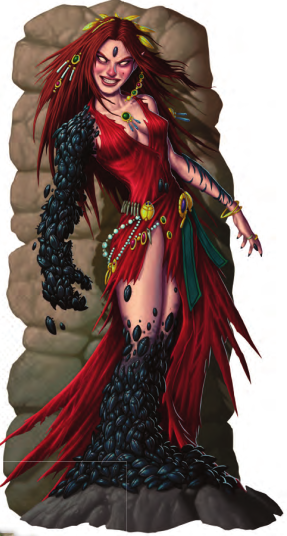
In Greek mythology, Lamia was a woman cursed by Hera to become a half-human, half-snake, child-eating monster. The Greeks themselves would end up using the name for a whole species of such creatures later on, and a few naughty anime shows would end up adopting it for their own brand of snake lady.
D&D lamias are a bit different, and have been in the game since at least 1st Edition. Here, they are only present in the MM.
The Lore
It looks like 1e Lamias were a bit closer to the original myth in that they were creatures with the upper bodies of women and the lower bodies of beasts. In 4e they’re a type of fey whose true form is that of a swarm of large black scarabs wrapped around a skeleton, but who can disguise itself as an attractive humanoid.
D&D lamias are not very nice. They eat people, using their disguise ability to lure them to their deaths. Some of them also seek to gain arcane power “by any means necessary”. Every person they eat adds another beetle to the swarm, and when the swarm grows too large a lamia reproduces by slaying a “worthy fey” such as a powerful eladrin and injecting half its beetles into the corpse. Once the bugs finish eating the victim’s flesh, they rise as a new lamia that shares most of the victim’s memories and knowledge.
In short, they’re fey nightmare monsters.
The Numbers
There’s a single lamia stat block. It’s a Medium Fey Magical Beast (shapechanger), and a Level 12 Elite Controller with 244 HP. It has land and climb speeds of 6 and trained Perception, though no supernatural senses for seeing in the dark. Their other trained skills are Arcana, Bluff, and Insight.
Lamias are effectively swarms! They take half damage from melee and ranged attacks, and 10 extra damage from close and area ones. They also have a Swarm’s Embrace aura 1 that deals damage to any enemies that start their turns inside.
The way a lamia kills you is by using its Change Shape ability to look like a pretty girl/boy/other and lure you into favorable ambush terrain with a convincing sob story. Once the group is packed nice and tight, it will release a psychic Pacifying Burst (close burst 5 vs. Will; recharge 5-6), which does no damage and stuns on a hit (save ends).
Once everyone is nice and stunned the lamia will cover one of the victims in part of its scarab mass in a Devouring Swarm attack (Reach 5 vs. Fortitude), which does physical damage on a hit and allows the monster to sustain the effect as a minor action to deal the same amount of automatic damage every turn. The only way to escape is to move beyond the power’s maximum range, which you can’t do if you’re stunned.
If anyone resists the initial burst, or of they recover early, the lamia can hit them with its Cursed Touch, a basic attack against Fortitude that heals the monster for the same amount of damage caused on the victim. It also dazes on a hit (save ends).
If all else fails there’s the Squeezing Swarm trait, which allows the lamia to squeeze through narrow openings as if it was a Tiny creature, likely by disassembling into a bunch of individual beetles.
Sample Encounters and Final Impressions
The book says lamias often enslave weaker creatures to serve as bodyguards. Though their stat blocks don’t have powers that allow them to dominate others in combat, it’s quite possible they know custom rituals that allow for long-term mind control, or just use good old-fashioned mundane intimidation and cruelty.
The sample encounter is level 12: a lamia, 2 mezzodemons, and 4 cyclops guards. As this shows, they might also just know enough magic to summon some demons as muscle.
Lamias are mechanically interesting, though if you dislike the “comely seductress that actually wants to kill you” trope they might not be your cup of tea. Their knowledge of magic could allow them to fulfill the same dramatic roles as hags, but as written they seem a bit too overtly hostile for that.
-
Let's Read the 4e Monster Manual/Vault: Kuo-Toa
Copyright 2008 Wizards of the Coast This article is part of a series! Click here to see the other entries.
Kuo-Tua are one of the ten or so kinds of fish-people who have graced D&D’s bestiaries over its history. The first time they appeared on a core monster book was in AD&D 2nd Edition, but I guess they must show up in a 1st edition supplement somewhere. They appear on the Monster Manual and get a Monster Vault-style update in Dungeon 193.
The Lore
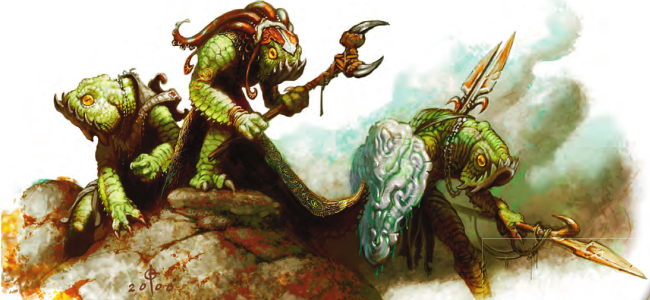
Kuo-Toa are “loathsome fish-people” who live in the lakes and seas of the Underdark, where they worship sinister alien gods. They build shrines on the margins of these watery bodies, and their settlements around these shrines.
Kuo-Toa think little of other sapients, viewing them as potential slaves or sacrifices. They’re led by their priestly caste, whose members are known as “whips”. There’s also an elite warrior caste who serves and protects the whips, and whose members are known as “monitors”.
Whips and monitors lord over the general kuo-toa populace, but they also watch them closely. You see, they’re very succeptible to the sort of dangerous destructive madness that often afflicts those who spend too much time worshipping Lovecraftian entities. Whips and monitors practice mental disciplines that (mostly) protect them from this, but for some reason these aren’t shared with the commoners. There’s more than one story about a kuo-toa village that’s been destroyed by its own inhabitants in a frenzy of senseless violence.
This entry doesn’t say much about who these sinister gods are, but kuo-toa are right at the level range for being aboleth servitors and the sample encounters in both entries bear this out. So it’s quite possible they worship the aboleths themselves, or see them as avatars of whatever chtonic deity they cults are centered around.
Kuo-Toa: for all your fishy cultist needs! Also the Underdark has actual seas, which is awesome.
The Numbers
As inhabitants of the medium-to-deep Underdark, kuo-toa levels cluster around the mid-Paragon tier. They’re all Medium Natural Humanoids with the Aquatic keyword plus land and swim speeds of 6. They also have Darkvision.
Their signature power is Slick Maneuver, a move action that’s rather confusingly worded in the MM. The text makes me think they can spend a move action to essentially slide an ally 1 square around an enemy. The updated version is a lot cleader: a kuo-toa adjacent to an enemy can spend a move action to shift 3 squares to another square adjacent to that enemy. They’re slippery and can give you the run-around, clearing the way for their buddies to close in and surround you.
Other than that, the only change between versions is the fixed damage. If you have Dungeon 193, you can go ahead and use the kuo-toa there without losing anything. Otherwise, update their damage and use the new version of Slick Maneuver and you should be good to go.
Kuo-Toa Guard
This is a Level 16 Minion who I think is meant to be a Skirmisher. It wears leather, fights with a shield and spear, and its only special trick is Slick Maneuver.
They fight to the death when in the presence of a strong leader, but run away immediately if the leader dies before they do.
Kuo-Tua Marauder
This Level 12 Skirmisher has 119 HP and the same gear as a guard. It also covers its shield in slime!
Its basic melee attack is a Skewering Spear that does the usual physical damage, plus ongoing damage on a hit (save ends). When missed by a melee attack, the marauder can bash with its Sticky Shield as a reaction (vs. Reflex). A hit does no damage, but it disarms the target!
While bloodied, marauders can use Quick Step to shift as a minor action, and they also have the standard Slick Maneuver.
That’s more mechanical flavor than I expected!
Kuo-Toa Harpooner
This Level 14 Soldier has 137 HP and trades the standard spear for a harpoon.
The basic Harpoon attack also grabs on a hit, and deals 5 ongoing damage until the target escapes. The harpooner can’t use the weapon on anyone else while the grab continues.
The weapon can also be thrown in a Reeling Harpoon attack (Ranged 5/10 vs. AC), which does the same damage as a melee hit and allows a secondary attack against Fortitude. A hit here does more damage and pulls the target 3 squares.
Harpooners have the same slimy, sticky shields as marauders, as well as Slick Maneuver.
Kuo-Toa Monitor
Smarter and stronger than their plebeian compatriots, Monitors use crossbows to fight at range and unarmed combat to pound fools into submission up close. They are Level 16 Skirmishers with 153 HP.
The monitor’s basic melee attack is a respectable slam, and their ranged attack a crossbow shot. They can also use a Leap Kick as a standard action, which allows them to shift 2 squares before making a slam attack.
Once per encounter, they can use their ultimate technique: Lightning Fist targets Reflex and does a goodly amount of lightning damage with a stun rider (save ends). They keep this in reserve until they have combat advantage over a target. Slick Maneuver rounds out their repertoire.
Kuo-Toa Whip
These priests are Level 16 Controllers with 156 HP. They wield pincer staffs in combat, and also cast spells.
The Pincer Staff is a Reach 2 exotic weapon whose strikes do damage and grab the target, who takes 1d10 damage every time the whip sustains the grab. This is a little better than the flat ongoing damage of the harpooner. Instead of sustaining the grab, the whip can slide the target to any square within staff reach and release them.
Whips fight at range with Lightning Strike spells (Ranged 10 vs. Reflex) which do lightning damage and blind the target for a turn. Once per encounter they can summon a Slime Vortex (Area Burst 4 within vs. Fortitude; enemies only) that’s likely to do a whole bunch of unpleasant stuff to its victims.
A hit from the vortex does damage, inflicts a -2 attack penalty for a turn, slides 3 squares, and knocks prone. A miss inflicts half damage and slides 1 square. Cast this spell and watch as the whole battle turns into a Three Stooges skit.
Slick Maneuver rounds out their arsenal.
Sample Encounters and Final Impressions
We have two encounters here:
- Level 12: 3 marauders and 1 foulspawn hulk.
- Level 18: 2 monitors, 4 guards, 1 aboleth overseer and 8 aboleth servitors. A slave-catching party.
There’s a sentence saying sometimes kuo-toa escape this cultish existence and become mercenaries or even leaders in other Underdark communities.
I think 4e has done a lot of good for these fishy cultists. My memories of them from 3e were just another type of “fish person with spear”, with little to distinguish them from locatah or saguahin. Sahuagin are also present in the MM, so when we get there we’ll see how unique each of them really is.
-
Let's Read the 4e Monster Manual/Vault: Kruthik
Copyright 2008 Wizards of the Coast This article is part of a series! Click here to see the other entries.
I first read about kruthiks in 4e itself, though I think they might have been introduced in 3e. Here, they’re only on the Monster Manual.
The Lore
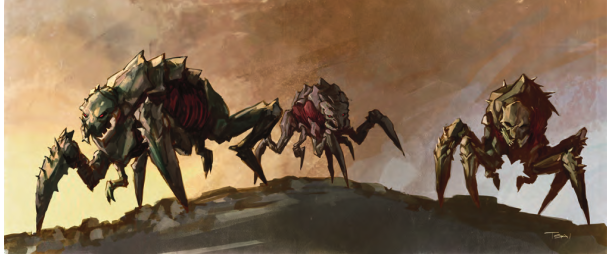
Kruthiks are dangerous and clever predators that hunt in packs and live in hives. They resemble big pointy four-legged bugs, but are actually reptiles beneath those chitin plates.
These beasts were created by the ancient tiefling empire of Bael Turath, which mutated “wordly reptiles” (likely drakes) through infernal magic in order to turn them into bioweapons capable of infiltrating enemy camps and fortifications by burrowing underneath them. It’s likely they had means of controlling kruthiks back them, but those have been lost to time.
Kruthiks install their hives in large subterranean caves, either natural or dug out by the monsters themselves. The tunnels they dig are stable, so kruthik territory will be completely riddled with them. It wouldn’t be uncommon for these caves and tunnel networks to extend into the “shallow” Underdark.
A kruthik hive will methodically hunt all available prey in the region and then move or expand somewhere else. Kruthiks butcher their kills and carry the meat and any treasure back to their hives, and they can communicate through a series of clicks and insectile buzzing sounds. They also associate the smell of their own dead with danger, so killing a bunch of them is a way to get the rest of the hive to move away.
A kruthik undergoes metamorphosis several times over its life, but all of its forms are dangerous.
The Numbers
Kruthiks are Natural Beasts of varying size, with the Reptile keyword. They have low-light vision and tremorsense, and have land, climb, and burrow speeds, though that last one tends to be lower.
Their signature trait is Gnashing Horde, an aura 1 that deals 2 damage to any enemy that ends their turn inside. This stacks: if you’re inside multiple auras, you take damage from all of them.
Kruthik Hatchling
Hatchlings are Small, Level 2 Minions. They run and climb at speed 8, and burrow at speed 2. They only attack with a basic bite and Gnashing Horde, but you can expect a lot of them (and a lot of pre-dug tunnels) if you breach a kruthik hive.
Kruthik Young
Slightly older, nonminion versions of the hatchling. These are still Small, but they’re Level 2 Brutes with 43 HP. Their speeds are the same as that of the hatchlings, and their bites do full damage.
Kruthik Adult
Adults are Medium size, and Level 4 Brutes with 67 HP. Their greater size makes them a bit slower, with a running and climbing speed of 6, but they burrow better with speed 3.
Adults keep the Gnashing Horde aura, but their main attack is now their pointy claws. They can also launch Toxic Spikes from their body at up to 2 simultaneous targets (Ranged 5 vs. AC; recharge 5-6). A hit from these does immediate physical damage, ongoing poison damage, and slows (save ends both).
They’re basically a larger and stronger version of the young, but the spikes are a nice addition and a nice surprise for unfamiliar PCs.
Kruthik Hive Lord
Though kruthiks are animals they display some instinctive organization, and hive lords are at the top of the heap. Some times, an adult will undergo a second metamorphosis into one of these.
Hive lords grow to size Large, and are Level 6 Elite Controllers (Leaders) with 148 HP. The Gnashing Horde aura is replaced with Hive Frenzy, an aura 2 that makes any kruthik inside deal double damage with its basic attacks. This actually takes them from “slightly weak” to “noticeably stronger” when compared to the updated average damage for their level. You might want to replace this with a flat +5 bonus if you fix base kruthik damage, which should lead you to the same end result. Hive Lords are as fast as adults.
A hive lord’s claw attack remains a bit too weak for its level, and doesn’t benefit from the lord’s own aura. It can also spray victims with an at-will Acid Blast (Close Blast 5 vs. Fortitude; Enemies only), which does immediate and ongoing acid damage and weakens on a hit (save ends both).
The little tactics paragraph says hive lords open with an acid blast and switch to claw attacks, but there’s no reason not to spam the blast if you’re so inclined. In either case, they should keep as many fellow kruthiks in their aura as possible.
Sample Encounters and Final Impressions
The sample encounters are what you’d expect: lots and lots of kruthiks in different combinations. One of them includes a couple of zombies, though, which is interesting. Perhaps they don’t eat undead flesh.
Not only had I never heard of kruthiks before 4e, my first contact with them was actually in Keep on the Shadowfell or another low-level adventure that came out before the Monster Manual. The text on those adventures just expected me to know what these things were, so the first time I actually saw a picture of one was when I first read this entry.
They work well enough mechanically, but I don’t remember seeing them used as anything other than a single encounter off to one side of the dungeon in these published adventures. Perhaps this led to them not being very popular. Reading the lore makes me think you could make a “kruthik apocalypse” scenario instead of using the usual zombies, though you’d probably need to come up with more varieties of the beasts (like skirmishers and artillery) to keep things varied.
-
Troika Numinous Edition: A Short Review
From what I’ve observed of the “Old School Renaissance” movement, it can be divided into two main categories. You have the “Reenactment” group, and the “Avant-Garde” group.
The Reenactors are people who focus on old editions of D&D. They research historical documents to learn how Gary Gygax and his group played, in order to glean all of the assumptions he thought were so obvious he never put to paper. They play those old editions, and write new material for them. They write and buy retro-clones, which are either old editions of D&D in different trade dress, or new games that attempt to precisely replicate the feel of old D&D without using the same rules.
The Artistes of the Avant-Garde category are people who looked at these retro-clones and realized that they were always free to write their own games set in their own weird settings without having to conform to tropes set by some guy in the 70’s. Perhaps they had already been doing that privately, perhaps not. But what the existence of these retro-clones did was give then a commercial platform for their personal weirdness. They could just slap a set of vaguely Basic D&D-ish rules on something, call it an OSR supplement, and earn an audience who was suddenly very interested in anything bearing that logo.
Troika: Numinous Edition is very much an Avant-Garde game, though its only real link to anything D&D is in its high concept. This is “The World’s Most Popular Fantasy Roleplaying Game”… from another world.
The art style is what first caught my eye in some advertising banners I saw on RPG.net. The core book was a bit too expensive for me given the current BRL/USD exchange rate, but fortunately it came with the Itch.io Bundle For Racial Justice and Equality, so I gave it a read.
The cover is quite trippy, and the internal layout gives the pages a pleasant cream background color, wide margins, and single-color text in a font that’s readable enough and is apparently meant to look type-written, as if you were reading a zine. The style for the internal art is equally trippy, and done in that mock-woodcut style in blacks, reds, yellows and blues.
The system is simple, and uses only six-sided dice. Characters have three main stats: Skill is what you test to do things; Stamina acts as both your health and your magic points; and Luck is what you use for “saving throws” and other similar tests. You determine them all randomly, and then roll on a big d66 table to add a background on top of that, which gives you additional specialized skills and some starting gear.
Combat is an opposed test of skill. Whoever rolls highest gets to deal damage, no matter who it was who initiated the attack. Monsters can have multiple actions, and PCs can only ever have one per round, but a skilled and lucky PC can still end up damaging a lot of enemies over the course of that round. The damage roll is always a single d6, which you then cross-reference with a weapon table at the start of the book to see how much actual damage you dealt. Three of the “weapon” entries are “small beast”, “medium beast”, and “large beast”, so monsters are covered here too.
There’s a sample bestiary with creatures of all types, and it’s easy enough to come up with your own, since they use the same three stats as PCs.
The setting is an entire psychedelic universe with infinite worlds, through which you can travel by means that range from spaceships to magical portals (so yes, you can travel the universe on foot). The archetypes I mentioned above all seem to be typical inhabitants of the most well-known parts of the universe, ranging from a civilization of nomadic giants looking for their lost home to an order of philosophers that voluntarily gave on on their higher brain functions, and includes other highlights such as stone dwarves that come in well- and poorly-made versions, several forms of bizarre knightly orders and esoteric magical traditions, and a catch-all “mysterious foreigner” archetype whose dress and customs look odd even to this lot.
There’s not really a setting chapter. The basic “science-fantasy universe filled with portals” description is in the introduction, and most of the rest of the setting information contained here is in the archetypes. I’m guessing the GM is meant to come up with their own setting details as needed, and a worked example of this is in the included adventure, titled “The Blancmange & Thistle”. I don’t think I like it very much, though.
The Blancmange and Thistle is name of a hotel in the city of Troika. The idea is that your PC party has just arrived and is looking for accommodation. There’s only one room left, in the 6th floor, since there’s a festival happening today. It’s pre-established that all the PCs have agreed to share that room, strangers though they may be.
And the goal of the adventure is just for the characters to go up to their room. Only this is written as a linear dungeon crawl sort of thing, where an incredible amount of concentrated bullshit is thrown at the character’s direction. They get to choose whether to take the elevator or the stairs. Either way, at each floor there’s going to be a strange and potentially deadly encounter, you’re just picking which set you want. The party is not expected to solve all these encounters with violence, but many of the “peaceful” ones are still dangerous.
I get it that they’re trying to give us a feel for the type of weirdness you can find in the setting without describing the setting itself, but this is just too much, y’know? The poor PCs are just trying to get to their room in an hotel, and they have to contend with a toxic gaseous life form, a herd of tigers, someone whose dreams of an infinite abyss leak into reality, a gang of owl hooligans, ornery mandrill security guards, and so on. All in rapid succession, with little time to think or recover. There’s no way around any of these things, as all the encounters happen inside the elevator or in a narrow stairwell. You can switch from the lift to the stairs and vice-versa, but there’s going to be a random encounter while you walk through that floor.
You just know that even after the PCs get to their room after the adventure ends, someone is going to die on the way to the toilet. Probably swallowed by a drunk sapient black hole who was staying in the next room over and got into the wrong door by mistake.
I think Troika is a good game on balance. The system is simple, relatively unobstrusive, and allows for a really wide variety of bizarre characters. The feel of the setting is great, but the design of the included adventure makes me feel like the authors were still a bit too attached to the “dungeon crawl” paradigm. If you do GM it, I would recomment spreading the weirdness out a lot more, and using it for picaresque adventures that run at a calmer pace than the frantic “try not die while getting to your hotel room” scenario presented here.
subscribe via RSS