Posts
-
Let's Read the 4e Monster Manual/Vault: Magma Beast
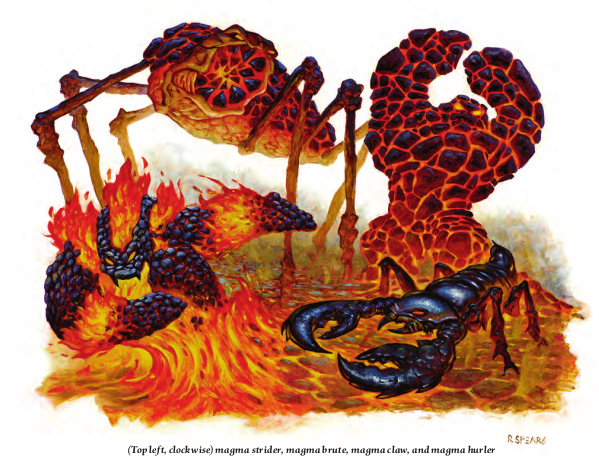
Copyright 2008 Wizards of the Coast This is part of a series! Go here to see the other entries.
Magma beasts are probably the conceptial descendants of the Magmen of AD&D 1st Edition, which later turned into Magmin during 3.x. There are likely a few other monsters that ended up in this entry as well. They appear only on the Monster Manual.
The Lore
Magma Beasts are elementals of earth and fire, obviously native to the Elemental Chaos. They seem to be a little more physical than the creatures that were listed under the Elemental entry, in that they actually have metabolisms and thus have goals other than to exuberantly rage for all eternity.
These creatures live in the most fiery patches of the Elemental Chaos, the ones that contain rivers of flowing magma, active volcanoes, or at least large amounts of ambient geothermal energy. They can be found in the world or the shallow Underdark in similarly hot places.
They sustain their mineral bodies by eating various ores and clays found in these environments, but they’re also quite capable of digesting lesser elemental creatures and even organic beings! Organics do have a lot of calcium and iron in their composition, after all.
Some magma beasts prefer an organic diet, having acquired a taste for the flavor or burned meat. That doesn’t necessarily make them people-eaters, though I guess the stupider varieties aren’t going to stop and ask their next prospective meal if it can talk. The lair of a people-eating magma beast will not be littered with the valuables of its victims - it eats those too.
Sapient magma beasts (magma brutes and magma hurlers) can be reasoned with and bribed with offers of food, so that’s one way you can find them working alongside others. They’re also able to bully their dumber relatives into obeying them.
The Numbers
Magma beasts tend to be lower level than the creatures in the Elemental entry, so they might be a good way to introduce your Heroic Tier PCs to monsters from the Elemental Chaos.
The “stupid” kinds of magma beast are Elemental Magical Beasts with Int 2, while the “smarter” kinds are Elemental Humanoids with Int 5. The lore makes me think the stupid ones should be Beasts, since they seem to behave more like animals.
All magma beasts are immune to petrification, have 10/tier fire resistance, and are slowed for a turn when they take cold damage. They have the Earth and Fire keywords.
Magma Claw
This Medium beast looks like a stinger-less scorpion. It’s a Level 4 Brute with 64 HP and training in both Endurance and Stealth. It uses the latter to disguise itself as a rock outcropping until a potential victim wanders into charge range. It moves at speed 4, but charges at speed 8.
Its basic attack is a claw that does a mix of physical and fire damage, and it can also Spew Lava at-will (vs. Reflex). A hit with this does ongoing 5 fire damage and immobilizes (save ends). I imagine the lava comes out of where the stinger would be.
Magma Hurler
This Medium humanoid is Level 4 Artillery with 41 HP. It moves at Speed 4.
Magma hurlers fight in melee with slams, and they can also form and hurl balls of magma. These have a range of 15, target Reflex, and do fire damage; a miss causes all creatures adjacent to the target to take a bit of automatic fire damage. Don’t cluster up!
Hurlers are one of the two “smart” magma beasts. If you know Primordial, you might be able to talk to them.
Magma Strider
These Large beasts look like those long-legged water strider bugs. They hunt through the same endurance-based method ancient humans used, pursuing their intended prey for hours until it becomes exhausted. They’re Level 10 Skirmishers with 105 HP who move and climb at Speed 6, so they can keep up with most terrestrial creatures.
Their basic attack is a Reach 2 bite that does both immediate and ongoing fire damage (save ends). They can often Burn Across the Battlefield (recharge 3-6), which allows then to immediately charge another target after hitting someone with a basic bite. Their Burning Mobility also causes 5 fire damage to anyone who hits them with an opportunity attack.
Magma Brute
This Large humanoid is the other “smart” magma beast. Left alone, they behave as nomadic scavengers. However, as Level 13 Brutes, they’re right at the point where they begin to bump into “proper” elementals and other more powerful denizens of the Chaos, so they often end up bullied into servitude.
Magma Brutes have 156 HP, walk at speed 4, and have a fire resistance of 20 as Paragon-tier creatures. Their single attack is a Reach 2 Slam that does physical damage plus ongoing fire damage (save ends) and is in dire need of a damage fix.
Sample Encounters and Final Impressions
We have two:
-
Level 5: 2 magma claws, 2 magma hurlers, and 2 fire bats. Perfect for an early fire dungeon, and likely to make your tieflings and fire sorcerers feel powerful.
-
Level 13: 3 magma brutes and 1 beholder eye of flame. Oh, so that’s who likes to bully the brutes.
I’m not terribly enthusiastic about magma beasts. However, I think it’s refreshing to see an entry about what is basically dangerous fantasy wildlife after so many instances of “kill this thing on sight” courtesy of the Monster Vault.
-
-
Let's Read the 4e Monster Manual/Vault: Lycanthrope
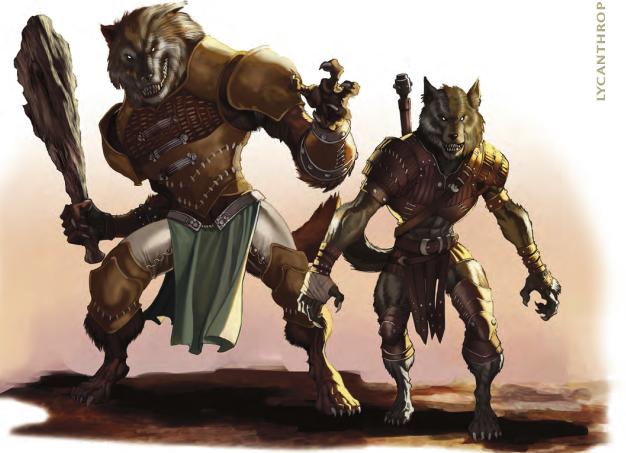
Copyright 2008 Wizards of the Coast Lycanthropes have always been a part of D&D, which apparently took inspiration from a mix of Holywood horror movies and a bit of traditional folklore. They are present in both the Monster Manual and the Vault.
The Lore
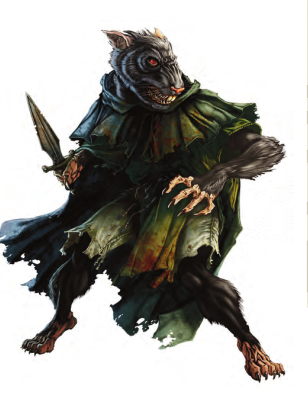
Copyright 2008 Wizards of the Coast Lycanthropes are creatures who can change their shape to that of a humanoid, an animal, or a bipedal, animal-headed hybrid. There are different species, each associated with a specific animal. Contrary to popular myth, lycanthropy cannot be spread via bites, nor are lycanthropes forced to transform in the full moon.
If I understand it correctly, a lycanthrope is more like an animal who happens to be able to change into a human than the reverse. Many don’t feel comfortable living for an extended time in human society, and fear discovery of their true nature. They can reproduce normally with each other or with their related animal, unions which always result in new lycanthropes. They can also reproduce with humans, though in these cases their offspring is more likely to consist of “shifters” who can’t transform completely (and were introduced as a playable race in Eberron).
Villainous lycanthropes are the type that treats sapients as prey and who use their shapeshifting to infiltrate polite society and gnaw at it from within. The Monster Vault once again tells us all lycanthropes are like that. Guess it was ghostwritten by that bigot Volo.
The myths about the bite do have a shred of truth to them, as the bite of some lycanthropes can infect humanoid victims with diseases that might make them behave in an erratic or “bestial” way.
The Numbers
Both books give us stats for the two types of lycanthrope most likely to fight adventurers: wererats and werewolves.
In all cases their signature lycanthrope trait is the ability to change shape! They can use a minor action to switch between their human, animal or hybrid forms. As humans, they can use weapons. As animals, they can bite (and possibly spread disease). As hybrids, they can do both!
Lycanthropes also have Regeneration 5, which is disabled for a turn when they take damage from silver weapons. Due to the way regeneration works in 4e, you can kill them without silver, it’s just harder.
Wererat (MM)
Wererats are likely to be the first lycanthrope your PCs encounter, and also the ones most comfortable with living in civilization. Wererat thieves’ guilds are a classic staple of D&D.
Here they’re Medium Natural Humanoids with the Shapechanger keyword, and Level 3 Skirmishers with 48 HP. They also have the common traits listed above. They run at speed 6 and can climb at speed 4 in their non-human forms.
Wererats fight with short swords and bites. The bites do a little less damage but also do ongoing damage (save ends) and spread filth fever.
Wererats gain bonus “sneak attack” damage if they attack with combat advantage.
Filth Fever is a level 3 disease. Stage 1 makes you lose a healing surge, Stage 2 also inflicts -2 to all your defenses, and Stage 3 keeps the penalty and takes away all your healing surges and your ability to regain hit points. 4e disease rules have you make periodic Endurance checks to see if you worsen, improve or stay stable. Also I think you cannot recover on your own when you reach Stage 3.
Scurrying Wererat (MV)
This is much like the MM version, though its attacks are different.
This wererat’s weapon is a dagger, which does extra damage with combat advantage. Their bite deals ongoing damage with combat advantage (save ends).
The Vault also specifies someone bitten by a wererat must roll at save at the end of the fight to see if they contracted filth fever or not. The disease’s effects are the same.
As a move action while in rat form, this wererat can use Rat Scurry to shift its speed.
Frenzied Werewolf (MV)
Werewolves are the most classic lycanthropes and likely the first to be statted up for D&D.
This one is a Level 6 Brute with 78 HP and all common lycanthrope traits. It runs at speed 6, or 8 while in wolf form. Its weapon is a club, and both it and its claws do extra damage against bloodied targets. They can also bite, and bitten victims contract Moon Frenzy if they fail a save at the end of the fight.
In hybrid form, the werewolf can use Lycanthrope Fury to make both a claw and a bite attack as a standard action, dealing 5 damage to itself in the process.
Moon Frenzy is a level 6 disease. It doesn’t turn you into a werewolf, but it penalizes your Will (Stage 1) and forces you to attack a nearby ally when you become bloodied (Stage 2) and later on whenever you’re hit by an attack (Stage 3).
Werewolf (MM)
This one is quite similar to its Monster Vault counterpart, but is level 8 with 108 HP, lacks claws and Lycanthrope Fury and transmits a level 8 version of Moon Frenzy.
It’s worth noting that disease DCs are 3-4 points higher in the Monster Manual versions. I guess they must have been lowered by the time the Vault was published when the authors realized very few PCs ever trained Endurance.
Sample Encounters and Final Impressions
We get two in the Manual:
-
Level 4: 2 wererats, 4 dire rats, 6 human rabble. Your typical wererat thief gang.
-
Level 9: 4 werewolves, 4 dire wolves. A pack with extra punch.
The gothic/Holywood werewolf afflicted by a curse that turns then into ravenous murderers on the full moon is a classic… but that’s not what we get here at all. These lycanthropes are just another sapient species, and while there’s nothing preventing some individuals from turning to evil, there’s nothing compelling them to do so anyway (despite all the stat blocks we’re given being Evil).
This makes the Monster Vault’s more aggressive stance feel like vile bigotry to me. If you take it at face value you can say the Church of the Silver Flame was right to genocide lycanthropes and shifters in Eberron, which to me is a clue to not take it at face value.
-
-
Let's Read the 4e Monster Manual/Vault: Lizardfolk
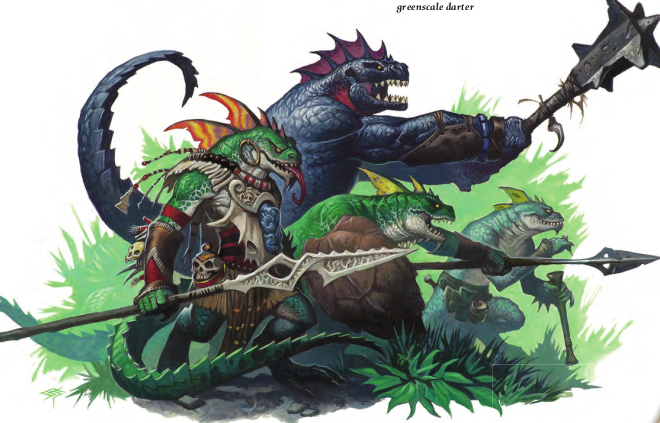
Copyright 2008 Wizards of the Coast This is part of a series! Go here to see the other entries.
Lizardfolk have been in D&D since its beginnings, when they were known by the less inclusive name of “lizard men”. As members of the classic humanoid power ladder, they are present in both books.
The Lore
Lizardfolk are reptilian humanoids who prefer to live in hot, humid environments like jungles and swamps, where they establish hunter-gatherer societies. They are naturally adept swimmers and can hold their breaths for up to ten minutes.
Lizardfolk hatch from eggs and reach physical maturity in 2 years. All of a village’s eggs are buried in a communal pit for incubation, and the hatchlings are raised by the tribe as a whole. Lizardfolk culture has no concept of parenthood or nuclear families.
Their society is patriarchal, with the most powerful male acting as chieftain advised by shamans and mystics. They don’t worship any deities, but a truly legendary chieftain may be elevated to the status of “Lizard King” and be treated as a living god. I think the concept of primal spirits wasn’t 100% developed at this time, but lizard-people should probably be a primary example of a culture that worships them more than the gods.
Older editions described lizardfolk as murderous cannibals, but the Monster Manual lore seems to be considerably nicer. Lizardfolk tribes are territorial and insular, but usually not malicious. They even trade with those outsiders who manage to win their trust (most often halflings). Some communities on the other hand are malicious and practice both raiding and cannibalism. Those don’t trade with anyone.
There are several different lizardfolk “ethnicities”. The most common are known as “greenscales”, of average build. You also have the stronger and larger “blackscales”, and the MV also introduces us to the smaller and faster “poisonscales”. All three can either form their own communities, or live together in a single village.
The Monster Vault lore has absolutely nothing nice to say about lizardfolk, by the way. This seems to be a trend in that book when it comes to humanoids. The MV goes right back to Basic’s line about all lizardfolk being murderous cannibals who don’t even build their own villages if they can instead slaughter a “civilized” community and take their houses.
In either case, lizardfolk hunt and fight by employing their superior knowledge of their territory, and the superior mobility they enjoy therein. They often use nets or poison darts, and will try to lure invaders into traps or natural hazards (like quicksand pits or hungry crocodiles).
The Numbers
Poisonscales and Greenscales are Medium Natural Humanoids with the Reptile keyword. Blackscales are Large. They all have Speed 6 with Swamp Walk, ignoring all swamp-like difficult terrain.
MV lizardfolk tend to have an atavistic theme going on, gaining minor-action “feral” attacks when they become bloodied.
Poisonscale Needler (MV)
Needlers are Level 3 Minion Artillery with the common traits outlined above. They fight in melee with claws, and at range with blowguns. The blowgun darts do poison damage, and on a critical hit cause the target to fall unconscious (save ends).
They also have the Sniper trait, which make a needler that misses a ranged attack from hiding remain hidden.
Poisonscale Brawler (MV)
These are Level 3 Brutes with 55 HP and all common lizardfolk traits.
Their main weapon is a club, and they can perform a Feral Grab as a 1/round minor action. This targets Reflex, does no damage, and grabs on a hit (escape DC 13). Brawlers can apply a Crushing Grasp to grabbed victims, targetting Fortitude and doing more damage than the club (half on a miss).
Greenscale Raider (MV)
These are Level 3 Soldiers with 45 HP. Their club attacks mark for a turn, and they can attack marked targets who shift as a reaction, doing more damage than the basic attack (half on a miss).
Once bloodied, they can also attack with minor-action tail sweeps (vs. Reflex), which do no damage but knock the target prone on a hit.
Greenscale Trapper (MV)
This is a Level 3 Controller with 46 HP, and a rare non-spellcasting controller at that. It carries a spear and three nets into combat.
Aside from basic spear attacks, the trapper can toss a net (Close Blast 2 vs. Reflex; enemies only) to do a bit of damage and immobilize (save ends). On a miss, it can still slide the target 1 square to a square not in the blast. You dodge, but end up right where the trapper wanted you!
As a move action, the trapper can use Net Drag, moving its speed and pulling any targets immobilized by its net along. Once bloodied, it can perform a Feral Kick (vs. Reflex) as a minor action, which does no damage but slides the target 1 square on a hit.
Greenscale Hunter (MM) and Raider (MV)
Different versions of the same monster, these are Level 4 Skirmishers with 54 HP. They fight with spears and can shift 1 square before attacking with them. The Hunter gets a minor-action Feral Tail Lash when bloodied, which on a hit deals a smidge of damage and allows the hunter to shift 1 square.
Greenscale Darter (MM)
A nonminion version of the Needler. These are Level 5 Lurkers with 50 HP. They fight with clubs in melee. Their blowgun attacks do a single point of physical damage and trigger a secondary attack vs. Fortitude. If that one hits, the target takes 5 ongoing poison damage and is slowed (save ends).
You should probably change the blowgun to do level-appropriate poison damage instead if you update them.
They also have the Sniper trait.
Greenscale Bog/Marsh Mystic (Both)
Lizardfolk spellcasters, likely primal. The one in the MV is named the Bog Mystic, and the one in the MM is the Marsh Mystic. They’re Level 6 Controllers (Leaders) with 70 HP and all common lizardfolk traits.
The Marsh Mystic has an aura named Marsh Blessing with a radius of 5 squares. Allies inside heal 3 HP at the start of their turns. The Bog Mystic replaces that with Swamp Tangle, which has the same radius. Whenever an enemy inside is hit by an attack, the aura’s squares become difficult terrain for them for a turn.
Their other attacks are equivalent. They fight with spears in melee, and at range with a spell named Bog Cloud (Area Burst 2 within 10 vs. Fortitude; recharge 5-6). This does poison damage and dazes for a turn. The MV version still makes the targets grant combat advantage for a turn on a miss.
The mystic’s ultimate technique is Swamp’s Grasp, an encounter power whose mechanical effects differ between versions. In both it’s an area burst 2 that targets Reflex and represents swamp vegeration heaving up to entangle victims. The MM version has a range of 10, does no damage, and immobilizes (save ends). The MV version is a lot better, doing damage in addition to the immobilize effect, or half damage and slow (save ends) on a miss. It only has range 5, though.
In both cases, Swamp’s Grasp creates a zone of difficult terrain until the end of the encounter, which can be ignored by creatures with swamp walk.
Finally the MV mystic has a Feral Tail Lash that can be used once it’s bloodied, does a bit of damage, and slows for a turn.
Blackscale Bruiser (MM) and Crusher (MV)
This Large lizard-person is a straightforward Level 6 Brute with 86 HP. The Bruiser fights with a club whose attacks damage and can push targets 1 square, and with tail slaps that target Reflex, do damage, and knock prone.
The Crusher has the same club attack but its other options are a little fancier. Its Tail Swipe can be used twice per encounter, recharging when the creature is bloodied. It’s a Close Blast 2 vs. Reflex that does a goodly bit of damage and knocks targets prone.
Once bloodied it can also use Feral Bites as a minor action, which do more damage than the other “feral” attacks we saw but have no riders.
Sample Encounters and Final Impressions
We have 2 here:
-
Level 4: 2 greenscale hunters, 2 visejaw crocodiles, 1 vine horror. A sampler of the pets lizardfolk keep.
-
Level 6: 1 mystic, 2 bruisers, 1 darter, 2 hunters. Either a serious hunting party or the mystic’s personal guard.
Mechanics-wise the MV stat blocks are almost always better, particularly the ones for mystics and bruisers. However, I’m 100% behind the MM’s non-xenophobic lore. Neutral lizardfolk who might trade and talk with you are a much better addition to a setting than yet another Angry Humanoid.
-
-
Let's Read the 4e Monster Manual/Vault: Lich
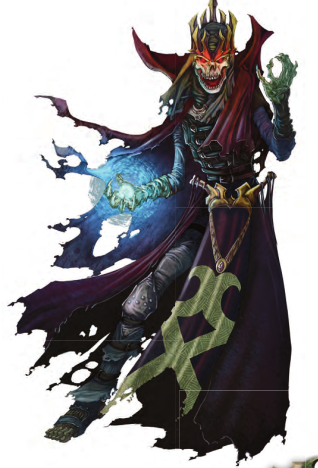
Copyright 2008 Wizards of the Coast This is part of a series! Go here to see the other entries.
Lichs are the original horrible undead wizards of D&D, having existed since the beginning. They’re both in the 4e Monster Manual and the Vault.
The Lore
A lich is a spellcaster, usually a wizard or warlock, who has performed an unspeakably evil ritual to become undead while retaining all of their intellect and magical power. Several liches have been successful enough that their names are known throughout existence. There’s Vlaakith, the supreme ruler of the githyanki; Acecerak, whose disembodied soul wanders the planes; and of course Vecna, who became a god.
All liches are evil. In life, they were at the very least ambitious individuals with an insatiable lust for both temporal and magical power. While someone can technically possess these traits without being evil, the stuff they have to do as part of the ritual, as well as the process itself, will inevitably warp their alignment that way.
Most such greedy wizards become liches to cheat death. They start to search the world and the planes for lore that allows them to piece together the ritual as soon as they realize they’re not going to live long enough to conquer the entire universe. Sure, death is not the end in D&D, but it usually means losing your stuff and for some wizards that’s worse than oblivion. I imagine these spellcasters make an effort to erase any knowledge of this ritual after they find it to prevent future competition, but somehow the next lich candidate always manages to find their own copy.
Liches are a lot more patient about their schemes than they were in life - they now have the whole of eternity to work them. Their goal remains to accumulate as much power and knowledge as possible, and now they have absolutely no moral qualms about the methods used for this (if they ever had any before). Lots of evil creatures serve liches willingly because they like to bask in their utter depravity.
Liches tend to be security conscious (read: paranoid), because their immortal forms can still be destroyed through violence. They’ll rarely leave their fortified lairs, sending lackeys to further their schemes when possible. A Lich’s soul is anchored in a phylactery, which is usually a tiny metal box filled with arcane writings, but can also be any other small item. The phylactery ensures a destroyed lich will re-materialize in a few days. The security arrangements around phylacteries are even more elaborate and dangerous than those around the lich itself, and can tell you a lot about the personality of the lich in question.
Destroying a lich requires destroying the philactery first, and then the lich itself. You have to be fast about it, because the lich can build itself another philactery in a few days. Sometimes, not even this is enough: a powerful entity associated with undeath such as Orcus or Vecna can call a destroyed lich back into existence as a vestige. Orcus is the original architect of lichdom, and nearly all liches are his agents in the end. I imagine this doesn’t apply to Vecna, and that the demon lord has competition in this area now.
Fifth Edition would add that liches need to regularly consume souls to keep existing, but this is absent from the text here. Their all-consuming greed and ambition is enough reason for them to keep inflicting evil upon the world.
The Numbers
First off, we get stats for the Lich Transformation ritual! It’s level 14, requires training in Arcana or Religion, takes 1 hour, and costs 100,000gp in components. A market price of 250,000gp for the formula is also listed because that’s the standard format for rituals, but this is definitely not something you can find in most markets. Maybe there’s a kiosk in Orcus’ abyssal layer or Vecna’s domain that sells it, if you want to be cute about it.
Constructing the philactery is a separate process that takes 10 days - the 1 hour ritual casting time is just the final step that kills you and makes you a lich. Phylacteries are tough, with 40hp and resist 20 to all damage. The cost for the first one is included in the ritual’s casting cost. Replacements take another 10 days to build and cost 50,000gp. Feel free to include any amount of baby-eating you require to mark this whole process (both building and casting) as irredeemably evil.
Early in 4e, “Lich” is a monster template presented in the DMG, which the Monster Manual applies to a “Human Necromancer” and an “Eladrin Wizard” stat block. By the time the Monster Vault had been written those templates had fallen out of favor, so its stat blocks are built from scratch while observing the same themes.
On to the stat blocks!
Lich (Human Necromancer) (MM)
This is a Medium Natural Humanoid (undead) and a Level 14 Elite Controller with 218 HP (MM). It has Speed 6, Darkvision, Resist 10 Necrotic, and immunity to disease and poison. It also has Regeneration 10, which can be turned off for a turn by radiant damage.
This lich surrounded by a Necromantic Aura with a radius of 5 squares, which deals 5 necrotic damage to anyone caught inside. Against civilians with 1 HP, this is a weapon of mass destruction all by itself, though few liches would be murderous enough to use it in that way.
Its active powers are weird in that it entirely lacks a melee basic attack. This is likely an editorial oversight. Instead it has a ranged basic attack named Shadow Ray (Ranged 20 vs. Reflex) which does necrotic damage.
Every once in a while the lich can use Frostburn (Area Burst 2 Within 20 vs. Fortitude; recharge 5-6), which does cold and necrotic damage and creates a zone that deals another 10 cold and necrotic damage to anyone caught inside. This lasts a turn and can be sustained as a minor action.
A lich reduced to 0 HP will crumble to dust along with its possessions, and both will reform adjacent to its phylactery in 1d10 days. This can be stopped by destroying the phylactery.
Finally, it can use the Second Wind action to recover 54 HP and get +2 to defenses for a turn.
Lich Necromancer (MV)
The updated version of the messy lich above. This one is also a Level 14 Elite Controller, with 268 HP and no Second Wind. It has the same speed, senses, immunities, resistances and vulnerabilities but no regeneration.
The Necromantic Aura remains and works the same way, as does the phylactery. Its active abilities are a lot more interesting.
The lich attacks in melee with a Vampiric Touch (vs. Fortitude) that deals necrotic damage and heals the lich for the same amount. Its ranged attack is Freezing Claw (Ranged 5 vs. Reflex; one or two creatures) that deals cold and necrotic and immobilizes on a hit (save ends); on a miss, it does no damage and slows (save ends).
Its big attack is Enervating Tendrils (Area Burst 1 within 10 vs. Fortitude), a tentacular explosion that deals a bunch of necrotic damage and weakens on a hit (save ends). It deals half damage on a miss and recharges once the lich is first bloodied.
As a move action it can use Shadow Walk once per encounter, teleporting twice its speed.
As a minor action, it can use Lich’s Control (Close Burst 10; recharge 5-6), which targets one enemy suffering from a “save ends” effect and automatically inflicts a -5 penalty on their next save.
If you need a level 14 lich, use this one and forget the one on the MM.
Lich (Eladrin Wizard) (MM)
This is pretty much a level 24 version of the human necromancer lich. It’s a Level 24 Elite Controller with 262 HP and exactly the same passive traits, speed, immunities, resistances, and so on. Even the numbers on the resistances are the same.
Like its weaker counterpart, this lich lacks a melee attack. It attacks at range with a Shadow Ray that does necrotic damage, and occasionally upgrades it to a Necrotic Orb (recharge 5-6) that doe the same damage and also stuns for a turn. Every once in a while it will cover an area with an Entropic Pulse (Area Burst 2 vs. Reflex; recharge 5-6) that does necrotic damage.
The eladrin lich has the same phylactery mechanics and Second Wind, too.
Lich Soulreaver (MV)
This one is a Level 22 Artillery lich with 156 HP. It has all the same senses, speed, and resistances as the Lich Necromancer, though their numbers have been increased to reflect an epic tier monster. The same happened with the Aura, which now does 10 damage.
Soulreavers fight in melee with a Vampiric Touch that works like that of the Necromancer but does more damage. They fight at range with Dark Bolts (Ranged 20 vs. Reflex; 1 or 2 creatures) that do lightning and necrotic damage and allow an ally adjacent to the target to shift 2 squares.
Twice an encounter they can cast Black Flames (Area Burst 2 within 10 vs. Reflex; enemies only) which does both immediate and ongoing fire and necrotic damage while also making the target grant combat advantage (save ends all). On a miss it still does half damage and slightly less ongoing damage (save ends).
And finally, this lich can also Shadow Walk.
Lich Remnant and Lich Vestige (Both)
These wispy, fragile things are what you get when Orcus or Vecna prevent a lich from being entirely destroyed. Aside from level they’re mostly identical. Remnants (from the MV) are Level 16 Minion Artillery, and Vestiges (from the MM) are level 26.
Remnants and vestiges fight in melee with a Shadow Touch and at range with a Shadow Ray. They can also cast a Orb of Obliteration (Area Burst 1 within 10 vs. Reflex) at will, or alternatively use Obliteration Empowerment on another remnant/vestige. This causes the orbs the ally uses on their next turn to cover a larger area (+1) and do more damage (+5). Multiple uses of this stack, so you could have a bunch of minion liches empower one single ally so it can nuke the party.
The Vestige’s powers work the same, but they’re worded a bit differently.
Sample Encounters and Final Impressions
The MM has two sample encounters, both Serious Business:
-
Level 25: 1 eladrin lich, 2 great flameskulls, 2 soulspike devourers.
-
Level 26: 6 lich vestiges, friggin’ Dorensain the Ghoul King, 2 dread wraiths.
As you can see, liches surround themselves with all sorts of undead lackeys of their own making. Constructs are probably very common as well, with summoned elementals and demons being used as one-off muscle. I imagine devils wouldn’t appear very often, though. It’s probably not uncommon for a powerful evil wizard to sell their soul and renege on the deal by turning into a lich, so devils would dislike liches on principle.
I imagine you could do a whole party of undead villains too: a lich, a death knight, a vampire and so on.
Mechanically, you should ignore the liches from the Monster Manual and focus on the ones from the Vault, which are much better designed. If you want to create your own varieties, base them on the MV liches and their signature traits.
-
-
Let's Read the 4e Monster Manual/Vault: Larva Mage
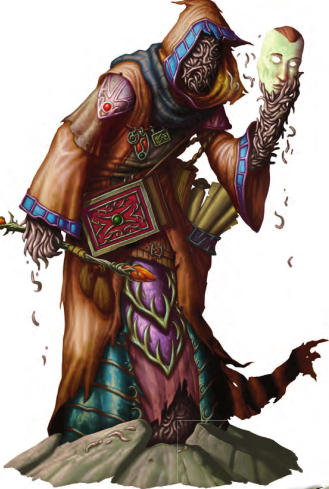
Copyright 2008 Wizards of the Coast This is part of a series! Go here to see the other entries.
“Larva Mage” is a more generic name for the Spawn of Kyuss, a monster that as far as I know appeared in the Age of Worms adventure path for 3e. Here, they are only present in the MM.
The Lore
A larva mage is what you get when an evil spellcaster dies and their restless spirit takes over the maggots infesting their corpse. This possessed mass assembles itself in a roughly humanoid shape to seek revenge or simply to continue whatever schemes it had in life.
On the surface larva mages seem like a more disgusting variety of lich, and you could play them that way, but there are some differences. Becoming a larva mage is a spontaneous process, not an intentional ritual, and it may cause the mage to lose some of the magic power it had in life.
A particularly powerful specimen might retain much of its power, but it’s not guaranteed. The first larva mages were created by an elder evil named Kyuss, to guard vaults of forbidden lore. These are the most powerful among their kind.
Though larva mages are hard to hurt, they can be destroyed through a sufficient application of violence. When that happens, the worms that comprise their bodies lose their cohesion and sapience.
The Numbers
We get a single stat block, which supposedly represents a “typical” larva mage whose powers are a mix of spells and being made of worms. You can give them more combat spells and however many rituals you think are appropriate to represent an individual that retained more of their magic ability.
Larva Mage
This is a Medium Natural Magical Beast (undead), and a Level 21 Elite Artillery monster with 304 HP. As an undead, it has Resist 10 Necrotic and Vulnerable 10 Radiant. As a swarm creature, it takes half damage from melee and ranged attacks, and has Vulnerable 10 to close and area attacks. A radiant area attack will really ruin this thing’s day.
Larva Mages have Speed 6, and like the lamias we just covered, they can disassemble to squeeze through openings as if they were Tiny creatures.
The larva mage’s basic attack is a Corrupting Touch that does necrotic damage, but as an artillery monster it doesn’t want anyone to get close to it. For that, it will use its Horrific Visage (Ranged 10 vs. Will; minor action; recharge 5-6) on melee-focused PCs. This dazes them and prevents them from attacking the mage (save ends).
It will follow that up with Rays of Cold Death (Ranged 20 vs. AC), which do cold and necrotic damage, with a big damage bonus against bloodied targets. Against groups it will use Withering Flame (Area 1 within 20 vs. Reflex) for fire and necrotic damage.
If someone looks like they’re near death or manages to get too close, the mage will use Worm’s Feast (Ranged 5 vs. Will; recharge 6), an illusion that tricks the victim into believing worms are eating their flesh. This does a big chunk of untyped damage, but only if that damage would reduce the target to 0 HP. If it wouldn’t, the victim is instead stunned for a turn.
Sample Encounters and Final Impressions
We get three sample encounters:
-
Level 21: 1 larva mage, 4 slaughter wrights, 1 sword wraith.
-
Level 22: 1 larva mage, 3 rot harbingers, 5 abyssal ghoul myrmidons.
-
Level 22: 2 larva magi, 2 rockfire dreadnoughts, 8 grimlock followers.
From this we gather that larva mages tend to hang out with other high level undead, or similarly powerful summoned servants depending on what spells they knew back in life. They need these servants, too, since they’re pretty much dead if an epic-level party manages to corner them in melee. If their buddies manage to keep the PCs far away, though, they can do a lot of damage.
I haven’t actually read Age of Worms or anything else related to Kyuss, so larva mages don’t stir any strong emotion in me in that regard. Their imagery is nice and creepy, though.
-
subscribe via RSS