Posts
-
Let's Read the 4e Monster Manual/Vault: Medusa
We already lightly touched upon medusas on the entry for gorgons (which, in D&D, are entirely unrelated). They’re based on Greek Myth, where Medusa was an individual, the only mortal among the semi-divine Gorgon sisters. I see them on the Rules Cyclopedia, so they’ve been around since at least BECMI and probably since the beginning.
The Lore
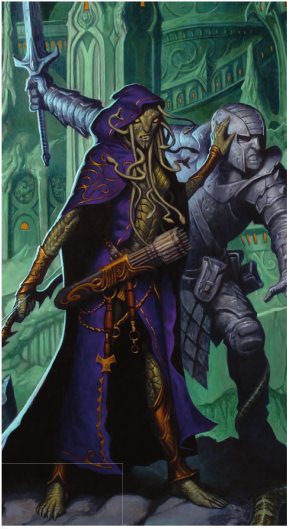
Copyright 2008 Wizards of the Coast As is common with creatures based on singular entities from Greek Myth, D&D medusas are an entire species of humanoids with snake-like features. Females have the iconic hair snakes, and their gaze can petrify victims. Males are completely bald, and their gazes can “poison the mind and body”.
The Monster Manual portrays medusas as a haugthy and ambitious people. They live in small groups, but their ambition drives them to seek money and power in the societies of others. Evil medusas turn up as assassin guild masters or terrifying nobles, but you also get nicer ones working as eccentric veiled scholars and alchemists. Eberron has medusas make up part of the elite in the monster nation of Droaam, so you can have medusa ambassadors and such.
The Monster Vault, as usual goes a bit harder on the evil angle and says that medusas are universally regarded as unnatural by all the other sapients. Rumors and myths abound about their origins, and run along two main lines. One says they were wholesome/wicked people who got punished/rewarded by Zehir with their current forms. The other says they were the result of yuan-ti genetic experiments, originally meant to serve as a slave race. Villainous medusas do often worship Zehir, the snake god of treachery and snakes, and they often have cordial relations with yuan-ti, who are one of the few other peoples they are said to truly respect.
Medusas like to decorate the area around their lairs as demarcation and warning. There’s the classic statue gardens, of course, and males also like to paint the walls with the blood of their victims.
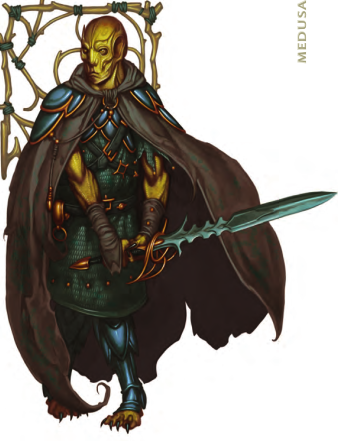
Copyright 2008 Wizards of the Coast The Monster Vault also turns them into another of those evil matriarchies where males are oppressed, with only those few who are immune to petrification being singled out for special treatment. The Monster Manual makes no mention of this, and says every medusa is immune to petrification regardless of gender.
In combat, medusas use weapons, with a preference for swords and bows. Their blades and arrows are often coated in poison derived from the their own saliva or blood. Someone who has been petrified by a medusa can be brought back to life by the application of a few drops of that medusa’s blood to the victim’s lips. While the text assumes you’ll kill the medusa to get that blood, I don’t think that’s a hard requirement. If you do kill it, you must apply the blood to the victims within 24 hours.
The Numbers
Medusas are Medium Natural Humanoids. All are immune to petrification, and have some degree of poison resistance. They also have a gaze attack, which can be either petrification or venom depending on the individual.
Gaze mechanics are different in both books. MM gazes are standard action attacks, to which blind creatures are immune. It’s up to the PCs to decide whether it’s safer to fight an elite paragon medusa blindfolded or to risk its gaze.
MV gazes are triggered actions, which means the monster doesn’t need to choose between using its weapons or its gaze in a turn. Also, blinding yourself won’t save you from these gazes.
Medusa Archer (MM)
This lady is has the closest stat block to the classic medusas of editions past. She’s a Level 10 Elite Controller with 212 HP. Her speed is 7 and her poison resistance 10.
She fights in melee with her Snaky Hair, which does a bit of physical damage plus 10 ongoing poison damage, and also inflicts a -2 penalty to Fortitude (save ends both). Her main ranged attack is a Longbow (range 20/40 vs AC) whose poison-dipped arrows trigger a secondary attack against Fortitude on a hit, causing the same rider effects as the hair.
The archer’s Petrifying Gaze is a Close Blast 5 vs. Fortitude. It slows on a hit, and this worsens to immobilized on the first failed save and to full petrification on the second. The first two conditions are (save ends), but petrification is permanent until cured. This is an at-will power, and the perfect thing to use on people already weakened by the poison from the other attacks.
Medusa Bodyguard (MV)
One of those poor oppressed MV males, this guy is a Level 12 Soldier with 123 HP. He is not immune to petrification and has Resist 10 Poison and Speed 6.
The bodyguard is armed with a broadsword and a longbow. The longsword marks for a turn on a hit, and both attacks have an ongoing 5 poison damage (save ends) rider. The bodyguard’s Mind-Venom Gaze triggers as an interrupt when a marked target ignores the mark. It’s a Close Blast 5 vs. Will that must include the triggering character. It does a good bit of poison damage to those it hits, and also stuns the triggering character if it hits them. The gaze recharges whenever the bodyguard hits with his sword, and blind creatures are not immune.
Medusa Venom Arrow (MV)
Venom arrows are non-elite versions of the MM Archers, being level 12 artillery monsters with 96 HP.
Like Archers, they fight in melee with their less-whimsically named serpent hair, which deals poison damage and inflicts a -2 to Fortitude for a turn. Their Range 30 bows do physical damage, ongoing 5 poison damage, and slow (save ends).
Their Petrifying Stare is a triggered opportunity action. If an enemy starts they turn within 2 squares of the medusa, they’re subject to a gaze that hits automatically and slows them (save ends). This progresses to full permanent petrification just like the Archer’s gaze.
The possible cures for this petrification are specified here: the right power or ritual, a willing kiss from the medusa, or the afore-mentioned blood drops.
Medusa Warrior (MM)
We’re back in elite territory with these dudes, who are Level 13 Elite Soldiers with 272 HP. They fight with longswords and longbows as well.
The longsword attacks trigger a secondary attack against Fortitude on a hit, dealing ongoing 10 poison damage and slowing (save ends both). The arrows automatically inflict the ongoing damage if they hit (save ends).
As elites, warriors can use a standard action to make two sword attacks, and those deal extra damage against a dazed target. Their source of daze effects is their Venomous Gaze (Close Blast 5 vs. Will), which does poison and psychic damage, with “daze” and “weaken” riders (save ends both).
Warriors prefer melee, alternating between their gaze and their double sword attacks. If you have more than one, they’ll coordinate their actions to that effect as well.
Medusa Spirit Charmer (MV)
The lady medusa from the MV. She’s a Level 13 Controller with 130 HP, immunity to petrification and resist poison 10. This is more of a spellcaster or psion type.
Like the MM archer, she uses her serpent hair to fight in melee, doing poison damage on a hit and inflicting a -2 penalty to saves for a turn. Her main ranged attack is Spirit Charm (Close Blast 5 vs. Will), which does a bit of psychic damage and compels the target to approach the medusa. This isn’t a pull, but a choice: the victim must either end their next turn within 2 squares of the medusa, or it must take further psychic damage.
Once per encounter she can cast Swords to Snakes (Area Burst 1 Within 10 vs. Will), an illusion that makes people think their weapons and tools have become snakes. This prevents them from using weapon or implement powers (save ends).
The spirit charmer’s Signature Medusa Move is the Stony Glare, a reaction that triggers if an enemy ends their movement within 2 squares of the medusa. Which by the way can happen due to Spirit Charm! This is a Close Blast 2 that only affects the triggering enemy, targets Fortitude, and petrifies immediately. This is a (save ends) condition until the third failed save, in which it becomes permanent until cured.
The possible cures are the same as those of the Venom Arrow’s gaze.
Medusa Shroud of Zehir (MM)
A powerful Zehir-worshipping avenger or assassin. This lady is a Level 18 Skirmisher with 172 HP. She is immune to petrification and has 10 resistance to both acid and poison.
The Shroud fights with paired short swords, which do physical damage and ongoing acid and poison damage (save ends). She will often use a maneuver named Fangs of Death (recharge 4-6) which allows her to make two sword attacks and shift 3 squares between them. There’s a typo in her attack bonus, which is listed as +15 instead of the correct +23.
Her Snaky Hair is a minor action, with the right attack bonus and the same damage as a sword blow. It inflicts the same ongoing damage and a further -2 penalty to Fortitude (save ends both).
The Petrifying Gaze is here and works the same as the archer’s.
Shrouds spam those snake bites and use Fangs of Death whenever it’s charged, since it spreads the poison around and allows them more mobility. When it’s not charged, they use their gazes.
Sample Encounters and Final Impressions
There are a few on the MM.
-
Level 11: 1 medusa archer, 1 venom-eye basilisk, and a gaggle of snaketongue cultists.
-
Level 14: 1 medusa warrior, a bunch of grimlocks and 2 gargoyles.
-
Level 17: 2 shrouds of Zehir, 1 yuan-ti malison disciple of Zehir, and 3 yuan-ti abominations.
As you can see, medusas are probably the world’s premier basilisk owners, since they are completely immune to that monster’s gazes and they complement their own powers nicely. I imagine even good medusas subscribe to newsletters on the care and feeding of basilisks.
They also tend to associate with or employ other monsters who are similarly immune to their powers, like the blind grimlocks or gargoyles and other earth-elemental creatures. Also, if you feel like yuan-ti alone don’t give you enough options to stock a dungeon full of snake-people, you can add some medusas in. If you believe those MV myths, medusas are instinctively compelled to serve yuan-ti, probably the only instance where they would put themselves in the “servant” position.
Personally I like the image of the “archer medusa” a lot, and as with most other humanoids I’d probably include non-villainous medusa in my setting to go along with the usual antagonists. The stat blocks from both books seem to imply their gazes attacks are always entirely voluntary, which would mean a peaceful medusa wouldn’t even need those veils or dark goggles. Guess they might still wear them as a sign of goodwill, though, like sometimes knights will peace-bond their swords to show they mean no harm.
-
-
Let's Read the 4e Monster Manual/Vault: Marut
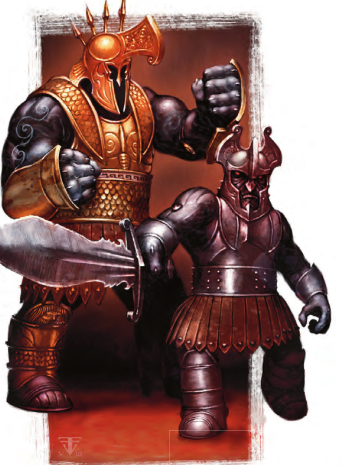
Copyright 2008 Wizards of the Coast This is part of a series! Go here to see the other entries.
My first contact with Maruts was in Third Edition, where they were a type of Inevitable, a Lawful Neutral outsider. It could be that they predate that edition (though AD&D was all about modrons instead). Here, they appear only on the Monster Manual.
The Lore
In Fourth Edition, Maruts are enigmatic natives of the Astral Sea, usually found wandering that plane and others as mercenaries for hire. As mercenaries, they probably don’t care much about who their bosses are, as long as those bosses stick to their end of the contract. If they don’t, I imagine retribution is… inevitable.
The price for a Marut’s service is always a reciprocal service, to be specified at a later date. They keep an exacting record of these favors in their astral fortresses. No one knows why they’re gathering favors in this manner.
The Numbers
We get two Marut stat blocks here, both epic. They have some common traits: trained Perception, Truesight, a land speed of 8, plus flight and teleport speeds of 4. They’re also immune to sleep, have Resist 10 Thunder, and an amazing Regeneration of 20 with no weaknesses that temporarily shut it down. These things are really hard to kill and really hard to get away from.
Maruts are Unaligned, being indifferent to the cosmic struggle between good and evil. All they care about is keeping their ledgers balanced.
Marut Blademaster
This Medium Immortal Humanoid is a Level 21 Soldier with 201 HP and all common marut traits. It wields a greatsword in combat.
That greatsword is its only attack, doing a mix of physical and thunder damage. A hit also pushes the target 1 square and marks them for a turn.
The damage of that basic attack is a bit underwhelming due to the early math, but the blademaster will often (recharge 4-6) be able to make two such attacks a round, making it considerably more dangerous.
You probably want to use enough of these to form a battle line. It’s hard to stand your ground against a wall of marut blademasters, and it gets even harder when they have backup.
Marut Concordant
This Large Immortal Humanoid is a Level 22 Elite Controller with 418 HP and all common marut traits. Concordants fight with their fists and with decrees backed by mystical power.
You’ll likely see them coming at you from behind a battle line of blademasters. They’ll bombard your position with Fortune’s Chains (Area Burst 5 Within 20 vs. Will; enemies only; recharge 4-6), likely catching the whole party and doing psychic damage with a daze rider (save ends).
Then they’ll stop melee PCs on their tracks with Dictums (minor action; Ranged 10 vs. Fortitude), which do no damage but immobilize (save ends). When the party finally manages to crash into the battle line, the concordants will push them away again with a Thunderous Edict (Close Burst 5 vs. Fortitude; enemies only; recharge 5-6) which does thunder damage and pushes 4 squares on a hit.
If all of these powers happen to be recharging at the moment, they’ll content themselves with reaching over the heads of the blademaster vanguard and punching the PCs with Reach 2 slams that do a mix of physical and thunder damage.
Sample Encounters and Final Impressions
There’s one level 23 sample encounter: 1 concordant, 2 blademasters, a war devil, and 8 legion devils. There’s your battle line.
Fans of 3e inevitables are probably missing a lot of the lore that was removed along with the Great Wheel cosmology. Personally, while I think 3e inevitables were interesting, I also like the new lore. Enigmatic mercenaries stockpiling favors for some future cosmic plan is an interesting background that leaves room for GM creativity.
-
Lich van Winkle: A Rather Interesting Blog
Lich van Winkle’s Return to Gaming is a rather interesting blog I found through Dungeon Fantastic. Its author started role-playing with D&D basic back in 1981, stopped around the mid-90’s, and is now coming back to the hobby after a 25-year hiatus.
I found some of the post titles there interesting enough, and the blog itself is new enough, that I’m reading it from the beginning. The first post proves that it’s going to be an interesting ride, because this is someone who played back when the old school was new and who says that “there is a lot of myth-making in the OSR”. Me, I started playing shortly before Mr. van Winkle here stopped, but I think I’ll find plenty to agree with.
-
The Great Irony At the Heart of Shadowrun
For a very long time Shadowrun was my favorite game system and setting. These days I still like the setting, but my annoyance at a host of small details in it is stronger than my wish to play in it as written. Still, it’s useful to think and talk about these details. It allows me to figure out what I want to do better in my eventual home-brewed rewrite.
One of these details isn’t small at all, however. In fact, I’d go as far as calling it the great irony at the heart of the game, as the title of this post implied. It was developed from some forum posts I made on RPG.net.
But First, The Good Parts
I don’t want to be unfairly critical of Shadowrun1. I know a few people who write for it, and the last thing I want is to give the impression that I’m attacking them. I’m not. This entire article is my personal opinion and in no way meant to disparage any of the fine people who are passionate enough about Shadowrun to write for it professionally. So let’s begin by talking about something that this game does right.
One of the best things about the setting design of Shadowrun is that it presents players with a very clear mission-based structure. The infamous question of “But what do we do in this world?” is answered very early and very clearly. This is a game about completing dangerous missions for money, just like D&D is about killing monsters and looting dungeons. Someone asks you to play Shadowrun, 99 times out of 100 you know the rough overall shape that campaign is going to take. You see a heist movie and you start thinking about it in the context of Shadowrun in your head, even if it doesn’t have all the same style elements, because the premise is strong.
Shadowrun nailed the answer to this important question so well that it kinda spilled over to other similar games. It became the default playstile for Cyberpunk 2020 against the wishes of its own authors, and it often gets adopted as the answer to “what do we do” in Transhuman Space2, which is so adamant about offering none in its pages.
Like a lot of Shadowrun setting elements, though, this structure has an excellent premise but its implementation gives rise to a lot of unintentional oddness. Or, in this case, to a Great Irony.
This irony, I think, emerges when the strong premise above gets combined with AD&D-style adversarial GMing, which was very popular when Shadowrun was first written. I believe it to be entirely unintentional, since as far as I can tell Shadowrun’s design methodology was mostly based on the Rule of Cool with a dash of “everyone else does this”. If it’s intentional, though, it’s among the greatest acts of trolling in all of gaming.
Isn’t it Ironic?
Okay, so the Sixth World is ruled by megacorporations who control every aspect of people’s lives. Most of these people live hand-to-mouth and work themselves to death in order to prop up the decadent lifestyles of a few billionaire executives. “Wage slave” is pretty much a synonym for “low-level megacorporate employee” in this setting.
But as the flavor text tells us, player characters are supposed to have managed to escape this cycle of misery. They live in the shadows cast by those giant corporate towers, and they have the skills to oppose the megacorps and make their independent way in the world.
Or do they?
I’ll admit I don’t know how things are structured in the most recent editions3, but I remember that the Shadowrun Companion for Second Edition contained detailed advice on how much money your PCs should be paid for those risky missions. I call it the “rent plus change” model.
According to the book, GMs should pay PCs enough for them to cover their lifestyle payments (i.e, rent and food) for the next month, with a little bit left over for resupplying consumables and eventually upgrading a piece of gear after a while. This was per month, not per run. If you had only one big run that month, it would pay this amount. If you had several, they would pay proportionally less so you’d receive the same “rent plus change” amount.
This was perfectly in-keeping with the AD&D school of GMing and design, which demanded PCs “earn” their power and had cool gear that cost money as a significant part of that power. If they earn “too much” money, they would get “too powerful”, and no one wants that! If your players look like they do, it’s because they’re cheating cheaters who cheat and should be punished for it.
Almost all published adventures started with a scene where the party met with Mr. Johnson to discuss the job. In the vast majority of these adventures, Mr. Johnson is a shady corporate exec working for one of the megas. And the GM text for this scene always included the oh-so-funny “If the players refuse the job, announce that the adventure ended, pack up your things and go home.” This is a joke about how the PCs don’t have any choice but to take the job as presented. In fact, the flavor text for the same scene almost always assumes they’re hurting for cash just before they get that call from their contact setting up the meeting.
So yeah, those fiercely independent PC shadowrunners? They’re all wage slaves too. And the game advises the GM to keep them that way.
Were the original writers oblivious to these implications, or are they still laughing today about how no one seems to have noticed? I don’t think I have seen any official discussion about this contradiction in any of the books I’ve read. It’s just taken as a given, and never questioned.
This central irony gets funnier when you add in two sets of rules that were published in the same edition.
Orichalcum
An early SR2 sourcebook called The Grimoire contained rules for making magic items. It required a lot of skill tests and time, and the materials were still super-expensive, but the final monetary cost was cheaper than buying the item.
“Do you buy or make your items?” would have been mostly a question of personal preference… if the book didn’t also have rules for making those materials from raw natural resources. You could use them for enchanting or sell them for half list price. You could even make orichalcum, the magical metal used in the creation of the most powerful magic items.
Orichalcum was so expensive that a single 10-gram “unit” cost the same as a sports car or as almost nine months of High Lifestyle. The process for making it was time consuming and laborious, but not really dangerous or illegal. And a skilled character could end up with multiple units of orichalcum at the end of that process. Selling even a single unit would more than pay the cost of the necessary equipment, which was reusable.
With these rules, a team of PCs that includes at least one magician has no financial reason to run the shadows. They can just set up an orichalcum-making operation instead, and live like kings.
Stolen Cars
The Shadowrun Companion sourcebook includes rules for stealing cars and selling them on the black market, which theoretically were meant to be used in a campaign where the characters were gangers instead of Shadowrunners. You could sell an entire stolen car for a fraction of its market value, or break it down for parts and sell those over several days and get money equal to the car’s full list price.
Stealing cars is of course illegal and dangerous, but it was trivial for the typical PC party in this game. After all they have the skills to routinely break into top-secret research labs full of intricate and deadly security measures.
The cheapest four-wheeled vehicle in the book was the Ford Americar, your typical “generic crummy sedan” that filled every street. Stealing and dismantling one of those every week would pay roughly five times the amount recommended in the “rent plus change” advice in the very same book. Or perhaps you could steal one limousine or fancy sports car per quarter. In either case, it was again much safer and more profitable than running the shadows.
Shadowrun + Irony = Awesome
When these two “oopsies” were first discovered, I remember seeing a lot of GMs go absolutely ballistic over them. The accusations of “munchkinism” flew thick and fast, but in true those GMs were mad that the PCs were doing something that wasn’t in the script. They reveled in describing the disproportionate response law enforcement or competitors would visit upon the PCs, which was just an excuse to punish the players for veering off the rails.
Personally, I think these two altertane activities are fraggin’ awesome, precisely because they allow the party to truly break free from the grind. If your players decide to retire from shadowrunning and make orichalcum or boost cars for a living, I fully believe that the right response is to play along and make the campaign be about that! All of those things mentioned as hard blocks by curmudgeonly controlling GMs are actually excellent adventure hooks. And I’m pretty sure any decent player group is going to keep finding non-monetary reasons to return to the shadows. There’s still people to help and megacorps to destroy, after all.
So I say that the first thing a team of shadowrunners needs to do is to find a way to leave classic shadowrunning behind for good. It’s a sucker’s game. Stay independent, take care of your community, tear down the system, make the Sixth World better.
-
Which already makes me nicer than most of the people who proclaim themselves its true fans. ↩
-
Though THS PCs tend to be working for government agencies or corporations rather than being freelance criminals. This is, after all, a cyberpunk setting as viewed by the bad guys. ↩
-
I stopped at the end of Fourth. ↩
-
-
Let's Read the 4e Monster Manual/Vault: Manticore
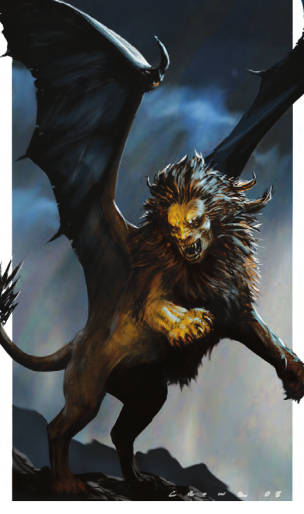
Copyright 2008 Wizards of the Coast This is part of a series! Go here to see the other entries.
Manticores are based on Persian myth, and have been in D&D at least since the days of BECMI. Here they are present in both the Monster Manual and the Vault.
The Lore
Manticores are monsters with the body of a very large lion, bat-like wings, and a vaguely humanlike face. Their tails are long, whip-like, and tipped with iron spikes.
These creatures are sapient, but deeply stupid and even more deeply mean, living up to their Chaotic Evil alignment. They claim large hunting territories around their lairs and are known to extend them even further on a whim. Like, say, when they discover a tasty village just on the other side of the current borders. They specifically seek out sapient prey if at all possible. Their favorites are humans and dwarves.
Tough technically capable of parley, manticores rarely bother listening. Those who manage to get through to a manticore can sometimes appease them with bribes of food, a tactic also used by smarter villains who want to hire some manticore muscle. There’s absolutely no guarantee the manticore will show up for the job, or stay appeased. Even manticores trained since they were cubs have a tendency to turn on their handlers. Should the beast actually hold its end of the bargain, it might end up serving as a mount for the villain commanding it.
Manticores have three rows of teeth that work a bit like a shark’s, often falling off and being replaced by new ones. Loose teeth and spikes, often stuck in mangled corpses, are a sure sign that you’re in manticore country. Despite having all those teeth, they prefer to use their claws in combat.
Heraldry has them as symbols of unpredictable danger, viciousness and cruelty. Manticore iconography is used in danger signs such as those meant to keep people away from an unstable abandoned mine or the like. They’re also adopted as symbols by groups such as evil mercenaries or bandits who want to seem all edgy and badass.
The Numbers
The Monster Manual only has one manticore stat block, but the Vault has four, each with a different role. That’s enough for you to make an all-manticore encounter. They’re Large Natural Magical Beasts.
Manticores run at speed 6 and fly at speed 8. Their keen senses give them trained Perception, and all of them can shoot those spikes from their tails. They don’t run out of ammunition either. Perhaps the spikes magically grow as soon as they’re fired, or perhaps there are so many to begin with they have Enough(TM) for any given fight.
Manticore (MM)
The classic model is a Level 10 Elite Skirmisher with 210 HP and the Mount keyword.
Its basic attack is a claw, and it can launch spikes out to Range 10. The spike attack allows them to shift 3 squares either before or after firing. Manticore Fury is a standard action that allows the beast to make both a claw and a spike attack in any order. Every so often (recharge 3-6) the manticore can whip its tail really hard and fire a Spike Volley (Area Burst 1 within 10).
Its mount ability is Guided Sniper, representing the fact that it allows its rider to act as a spotter. This gives both the basic spike throw and Spike Volley a +2 bonus to hit.
I’m tempted to plop a cheeky goblin atop a manticore, but realistically the rider would be someone more badass - otherwise they’d just get eaten instead.
Manticore Striker (MV)
Essentially a regular version of the MM elite manticore, this one is a Level 10 Skirmisher with 106 HP. None of the MV manticores have the Mount keyword or abilities.
The striker can shift 2 squares either before or after its claw and tail spike attacks, and lacks the ability to make both in the same round. If someone hits it, though, it can make a spike counterattack as a reaction, shooting a tail spike at the attacker without provoking opportunity attacks.
Manticoer Impaler (MV)
This Level 11 Brute has 138 HP. Its claw and tail spike attacks do Brute-level damage, and it also has a Tail Lance (melee 2 vs. AC) that can grab a target by impaling it.
The escape DC on the grab is 19, and while grabbed the target takes ongoing physical damage. While it has a creature impaled, the manticore’s flight gains an altitude limit of 6 squares.
While it’s grabbing someone, the manticore can also use Prepare to Drop, a move action that allows it to fly its speed and pull the target along. This includes pulling them straight up! It’s not stated in the stat block, but I think the manticore can choose to release someone it’s grabbing on its turn. Damage from the drop uses standard falling rules (1d10 per 2 squares/10ft, IIRC).
Manticore Spike Hurler (MV)
As you might have guessed from the name, this is the Artillery manticore. It’s Level 13 with 100 HP.
It has the usual claw and tail spike attacks, with the spike being more accurate and doing more damage. It can also launch a spike volley (area burst 1 within 10) at will.
Manticore Sky Hunter
This one is a Level 13 Soldier (Leader) with 130 HP, and it’s remarkable for being a manticore that cares about its allies. It has a Shielding Wings aura 1 that grants allies inside a +2 bonus to AC and Reflexes.
Its basic attacks are the usual claw and tail spike, with the claws also marking for a turn on a hit. As a minor action it can also let out a Threatening Roar that automatically marks everyone in a Close Burst 1 for a turn.
If any marked enemy within 5 squares makes an attack that doesn’t include the sky hunter, it can use a tail spike attack on them as a reaction (Defender’s Spike).
Sample Encounters and Final Impressions
The MM has two encounters featuring its elite manticore:
-
Level 11: 1 manticore, 1 galeb duhr rockcaller, 4 ogre savages.
-
Level 13: 2 manticores, 2 hill giants, 4 ogre thugs (minions).
In the first one I think the manticore is serving as the galeb duhr’s mount, having finally come across someone it can’t eat. While it’s funny to imagine the hill giants trying to hide the manticores in the second encounter, I don’t think that would work out very well for them.
I like manticores, they’re fun to run and fun to fight. The four MV stat blocks give us a bit more variety in tactics while staying true to the core MM concept. Perhaps you could take a pair of those and make them into Huge Elites so that those giants can finally make their dreams of flying come true.
-
subscribe via RSS