Posts
-
Better Than Bad: A Shadowrun Supplement Review
Older Shadowrun core books used to include this charming in-world dictionary entry that defined the term “shadowrunning” as doing illegal or semi-legal acts for money. A shadowrunner a criminal by definition, but in a setting where the laws are written by evil corporations and their bigoted puppet governments, that definition leaves plenty of room for heroic characters of many kinds.
From the tail end of Fourth Edition onwards, however, it seems the game’s publisher started interpreting that dictionary entry in the narrowest way possible: “Criminals are bad, m’kay?”. From that point on it portrayed shadowrunners as amoral assholes who work for truly horrible monsters doing truly horrible shit as long as the money is good. And that’s not the game I want to play. Shortly after the dismal supplement “War!”, I got out of the game1.
Whenever I write about my feelings on the matter in the RPG.net forum, a couple of very nice freelance Shadowrun authors always point me towards Better than Bad, a 2018 supplement for Fifth Edition, telling me it’s an attempt at reversing this trend. When it came up as part of a Bundle of Holding alongside a couple other setting books, I decided to check it out. This is a review of Better Than Bad. Reviews of the other books might come later.
The goal of Better Than Bad is to provide support for “hooding” campaigns. Hooding is a bit of Shadowrun slang that’s been around for a while, and originally referred to missions where the goal was to “rob from the rich and give to the poor” Robin Hood style. This book broadens the definition to any mission where the PC’s main goal is more altruistic than financial.
Does the book succeed at its stated goal? Well, it tries to, while fighting itself every step of the way. It fights itself with such tenacity that I wonder if there was a corresponding real-world struggle between its writers and editors.
The supplement starts with a real downer of an introduction: “Are your do-gooder runners going to change the world? Probably not - too much money and power are arrayed against them.” Gee thanks, book. I was nurturing some hope there for a moment.
The focus here is going to be in “fixing some damage, righting some wrongs, and making the lives of a few people better”. Which is all well and good in general terms, but still comes off as disappointing when presented as the absolute limit of what a group of PCs can accomplish.
I mean, yeah, if you want to be realistic about it, there’s only so much a group of 4-5 people can do to enact large-scale change in an unjust society, even if they’re badass action heroes. But if you’re going to be realistic about it you have to go all the way and state that the best way to enact this change is through collective action and give some support for that. Lancer does it. Sigmata does it. Does Better Than Bad do it? Eh, not really.
This introduction and a couple of short sections at the end are the only parts of Better than Bad that are written in an out-of-character, authorial voice. The rest of the text is written in an in-character voice using the traditional framing device of BBS/forum posts interspersed with comments from other users. For SR4 and 5, that BBS is Jackpoint, a small network with a more or less constant cast of commenters and the occasional invited guest. This format is known as “shadowtalk” by SR fans, a term which is also used to refer specifically to the comments.
The major sections of the book are:
-
“Lights in the Darkness”: A list of activist organizations who might hire runners for “hooding”-type jobs.
-
“Fixer-Upper Opportunities”: A list of specific examples of such jobs meant to act as plot hooks.
-
“Pretoria, Hurrah”: A big chunk of pages presenting the Pretoria metroplex in Azania (former South Africa) as a setting. Despite the name it also includes Johannesburg and lots of other cities.
-
“Jacaranda Citizens”: A large list of NPCs who live there in the Pretoria metroplex.
-
“Being Less Bad”: A chapter on more general hooding advice, and on what makes a hooder different from a “standard” shadowrunner.
-
“Building a Hooder”/”Hooder Runs”: The afore-mentioned short sections of mechanical bits and bobs, including a Random Hooding Run Generator.
These sections are separated by short fiction pieces.
The Good Parts
There are a few good things about this book I must acknowledge. The untitled fiction piece at the start of “Fixer-Upper Opportunities” is really good! The others are “just” okay, but still a sight better than a lot of the bleak stuff I read in other SR books.
“Being Less Bad” also contained some interesting information, and I particularly liked the way it emphasized that a hooder has a much close relationship with their community than your standard runner.
Most of the Pretoria NPCs are presented as potential employers, with specific goals and interests as well as specific types of job they like to offer. This is a very large leap in quality from older supplements like “Prime Runners”, whose NPCs seemed to be mostly intended to overshadow the PCs.
The mechanical bits and bobs seem cool, conceptually speaking. I’m not fluent enough in SR5 to say whether they’re well-implemented, and they have little to do with the theme of the book, but they’re nifty. There’s magically resistant armor and the magically resistant tattoos some geniuses made from the paint extracted from that armor. There are spells that can strip a spirit’s immunity so your gunslinger buddy can shoot them as if they were flesh. And there are several “life modules” that must plug into some sort of lifepath system and that do bear a relation to the book’s theme.
Those are the good parts. Now for the not so good ones.
Style and Organization Issues
We need to talk about shadowtalk.
The shadowtalk format works really well for “news”- or “travelogue”-style sections, since it allows the shadow-randos to chime in with the truth behind the official version of the facts and provide the reader with plot hooks. It lends the whole thing a very subjective air, emphasizing that nothing you read here is necessarily true. The main text certainly isn’t the whole truth, and most of the comments are all about rumor, hearsay, and personal opinions. These traits make it possible for a GM to take the information as a baseline and shape it as they want.
And it’s these exact same traits that make shadowtalk about the worst possible format for advice chapters. I was honestly a bit baffled when I saw that Better Than Bad chose to use it for explaining to the reader what hooding is and how to run a hooding campaign.
You can’t go two paragraphs without some amoral amoeba popping in with a hot take on how the entire concept of altruism is complete bullshit and only a fool would ever choose to practice hooding. This kinda muddles the message a bit, y’know? Makes me wonder why I spent money on a book that calls me names for being interested in its premise2.
You’re also no longer getting the official authorial stance of the game on something, but some shadow-rando’s opinion. As a result the main body of text also fights itself, with at least one instance where the “Being Less Bad” section disagrees with “Lights in the Darkness” because they’re written by different fictional authors. And since they’re separated by the huge chapters on Pretoria and its NPCs, it takes a while to get the full picture if you read through the book linearly.
Shadowtalk can also be useful to insert brief humorous exchanges that break long info-dump passages, but they don’t do that in this book. Rather, they spend space in long conversations between mysterious big shots who only ever speak in vague allusions to the lore of We’re No Longer Legally Allowed to Say It’s Earthdawn.
Plus the decision to present the Pretoria NPC list in-character means Jackpoint ends up doxxing the mysterious Zorro expy who’s supposed to be one of the city’s greatest forces for good. Way to go, chummers.
If it were up to me, the advice sections and the NPC list would have been rewritten as out-of-character, authorial-voice pieces with the extra space dedicated to a White Wolf-style discussion of themes and motifs for a hooding campaign.
Content Issues
You’d expect that a book named Better Than Bad would want you to stand up for people and things that are, you know, better than bad. The ways in which this book fights itself, however, make it so that’s not always the case.
Like, that list of activist organizations which your hooder PCs might work for? It includes a couple of literal terrorist groups. I’m not talking about “the corps say these people are terrorists but that’s a lie”. I’m talking about “these people would absolutely blow up a train station full of innocents to get at one bad guy.” Now, the text doesn’t really condone the violence, and if you go all the way to the other end of the book you’ll see that the general advice section also includes a full condemnation… but it really muddles the message to lump them in with the potential employers.
The Pretoria chapter is quite long but I’m not sure I’d use the setting as presented. In terms of real-world knowledge of the region I’m just another ignorant foreigner, so I can only speak of my own impressions of what I read in this book. And I get that this is a cyberpunk setting, so it has to focus on economic and social inequality to some extend, particularly in a book dedicated to fighting it.
But you see, the city is under a sort of er, well, apartheid. There are actual laws that make it so people are segregated into different districts based on their financial status plus tribal and/or corporate affiliation, and any citizen caught in an area “above their station” must have papers proving they’re allowed to be there.
And there’s this bit at the start where the fictional author of the piece (a shadow-rando named “Afrikaaner”) actually seems to defend this situation by calling it “a status quo that while not fair is the way of life in Pretoria”. This is in bad taste, right? It’s not just me that thinks so? Sure, the corps he’s speaking against want to put something worse in place (“everyone poor or SINless is now a slave in an diamond mine geofront”), but again this is Better Than Bad, not Settling for Segregation.
The “Being Less Bad” section, which I’ve praised before, is not without its share of “yikes!”. For starters, it lists cops as potential employers of hooders, with the example job being a detective who hires runners to plant evidence so they can arrest someone. It suffices to say that This Did Not Age Well.
It also contains several side boxes about how as a hooder you’re going to suffer from all sorts of psychological trauma and from an inevitable crisis of conscience due to the “inherent contradiction” of wanting to do good things while being a criminal. “Criminals are bad, m’kay?” is apparently still the order of the day, so the assumption here is that PCs are still doing all sorts of horrible shit and constantly hurting people even if their stated intentions are good.
Do “evil” shadowrunners get subjected to the same hazards in other books? Because if they don’t, the aggregate message kinda adds to “just be evil already”. I can definitely see your typical asshole Shadowrun GM penalizing players of altruistic PCs for not roleplaying their trauma while letting the amoral assassin live their best/worst life unimpeded.
And finally, there’s a significant chance the random mission generator gives you a run where all of the following are true: Mr. Johnson is a villain in disguise, opposition is overwhelming, completing the mission makes the world a worse place, and the group gets double-crossed at the end. I got something very close to that with my test roll. I’ll show these tables to the next person who says Shadowrun never intended this sort of thing to be common.
Conclusion
I’m told buying this Better Than Bad is a way to convince the publishers of Shadowrun that it’s worth their time to support a less relentlessly bleak vision of their setting. I sure hope that this is the case, because reading this book made it clear that they don’t really want to. It does have some good bits, unlike the completely execrable “War!”, but I don’t think I’d pay full price for it.
The now woefully out of print Leverage RPG gives the subject a much better treatment, used to cost the same, and also included a lot of other excellent rules for running cinematic heists. It wouldn’t take a lot of effort to adapt those to Shadowrun. I really wish someone made a white-label version of it available.
Alternatively, the Lancer RPG costs only a little bit more and has strong support for campaigns where PCs can enact large-scale change in a society through being part of collective action and getting into giant robot fights.
want to say I got angry when I found out Clockwork is still around and allowed to post on Jackpoint. I expected them to have better moderation standards. After what happened back in Emergence I’d also expect someone to nail Clockwork’s head to Fastjack’s front door along with a printed essay on the paradox of tolerance.
-
-
Let's Read the 4e Monster Manual/Vault: Naga

Copyright 2008 Wizards of the Coast This is part of a series! Go here to see the other entries.
Nagas are inspired by creatures from Hindu, Buddhist and Jainist tradition. Stories about them originate from both India and Laos. They’ve been in D&D since at least AD&D 1e, and here they’re present only in the Monster Manual.
The Lore
Nagas are serpentine creatures with humanoid faces, more spirit than flesh. They are the guardians of sacred places and secret lore, immune to the ravages of age, hunger, or sleep.
Nagas are sapient, highly intelligent, and possess magical powers. While the book doesn’t specify who exactly summons nagas to guard some secret, I imagine powerful servants of the gods or other equivalent entities might have the ability to do so. You’ll rarely find a naga guarding an easily accessible place like a big city temple or the like - remoteness is the first line of defense for the sites they tend to guard.
Nagas are often fond of treasure, and end up building small hoards out of the belongings of the interlopers they defeat. Some of them grow to despise their original mission, and install themselves as divine rulers of primitive reptilian tribes, over which they seem to have some influence. As you might expect, the servants of Zehir are among some of the most enthusiastic fans of nagas, though they’re not inherently associated with that deity.
The Numbers
Nagas are Large Magical Beasts with the Reptile keyword. Their origin is typically Immortal, but that can vary. They have Darkvision, very high Int scores, speak several languages, and have plenty of mental skills, such as Arcana, Insight, History, and so on. Their specific powers vary per stat block, but there’s always something snaky and something magical.
Guardian Naga
This naga is Level 12 Elite Artillery with 186 HP. In previous editions they used to be always Lawful Good, but here their alignment is listed as “any”. Presumably it matches that of whoever summoned them as guardians. They usually guard arcane secrets, rituals, or artifacts, as well as portals to the Astral Sea. They move at speed 6.
The guardian naga will likely open a fight with Thunderstrike (area burst 1 within 20 vs. Fortitude; recharge 5-6), which does thunder damage and dazes on a hit (save ends). On a miss it still does half damage, with no riders.
From them on it will hit its enemies with Word of Pain (ranged 20 vs. Will), doing psychic damage and immobilizing (save ends). It will likely spread this around so most PCs are immobilized, and then focus on what it perceives to be the biggest threats.
If someone manages to get close, it will Spit Poison at them (close blast 3 vs. Fortitude; recharge 5-6). This does immediate and ongoing poison damage, and it also inflicts a -2 penalty to Fortitude and saves (save ends all).
Only when it has no other alternative will the guardian naga fight in melee. Its only weapon there are weak Tail Slaps that do some damage and push 2 squares on a hit.
Bone Naga
This skeletal naga is a Level 16 Elite Controller with 328 HP. As an undead being, it’s immune to disease and poison, has Resist 20 necrotic, and Vulnerable 10 Radiant. It rattles along at speed 7.
Despite their sinister looks and undead-ness, bone nagas are Unaligned. Their mission usually involves guarding dangerous necromantic secrets, or tombs where some great evil is sealed.
Bone nagas prefer to mix it up in melee, in no small part due to their Death Rattle aura (radius 2) which causes any enemy who starts their turn inside to be dazed! It reinforces that with its Death Sway (Close Burst 3 vs. Will), which dazes enemies who were previously fine (save ends) and does necrotic damage to enemies who were already dazed.
It also has a Reach 2 Bite it can use, which deals immediate and necrotic damage (save ends), with a weakness aftereffect (save ends).
Dark Naga
So named because of its dark-colored scales, this naga is also Evil. That says nothing about the moral value of what it guards: prophecies, oracles, related relics and rituals, and Underdark sites. It is probably more likely to set up one of those cults mentioned in the lore, though.
Dark Nagas are Level 21 Elite Controllers, with 404 HP and speed 8. They’re all about mind effects at close range, starting with Lure (Close Burst 5 vs. Will; enemies only). This minor action pulls victims 1 square and dazes them (save ends), though it does no damage.
Psychic Miasma (Close Burst 3 vs. Will; recharge 5-6) does do psychic damage in addition to its daze effect (save ends). The first failed save here causes the condition to worsen to stunned (save ends).
Their tail sting does poison damage, and is more damaging against dazed targets. It also slows them (save ends).
In short, the party will have a very hard time staying un-dazed when fighting these monsters.
Primordial Naga
The only elemental naga of the bunch (all others are Immortal), this hints that the first nagas served not the gods, but the primordials. This multi-headed monstrosity is a Level 25 Solo Artillery with 1200 HP, comparable to an elder dragon. They guard portals to the Elemental Chaos, and the secrets of the primordials themselves.
Primordial nagas prefer to maintain a good distance between themselves and their foes, whom they will bombard with their fire spit and with wind slams. The first targets Reflex and does both immediate and ongoing fire damage. The second does physical damage and pushes the target 2 squares. Both are minor actions, allowing a stationary naga to make a total of three such attacks in any combination.
When the PCs close to within 5 squares, it will hit them with a Freezing Breath (close blast 5 vs. Fortitude; recharge 5-6) which does cold damage and slows (save ends).
And when the PCs finally close to melee, they’ll have a nasty surprise: primordial nagas are actually quite dangerous up close! First there’s the Energy Cascade aura (2) which does 10 fire and lightning damage to any enemies inside. Then there are the bites. They might be bit weaker than the ranged attacks, but the naga can make five of them. If at least three hit the same target, they also take ongoing acid damage.
Sample Encounters and Final Impressions
These are the sample encounters:
-
Level 12: A guardian naga, 2 fire archon emberguards, 1 stone-eye basilisk.
-
Level 16: 1 Bone Naga, 3 shadow snakes.
Nagas usually partner up with other guardian creatures assigned to the same place, and they can also end up allying or enslaving neighboring creatures to act as spies and agents, either to help with their mission of protection or to build a power base and take over the surrounding region. The latter is something the more evil or ambitious nagas might do.
I like nagas! Their lore has plenty of openings for interactions more complex than a fight to the death, and they have a nice mechanical flavor.
-
-
Let's Read the 4e Monster Manual/Vault: Mummy
Copyright 2008 Wizards of the Coast This is part of a series! Go here to see the other entries.
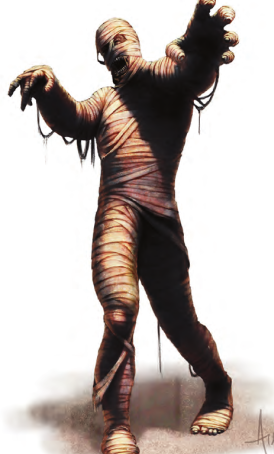
Mummies have been in D&D since its beginnings, when they were part of the rather large Undead Power Ladder. Here they are present in both the Monster Manual and the Vault.
The Lore
Mummies are corpses preserved through elaborate funeral rituals and procedures. While this immediately calls to mind pyramids and sarcophagy, there are several real world cultures that practiced other methods of mummification and that can be used as inspiration here. You could have mummies buried in a bog, or in high-altitude mountain tombs. Whatever the details of the mummification ritual, it can give mummies the power to rise again!
Mummies are creatures of wrath. They rise in response to some transgression, which is usually “thieves broke into my tomb” since most mummies are purposefully created to guard tombs or other sacred places. These guardian mummies are semi-intelligent at best and retain nothing of who they were in life, but they’re very strong, emanate an aura of fear, and can inflict terrible curses on their victims. These can take the form of the classic rotting disease, or something else. Their main disadvantage is that they burn easily, being dry corpses wrapped in flammable material.
Some mummies do retain most of their personality, memories and powers. These were usually already powerful in life: high priests, royalty, or other legends. They’re known as “mummy lords” or “royal mummies”, though of course each such lord should be a named individual. They’re often prepared to rise automatically after the burial ceremony, in order to continue their rule from beyond the gates of death. If that’s not the case, they can still be riled up by the usual tomb invasion, or by some more personal offense specific to the individual they were in life.
The Monster Manual says Yuan-ti often create royal mummies to guard the temples of Zehir, which works as a reminder that humans aren’t the only people to make mummies in D&D and provides a nice bit of nightmare fuel for your players.
The Numbers
Mummies are Natural Humanoids with the Undead keyword, and are usually Medium (with one notable exception). Their common traits vary between books:
Monster Manual mummies are immune to poison and disease, and have both necrotic resistance and a vulnerability to fire, with the exact amounts varying per stat block. They also have Regeneration 10, which can be turned off for a turn with radiant damage, and project an aura of Despair out to 5 squares. This is a fear effect that inflicts a -2 penalty on attacks against the mummy.
Additionally, MM mummies are capable of inflicting Mummy Rot with one of their attacks. This is a disease whose level is the same as that of the mummy (which affects its Endurance DCs). Stage 1 halves the HP you recover from any healing effects. Stage 2 does the same and deals you 10 necrotic damage that can’t be healed until your condition improves. And Stage 3 kills you!
Unlike in some previous editions, it seems Mummy Rot can be cured in the same way as any other disease: through successive Endurance checks, or through the Cure Disease ritual. It’s worth nothing that Cure Disease is a risky proposition here: it requires a Heal check penalized by the disease’s level, with a negative result killing the patient and anything below a net 30 dealing between 25%-100% of their maximum HP in damage. Even though it’s a level 6 ritual, an epic disease still requires an epic healer to cure.
The traits of Monster Vault mummies are a bit weaker. They’re merely resistant to poison instead of immune, and their weakness to fire causes them to take ongoing damage instead of being a standard vulnerability. They lack the continuous fear aura, though some have fear powers. And instead of transmitting mummy rot they have more varied curses whose effects are less lethal and rarely last beyond an encounter.
In both books, all mummies have darkvision. They’re also all Unaligned, which is quite interesting. Perhaps some of those royal mummies aren’t hatching sinister plots at all! Maybe they only wish for the safety of their kingdom, or to redress a genuine wrong committed against it, and the PCs might be able to reason or even ally with them.
Mummy Guardian (MM)
This Medium mummy is a Level 8 Brute with 108 HP and all MM common traits. Its necrotic resistance and fire vulnerability are 5, as is its land speed.
The mummy guardian’s sole attack is a slam that does low-ish necrotic damage and automatically spreads level 8 mummy rot on a hit. Since you’re likely to have more than one mummy guardian in an encounter, it’s a good bet your whole party will end up diseased by the end of the fight unless they’re super-careful.
Shambling Mummy (MV)
Pretty much an update to the Guardian above, this mummy is also a Level 8 Brute and has 104 HP and all common MV traits. It shambles along at Speed 4, and has Resist 10 Necrotic and Poison.
Its basic attack is a rotting grasp that does necrotic damage and prevents the target from regaining HP for a turn. As a minor action it can also inflict a warding curse (Ranged 10), which hits automatically and causes the target to take 5 necrotic damage whenever it attacks. This lasts until the end of the encounter, or until the mummy curses someone else.
The curse is a good way to suppress any high-damage PC, particularly those Twin Strike rangers. The “no healing” rider on the basic attack also makes focusing on a single PC at a time a very rewarding tactic for the mummy.
Moldering Mummy (MV)
This is a Level 10 Minion Brute with all common MV traits. Its speed is 4, and it still has Necrotic and Poison resistances of 10. I believe this means an attack using these damage types would need to do at least 11 damage to kill the minion.
Its basic attack is the Clutch of the Dead (melee 1 vs. Fortitude), which does some damage and grabs the target (escape DC 18). When killed by anything other than fire damage, it can use a Final Curse (ranged 10 vs. Will), which on a hit halves the HP recovery from the next healing surge spent by the target.
Mummy Lord (MM)
“Mummy Lord” is one of those monster templates that can be applied to NPC stat blocks to make them elite, introduced in the DMG. We already saw one of these in the Death Knight entry, and as I discussed there they would eventually be dropped in favor of elite monsters built from scratch along the same lines. Unlike common mummies they’re quite smart and likely to have a story role beyond that of a simple dungeon denizen.
The example mummy lord here in the MM was a Level 13 Human Cleric in life. Now, it’s a Level 13 Elite Controller with 205 HP and all MM mummy traits. Its Necrotic resistance is 10, and its vulnerability to fire remains at 5.
The mummy lord fights with a mace, and its basic attack is Warding Mace, which does damage and gives both the mummy and an adjacent ally +1 AC for a turn.
It also has some encounter powers: Awe Strike (melee 1 vs. Will) does lots of damage and immobilizes (save ends); Plague of Doom (ranged 10 vs. Fortitude) does the same damage and inflicts a -2 to defenses for a turn; and Second Wind recovers 51 HP an gives the mummy a +2 to defenses for a turn, like it would for PCs.
Rounding out the set are a couple of triggered actions: Unholy Aid (recharge 6) is an interrupt that triggers when the mummy is hit by a (save ends) effect, and immediately cancels the effect. And when the mummy dies it utters its curse (Close Burst 10 vs. Will), infecting any it hits with level 13 mummy rot.
This set makes for less sophisticated tactics than I anticipated. The lord will likely spend its encounter powers early and join the melee with Warding Mace, where it will be annoyingly resilient. The mummy’s most dangerous attack is the curse, which only triggers when it dies.
Royal Mummy (MV)
The Monster Vault update is a Level 12 Elite Controller (Leader) with 236 HP - the second wind has been folded into its HP total. It has all the standard MV traits, with resistance 10 to poison and necrotic.
Royal mummies project two auras out to 5 squares: Regal Presence allows it to slide allies that start their turns inside up to 2 squares as a free action; and Curse of Fear inflicts a -2 penalty to enemy attacks. This is the same aura all MM mummies get - out of the MV ones, only the royal gets it.
The royal mummy fights in melee with its Scepter, which is a basic attack. At range it uses the much more interesting Plague Chant (ranged 10 vs. Fortitude) which deals immediate and ongoing necrotic damage (save ends). Whenever a victim takes ongoing necrotic damage from the chant, any other enemies adjacent to it also take that damage.
Grip of Despair (ranged 10 vs. Will) is a focusing of the mummy’s fear aura, dealing psychic damage, immobilizing, and inflicting the -2 attack penalty for a turn. I think this stacks with the aura for a -4 total.
Sow Fear and Pestilence allows the royal mummy to use both Plague Chant and Grip of Despair at the same time! It will likely do this most rounds, unless forced into melee or an opportunity to use its strongest attack comes up.
Once per encounter it can lean even harder into the fear magic by using Grave Terror (Close Burst 3 vs. Will; enemies only) which does a lot of psychic damage and pushes targets 4 squares. A miss still does half damage and pushes two squares.
I love how fear effects are implemented as pushes. Feels a lot better than taking control away from the players by making their PCs waste their actions running away and cowering.
Royal mummies can use an enfeebling curse as a minor action once per round. This ranged 10 attack hits automatically and makes it so the target becomes weakened for a turn whenever it spends a healing surge. This lasts until the mummy curses someone else or until the target takes an extended rest!
That’s a rare long-term effect from a MM stat-block. Particularly cruel mummies will curse a striker with this as the party enters the dungeon and retreat to its depths so they have to delve the whole thing under its effects.
Giant Mummy (MM)
When your party makes it into epic level, they might think they left mummies behind. That’s when they learn giants also know how to make mummies.
Giant mummies are Level 21 Brutes with 240 HP and all MM mummy traits. Like guardian mummies, they’re only Int 6, so they don’t do much more than shamble towards their enemies at a respectable speed of 6 and punch them to death. The funny thing is that if they were hill giants in life, they’re actually smarter as mummies!
Their rotting slams do respectable damage and spread level 21 mummy rot! When they die, they release a cloud of Dust of Blinding Death, so named because of its corrosive nature. This is a Close Burst 2 attack against Fortitude, which does both immediate and ongoing acid damage on a hit. Giant embalming fluids are strong stuff!
Sample Encounters and Final Impressions
We have three sample encounters in the MM:
-
Level 8: 2 mummy guardians, 2 rot scarab swarms, 1 flameskull. Tomb denizens, with the flameskull perhaps being the person actually buried there.
-
Level 15: 1 mummy lord and a bunch of yuan-ti, the honor guard for an important temple of Zehir.
-
Level 21: 3 giant mummies, 1 dark naga. Likely hanging out in a temple complex in Fantasy Vietnam.
I love the idea of a giant mummy. I suppose it’s perfectly possible to also apply the mummy lord template to a giant stat block, preferably one that could cast spells. Pyramid of the Death Giant Pharaoh, anyone?
Speaking of lords, I find the MM cleric version a little underwhelming, since its non-basic attacks are all encounter powers. The MV update is a lot more flexible, with more at-will magic attacks and a strong fear theme.
I’m not ready to discard the Monster Manual mummies entirely, though. They cause mummy rot! That’s classic D&D! Giving that ability to at least some mummies that use the MV stats would help keep PCs on their toes even if the disease is a little easier to get rid of than it used to be.
-
-
Let's Read the 4e Monster Manual/Vault: Minotaur
This is part of a series! Go here to see the other entries.
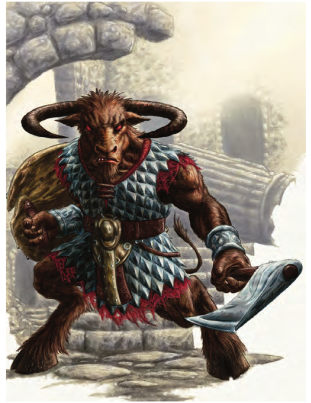
Minotaurs are inspired by Greek mythology, which as usual only had the one (his name is Asterion). They’ve been in the game pretty much since the beginning, and are present both in the Monster Manual and the Vault here.
The Lore
We have an unusual inversion in tone here, as the Monster Manual’s description of minotaurs is a bit more negative than the Vault’s. This is because minotaurs became a PC option in the Player’s Handbook 3!
Both books agree, however, that minotaurs are a divided people. Just as humans have a propensity for corruption, so do minotaurs have a propensity for rage of the sort that makes you froth at the mouth. The demon lord Baphomet has taken advantage of this, and his cult has managed to ensnare a significant percentage of the world’s minotaur population. Its main teaching is “Unleash the Beast Within”, so you can see why that happened.
Still, many other minotaurs reject these demonic teachings and instead attempt to tame their inner beasts, turning their worship to deities such as Erathis, Moradin and Pelor. This makes them a fierce but sophisticated people, who strives to keep friendly relations with their neighbors whether they live in all-minotaur settlements or whether they live in a multi-cultural civilization.
Both good and evil minotaurs love mazes and labyrinths of all kinds. That’s a minotaur thing, not a Baphomet thing. Even a minotaur road built on a flat plain will meander about rather than proceed in a straight line. They like to build their cities in places where the geography is naturally convoluted, such as craggy mountain chains or twisty valleys, and their architecture reinforces the labyrinthine aspects of the terrain. It’s quite easy for outsiders to get lost when visiting a minotaur city or delving a minotaur dungeon.
Minotaur philosophy is similarly maze-like. I bet they love koans. The good ones use convoluted meditations to help keep themselves peaceful, and the evil ones think in those terms when devising tortures for their victims.
Most demon-worshipping minotaurs gather in cults, and build their own settlements with temples to Baphomet right there in the open. Some of them forsake every part of themselves that isn’t the Beast, and go off to live as savage hermits at the bottom of some dungeon, growing larger and bloated with the blessings of Baphomet.
The Numbers
Minotaurs are usually Medium Natural Humanoids, though like dragonborn or goliaths they’re on the larger side of Medium. Baphomet worshippers are Chaotic Evil, but the others can be of any alignment.
Minotaurs from the Monster Manual have two signature traits: a Goring Charge attack that does physical damage and knocks prone on a hit, and the Ferocity trait that lets them make one last basic attack as a free action when they drop to 0 HP.
Monster Vault minotaurs lack the Ferocity trait (which was actually moved to orcs there). They still all have a Goring something, but the exact ability varies with the stat block. It’s usually a triggered ability, though.
We’ll look at the entries from both books in order of level.
Minotaur Soldier (MV)
This is a Level 8 Soldier with 89 HP, likely meant to represent the rank and file of a minotaur fighting force. It wields a large shield and a battleaxe, and probably wears heavy armor despite this not being shown in the stat block.
The Batleaxe basic attack also allows the minotaur to make a Shield Bash on a hit. Shield bashes target Fortitude, do a tiny bit of damage, and knock prone. They can also be done as minor actions once per round, so a minotaur who hits all of its attacks will perform one axe strike and 2 shield bashes per turn.
As an interrupt when someone adjacent to it shifts, the soldier can perform a Goring Toss (melee 1 vs. Reflex), which does damage, immobilizes the target for a turn and allows the minotaur to slide it 2 squares to an adjacent square. This makes it quite sticky!
Minotaur Charger (MV)
This Level 9 Skirmisher has 94 HP and is more focused on offense than the soldier.
As the name implies, it will try to Always Be Charging, using a falchion to attack. Its Deft Charge trait makes it immune to opportunity attacks while doing so! So once it reaches the group it will bounce around like a pointy pinball of death. If for some reason the minotaur can’t charge at an enemy, it will throw handaxes at it.
When damaged by an adjacent enemy, the charger can use a Goring Rush (melee 1 vs. Fortitude), which does a bit of damage and allows the charge to push the target 4 squares and shift to follow it, 1 square at a time. So when you think you finally have it surrounded, it will just carry the rogue away on its horns and charge you again next turn.
Minotaur Magus (MV)
This Level 9 Controller (Leader) is a priest of Baphomet. It has 96 HP and wields a glaive in combat.
Just by being present, the magus can compel its fellow cultists to Unleash the Beast Within, which works as an aura 3 that gives allies inside a +2 attack bonus on charges.
In addition to doing damage, the reach 2 glaive also slides targets 2 squares on a hit, 1 on a miss. This makes the magus a good second-ranker in combat, though its real power is delivered at range.
Crimson Bolt (ranged 20 vs. Reflex; recharge 5-6) does immediate lightning damage plus ongoing fire damage while also preventing the target from shifting (save ends both). A nice thing to use on those pesky mobile strikers just before they get charged by a soldier or charger.
Even funnier is Baphomet’s Rage (ranged 10 vs. Will), an at-will spell that does sub-par psychic damage but also forces the target to charge a character of the magus’ choice on a hit. You can use this on the fighter to get them to charge the wizard and take an opportunity attack or two from your own front line while doing so!
Minotaur Warrior (MM)
This level 10 soldier has 106 HP and is the MM’s take on the basic minotaur infantry. Its battleaxe attacks mark for a turn, and it has the standard MM minotaur abilities.
The Minotaur Soldier is generally more interesting, and you can easily level it up to 10 if you need.
Demonic Savage Minotaur (MV)
This is minotaur is Large, and a Level 11 Brute with 140 HP. It’s longer legs give it Speed 8.
Having embraced its inner beast completely, this monster fights with its claws. It can make two claw attacks per standard action, with a hit doing physical damage and grabbing the target. It can grab up to two victims.
As a standard action it can also Impale a grabbed victim on its horns (melee 1 vs. Fortitude). A hit does a whole bunch of damage and ends the grab, dropping the victim prone at the minotaur’s feet.
If an enemy up to 10 squares away damages the minotaur with a ranged or area attack, it can execute a Goring Assault, charging that enemy as a free action.
Minotaur Cabalist (MM)
This Level 13 Controller is the Monster Manual’s take on a Baphomet-flavored spellcaster. It has 129 HP, and is somewhat similar to the magus above.
The cabalist’s charge-bonus aura (Baphomet’s Boon) extends out to 10 squares, which means its allies will get the bonus every time on most maps. It fights in melee with a great cursed mace that does a mix of physical and necrotic damage.
At range, it can attack with Horns of Force (ranged 5 vs. AC), which do a bit of force damage and push 2 squares. It can also target its bloodied allies with Call out the Beast (Ranged 10), allowing them to make a charge as a free action.
Goring Charge and Ferocity round out its abilities.
I think the magus wins out again, though the cabalist is functional enough as a basic controller when you fix its damage.
Savage Minotaur (MM)
This is another Large minotaur, a level 16 Brute with 190 HP. Not quite as savage as its MV counterpart, it fights with a Reach 2 greataxe that is a High Crit weapon and pushes the target 1 square on a hit.
When it charges, it can choose between the standard Goring Charge and Thrashing Horns, which slide the target 2 squares instead of knocking it prone.
A bit less terrifying than the Demonic Savage Minotaur, but effective at pushing people around.
Sample Encounters and Final Impressions
The Monster Manual obviously focuses on the evil minotaurs when building encounters. We have two:
-
Level 13: 1 cabalist, 3 warriors, 2 vrock demons.
-
Level 18: 2 savage minotaurs, 1 rakshasa noble, 3 rakshasa assassins. Here the minotaurs are probably kept around as pets by the rakshasas.
I like it that the books themselves acknowledge there are good (or at least unaligned) minotaurs that you can talk to instead of fighting. As a playable option, good minotaurs are another option for people who want to be Big Honorable Warriors struggling with a dark side.
Mechanically, the MV versions are usually more interesting despite being lower level. That last part is easily adjustable, if you need them to be more powerful.
-
-
Let's Read the 4e Monster Manual/Vault: Mind Flayer
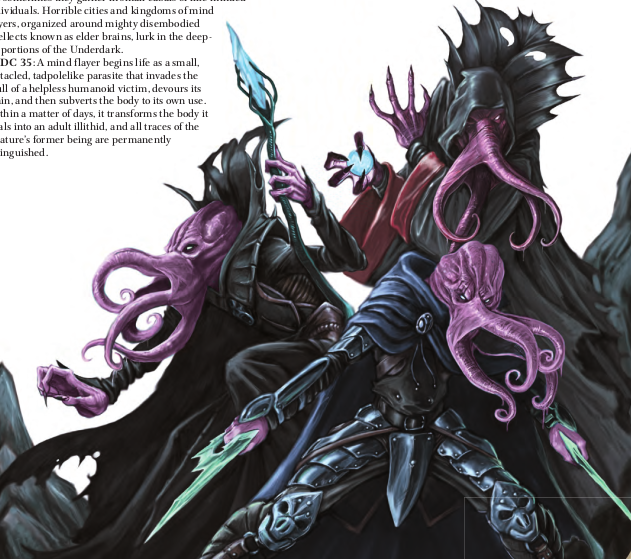
Illustration Copyright 2008 Wizards of the Coast. This is part of a series! Go here to see the other entries.
Mind flayers are one of those monsters that are so iconic to D&D they’re not covered by the D20 license. They’ve been in the game since AD&D 1st Edition, and are present in both the Monster Manual and the Monster Vault.
The Lore
Mind flayers, or illithids, are tentacle-faced humanoids who possess incredible psychic powers and use them to feed on sapient brains. They came from the Far Realm long ago. Before they arrived in the world, they had a great dimension-spanning empire whose experiments were responsible for the creation of the Gith peoples as we know them today. That empire was torn down when their slaves rebelled, and the illithids of today descend from its survivors.
Some versions of mind flayer lore assert that they come from a distant future, having travelled back in time to ensure their empire rises and to prevent its fall. A necessary step in this plan would be to turn the world into another region of the Far Realm.
Your typical mind flayer is a solitary, megalomaniacal villain bent on total world domination, who surrounds itself with large numbers of thralls to act as its hands and eyes to enact is elaborate plans on whatever society they’re targetting. That doesn’t mean the illithid is a coward! Should it see the need to get into a fight personally, it will do so without hesitation. There’s no limit to the number of thralls a single illithid may control - the process of creating them involves brain surgery, not active psychic domination. So those organizations may be quite large, and composed of a mix of thralls and willing (or ignorant) collaborators.
Sometimes, several mind flayers with similar goals will work together, though you probably can’t call their relationship “friendly”. In the deep Underdark you can find large illithid cities occupying huge caverns, where many of these beings gather and surround themselves with veritable armies of thralls. These cities are ruled by Elder Brains, huge masses of illithid neural tissue that live inside briny vats.
Mind flayers start their lives as tiny tentacled tadpoles, who upon reaching a certain level of maturity break into some poor sapient’s skull, devour its brain, and take over their bodies to mutate them into their adult form. In illithid cities, these tadpoles live in the Elder Brain brine pool until someone gives them a body.
Some versions of mind flayer lore mention that illithids who die in these cities have their minds assimilated by the Elder Brain. They consider this to be the perfect afterlife, believing their conscience lives on inside the Brain as part of a collective. The truth is that while the process does make the Elder Brain more powerful, it erases the conscience of the individuals joined to it.
5e tied all illithids a lot more closely to the Elder Brains, making them practically into a hive mind, but this isn’t true here. Individual, independent illithids are exactly that. They don’t need exceptional reasons to reject life in an Underdark city - maybe their plans for world domination are just incompatible (“I’m going to be the boss, not you”). This means that it’s perfectly possible to fight mind flayers in the surface without this being necessarily tied to some Underdark conspiracy.
The Numbers
The Monster Manual gives us 2 mind flayer stat blocks, and the Vault gives us 3. All are Medium Aberrant Humanoids with Darkvision and a land speed of 7. Every mind flayer can use a mind blast, grapple with its face tentacles, and do creepy things to people’s brains, though the exact effects vary.
All Mind Flayers understand Deep Speech, and can communicate via telepathy regardless of language barriers.
Mind Flayer Infiltrator (MM)
This is a Level 14 Lurker with 107 HP and trained Perception, as well as a host of other thiefy skills.
It it has to fight, the infiltrator will probably open up with its Mind Blast (Close Blast 5 vs. Will; recharge 6), which does psychic damage and dazes on a hit (save ends). Mind flayers and thralls are immune to this power, and the infiltrator itself is invisible to any dazed or stunned enemies (Stalk the Senseless).
It will then attack the squishiest target with its tentacles, which grab the target on a hit. After grabbing a victim, it will proceed with Bore Into Brain (Melee 1 vs. Fortitude), something which it can also use against stunned targets without grabbing them first. This does more damage than the basic attack, and if it happens to reduce the target’s HP to 0, the illithid eats its brain and kills it instantly. No death saves for you!
As lurkers, they probably give preference to targets made vulnerable by the Mind blast, and rely on their buddies and thralls to handle anyone who wasn’t affected. MM grab rules use either the Fort or Reflex as escape DCs, so you’re looking at a DC of 25 or 27 to get away from the infiltrator before it begins eating your brain.
Mind Flayer Thrall Master (MV)
This one is a Level 14 Elite Controller (Leader) with 260 HP. Its trained skills are Arcana and Insight, so it’s more of a scholar than a hands-on type.
That doesn’t mean its defenseless! The thrall master fights in a way that’s somewhat similar to the MM’s Infiltrator, but with stronger psychic powers. Its Mind Blast (Close Blast 5 vs. Will; Recharge 5-6) works similarly but on a critical hit it dominates instead of dazing (save ends).
The tentacles still grab on a hit, but they also hit dazed or stunned targets automatically. The escape DC is 21, and while the thrall master can only grab one person at a time, it can explicitly keep whipping other fools with its tentacles after that.
Against the grabbed victim, the mind flayer can use Manipulate Brain (vs. Fortitude), which does a big chunk of physical damage and stuns the target until it’s no longer grabbed! If this reduces the victim to 0 HP, the thrall master has two choices: it can either devour the brain, killing the victim and regaining 20 HP, or it can perform a field-expedient thrall surgery. This restores the victim to 1 HP and dominates it until the thrall master is slain.
Since the dominated condition also leaves the victim dazed, this results in a 1-HP, zombie-like thrall, whose main defence is the fact that its companions might not want to make it roll death saves. I imagine the illithid can do further work out of combat to make these thralls act more normally.
Mind Flayer Mastermind (MM)
This is essentially a more powerful variant of the Monster Vault’s Thrall Master. It’s a Level 18 Elite Controller with 324 HP and training in Perception, Arcana, Insight, Bluff and Intimidate.
It can use its tentacles, Mind Blast and Bore Into Brain abilities in much the same way the thrall master can. Aside from the damage bug, the main difference here is that thrall surgery restores the victim to half its maximum HP, not just 1.
The mastermind can directly Enslave a creature (Ranged 10 vs. Will), an attack which does no damage but dominates (save ends). Dominated creatures become immune to the flayer’s mind blast and gain a +5 bonus to Will while within 10 squares of it. The victims it makes into thralls also gain this benefit, by the way. Only one creature can be enslaved at a time, but as usual it can have as many thralls as it can make.
The mastermind can also plant an Illusion of Pain in its victims (Area Burst 1 within 10 vs. Will; Enemies only; recharge 5-6) which does both immediate and ongoing psychic damage and immobilizes (save ends).
When attacked, it can use Craddle of the Elder Brain (recharge 5-6) as an interrupt, teleporting up to 20 squares. If it’s targeted by a melee attack, it can instead Interpose Thrall, an interrupt which redirects the attack to a nearby thrall. That’s definitely going to be its preferred option if it has thralls nearby, with the teleport working as a tool of escape.
Mind Flayer Unseen (MV)
A more powerful version of the Infiltrator, this one is a Level 18 Lurker with 126 HP. It’s almost identical aside from the fixed damage, which makes its Extract Brain attack truly frightening.
Instead of being invisible to dazed characters, the Unseen has a Mental Cloak power which, as a move action, allows it to teleport its speed and become invisible for a turn. It recharges whenever the Unseen is hit by an attack.
Concordant Mind Flayer (MV)
This Level 19 Controller (Leader) also works more or less like the Thrall Master. It has 174 HP.
Its attacks are the usual trifecta of Mind Blast, tentacles and brain manipulation, which in this case is named Enthrall Brain and only gives the option of turning victims reduced to 0 HP into thralls. Like the Thrall Master, its mind blast dominates on a critial hit.
The Concordant Mind Flayer’s exclusive trick is Shared Pain, a reaction that triggers when an ally within 5 squares takes damage from an attack. The illithid can make one of its dominated victims in a Close Burst 5 take 20 psychic damage which bypasses all of its resistances. This is sure to kill someone that’s been made into a thrall during the fight, since they’ll only have 1 HP. It doesn’t prevent damage to the ally - it’s more of a hostage situation. “Attack my friends and your friends will suffer!”
Sample Encounters and Final Impressions
Mind flayers typically consider themselves superior to everyone else. Anyone found working with them is probably a thrall or underling. I’d consider thralls created outside of combat to be able to act normally instead of being considered dazed.
It’s possible for there to be a more congenial illithid that lives openly as a scholar and gentlesquid in a community ruled by another species. The most likely scenario in this case is that it lives and works alongside drow or duergar - congenial doesn’t mean good.
This gives us the two sample encounters from the MM:
-
Level 14: 1 mind flayer infiltrator, 1 drider fanglord, 1 drow blademaster, 2 drow warriors. Here’s our gentlesquid.
-
Level 18: 1 mind flayer mastermind, 1 mind flayer infiltrator, 3 grimlock followers, 2 war trolls. And here’s a pair of more traditional illithids and their thralls.
Mind flayers are such an iconic monster that even WoTC thinks it’s not D&D if they’re not in the books. And they do make excellent villains! You could have a single individual be the ultimate villain in even a mid-Heroic tier adventure by statting it up as a level 8 solo or the like.
Unlike what happens with the more naturalistic humanoids, this is one of the rare instances where I’m fine with the books portraying them as almost universally Evil. Good mind-flayers should be once-in-a-campaign events at most.
-
subscribe via RSS