Posts
-
Let's Read the Monster Manual/Vault: Ooze
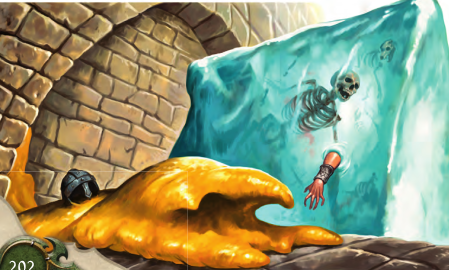
Copyright 2008 Wizards of the Coast This is part of a series! Go here to see the other entries.
Jellies, slimes, molds, puddings. Collectively known as “oozes”, these are likely the most iconic D&D monsters not exempted from the OGL. Talk about dragons all you want, but I’ll bet you far more adventuring parties have faced (and died to) some kind of ooze than they did dragons. They’ve been in the game since the beginning, and their variety has only increased as time went on. Here they’re present in both books.
The Lore
Talking about “oozes” is like talking about “animals”. There’s so many types that you can’t really describe them as a whole in anything but the most general terms. They’re goopy, they’re mindless, they like damp and/or dark places, and they eat just about any type of organic matter by dissolving it with their acidic secretions.
As far as the inhabitants of 4e’s implied setting are concerned, oozes are just a fact of life, like animals or plants. They’re natural creatures that have been around forever and everyone knows they exist. Learning how to keep your basement or root cellar ooze-free is probably a basic life skill.
The most sensible advice for any regular person who spots an ooze is to turn around and leave. This is complicated by the fact that sometimes these creatures wait in ambush. Also, adventurers are neither regular nor sensible, and they like to delve into exactly the sort of place oozes thrive in, so they end up running into these creatures much more often than civilians.
Oozes are drawn to heat and movement, so they often try to eat living creatures, but they don’t have a preference for them over any other organic matter and can subsist on dungeon crud just as well. Finding an unusually clean room or corridor is a sure sign that you’re approaching an ooze lair.
In addition to the no doubt large variety of natural species, these things are also quite likely to form as the result of botched magical experiments, or to spontaneously form in piles of magical waste. They’re even easy to summon, so your PCs might end up fighting them when they go up against the sort of wizard who’s into that.
The Numbers
Oozes are Natural Beasts of varying size, with the Blind and Ooze keywords. They always have some sort of blindsight or tremorsense they use to perceive their surroundings.
The Monster Vault adds an Ooze trait that all of its versions have, which allows them to ignore all penalties for squeezing. Normally, while a character squeezes past an opening smaller than themselves, they move at half speed, grant combat advantage, and attack at a -5 penalty. Oozes ignore all of that. I think the Ooze keyword implies the same rules for the MM oozes, it’s just less explicit.
Ochre Jelly (Both)
This Large ooze is a Level 3 Elite Brute with 102 HP and 5 acid resistance. It crawls at speed 4, and the MV also gives it a climb speed of 4.
Both versions attack with pseudopod Slams that do physical damage and ongoing acid damage (save ends). As a move action they can use Flowing Form to shift their speed, which means they pretty much never make normal moves. I think their Ooze trait also means they can squeeze between adventurers if the party surrounds them but leaves a small gap.
When first bloodied, an ochre jelly Splits into two jellies with half the original’s HP. So a jelly that hits exactly 51 HP would split into 25 and 26 HP halves. Both of these individuals act independently, and the new one doesn’t have any of the conditions that applied to the original.
If the fight ends with the two jellies alive (e.g., if the PCs ran away or died), they eventually recombine.
A pair of ochre jellies makes a nice mini-boss fight for level 1 adventurers! And you could easily make higher level versions that start out Huge and split more often to challenge more powerful parties.
Green Slime (MV)
Green Slimes split the difference between a monster and a hazard, with different editions treating them in different ways. Here, they’re monsters.
These green, runny slimes are Medium Level 4 Lurkers with 47 HP. They have 5 acid resistance and 5 vulnerability to both fire and radiant damage. Their basic slams target Reflex and do 5 immediate and 5 ongoing acid damage (save ends), which is notable because it’s a flat amount and not a damage roll.
They also have a special Engulf attack that also targets Reflex, does a bit of immediate acid damage, and initiates a grab with escape DC 18. This is the 4e version of the classic “a green slime drops on you from the ceiling” attack, so it will likely be made with combat advantage due to surprise. Until the target escapes the grab, they take 10 ongoing acid damage (a lot at heroic tier), and any attacks against the slime deal half damage to the monster and half to the victim.
This is not quite as bad as the “you’re dead in 1d4 rounds” of the old-school version, but if an unlucky level 1 adventurer runs into one of these the result will be pretty much the same.
Gelatinous Cube (Both)
Ridiculous, or ridiculously awesome? These Large translucent oozes are shaped like 10-foot cubes, fitting precisely in any Gygax-standard dungeon corridor. They’re Level 5 Elite Brutes with 156 HP, who crawl along at a ground or climb speed of 3.
In addition to the Ooze trait, they are Translucent, which makes them invisible until they’re spotted (a DC 25 Perception check!) or until they attack. I think it’s still true that they can’t digest metal or bone, so even if you fail to spot the cube you might still see a floating pile of coins, a skeleton, or a suit of armor. That’s not exactly a disadvantage: watch as the impetuous barbarian or paladin charges the foul “construct” or “undead” and walks right into the cube!
If you fail to spot the cube and walk (or charge!) into it, you’re automatically hit by its Engulf attack and sucked into its corrosive and anesthetic insides. This is a grab, and a grabbed victim is dazed and takes 10 ongoing acid damage until they escape (DC 15 in the MV, 16-18 in the MM).
Gelatinous cubes can also be more proactive in chasing their meals! Once the fight is joined, it will attack with Slams (Melee 1 vs. Fortitude) that deal acid damage and immobilize (save ends), and make active Engulf attempts (Melee 1 vs. Reflex).
Gelatinous cubes are still exactly as much fun as they were in older editions. Aside from the corridor, “pile of treasure” or “skeleton” setups, you can also put them at the bottom of pit traps and the like.
Black Pudding (MV)
The top of the food chain when it comes to classic oozes. This is a Large, Level 8 Elite Brute with 218 HP and 15 acid resistance. Their ground speed is 4, their climb speed 3.
Black puddings are super-aggressive. The pudding’s Slams do quite a bit of acid damage, and the thing can shift up to its speed before or after the attack. They’re more like lunges than slams.
The pudding can also engulf (close blast 3 vs. Fortitude), which does the same damage as a slam to everyone in the area and grabs them (DC 16). The pudding can them use a standard action to melt one of its grabbed victims, dealing a nice chunk of automatic acid damage and eating a healing surge. If the victim has no healing surges left, they take 10 extra acid damage instead.
Defense-wise, black puddings are less of a puzzle monster than they used to be, but they still retain some of that in their Split trait. When they’re hit by a weapon attack, a piece of them splits off and becomes a Black Pudding Spawn in an adjacent square.
Spawn are Medium Level 8 Minion Brutes whose slams have the same “shift your speed” rider as their parent’s and do minion-level acid damage. There is no limit to how many spawns may be in play at any given time, so the party is going to be in for a nasty surprise if they have a Twin Strike ranger or are all-martial.
Sample Encounters and Final Impressions
Being dumber than even mundane insects, oozes don’t “ally” with anyone. Still, some creatures might keep them in a convenient corner of their lair to deter intruders, or they might join an ongoing fight as opportunistic predators. And of course, as the lore text said you can have a wizard with Pokemon trainer aspirations summon oozes and direct them through magic.
The sample encounter covers the first case: level 3, 1 ochre jelly and 3 orc raiders.
This is another instance where you lose nothing by ignoring the Monster Manual entries and going all in on the Vault’s versions. They have almost the full set of classic oozes, and despite the many attempts by 3e to prove otherwise, they’re enough for the vast majority of campaigns. It’s not D&D if it doesn’t have some icky goo in it somewhere.
-
Let's Read the 4e Moster Manual/Vault: Oni
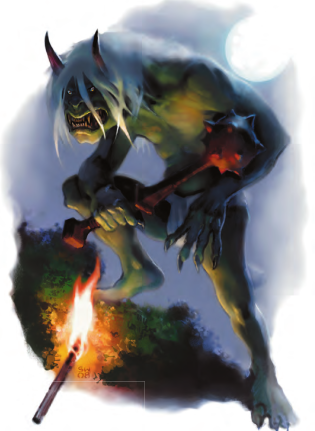
Copyright 2008 Wizards of the Coast This is part of a series! Go here to see the other entries.
Oni are inspired by Japanese mythology and have been in the game since the beginning. However I believe this is the first time in official D&D history in which they’ve been called by this name. Before, they were known as “ogre mages”. Here, they are only in the Monster Manual.
The Lore
If I recall correctly, the name “oni” translates roughly into “ogre”! The portrayal of oni in Japanese mythology varies depending on which story you’re hearing. Some are just big dumb brutes best represented by the standard ogres we just looked at. Others are still big, but they’re also smart and capable of sinister sorceries. This is the type represented by this entry.
4th Edition oni look a lot like their mythological counterparts, and a bit like ogres, though the two species are not related. Despite their great size and strength, oni are clever and prefer subtle tactics to advance their own goals and hurt their enemies. Most of them know how to assume illusory disguises and turn themselves to mist, in addition to a repertoire of other spells and rituals that match their preferred tactics.
The typical oni sees itself as a mighty lord deserving of respect, and is quite vengeful to anyone whom it sees as not giving it that respect. Oni measure their status by the wealth they’ve accumulated, along with the number and quality of the slaves they own. They build hidden strongholds to live in and surround themselves with all manner of luxury, and go out to enact their plans and/or inflicting suffering on the surrounding population.
The Numbers
Oni are Large Natural Humanoids, proving that “Natural” doesn’t mean “Mundane”. They have darkvision, a ground speed of 8, and a flight speed of 8 (clumsy).
They also have a couple of signature powers: Deceptive Veil allows them to take the form of any Large or Medium humanoid. Piercing the disguise is an opposed Insight vs. Bluff roll, and Oni tend to be good at Bluff. Gaseous Form allows them to become insubstantial mist with a flight speed of 8 (hover), but since it requires standard actions to sustain they can’t do anything but move around while in this form. It’s useful for escaping, or for sneaking up to the PCs prior to the fight starting.
Oni Night Haunter
This is a Level 8 Elite Controller with 180 HP, and it’s ironically a bit of an exception to the typical oni portraited in the lore section. Night Haunters live in small huts or caves, disguising themselves as elderly hermits. At night, they fly out to sneak into villages and towns and devour sleeping victims.
They don’t just eat the flesh of those victims either! When faced with an unconscious victim, the night haunter can use Devour Soul (melee 1 vs. Will)! A hit deals psychic damage, heals the oni for 10 HP, and doesn’t wake the victim up.
If its enemies are awake, it can try to put them to sleep with its Hypnotic Breath (close blast 5 vs. Will; recharges when first bloodied). This does no damage, but dazes on a hit (save ends). After the first failed save this worsens to unconsciousness, and then it’s Devour Soul time.
If its enemies stubbornly refuse to sleep, then the oni has to resort to its Reach 2 Morningstar and bash their heads in. When it looks like it will lose the fight, it likely uses Gaseous Form to escape.
Oni Mage
According to the book, these are often and mistakenly called “ogre mages” by ignorant mortals, which means they’re the classic model.
Oni mages are Level 10 Elite Lurkers with 172 HP. They wear mail, so their ground speed is only 7, but their flight speed remains the same.
In addition to Deceptive Veil, oni mages can become invisible at-will as a standard action, which lasts until they attack. They deal extra “sneak attack” damage on melee attacks when they have combat advantage.
Before engaging in melee, though, they’ll likely fire off a few attack spells: Freezing Blast (close blast 5 vs Fortitude; recharge 6) does cold damage and slows (save ends); and Lightning Storm (area 2 within 10 vs. Reflex; recharge 5-6) does lightning damage with no riders.
When they finally engage in melee, they’ll use finely crafted Greatswords for those sneak attacks while they wait for their spells to recharge.
Sample Encounters and Final Impressions
The sample encounters each feature one oni and a variety of other angry humanoids like ogres, orcs and trolls, which illustrate well who it is that the oni usually enslave. Depending on the individual in question, they might do it through overt conquest, or by disguising themselves as an ogre or orc and taking over the tribe that way. As accomplished mages, oni might also be surrounded by summoned creatures or other more exotic monsters.
I like oni! They work well as fairytale horrors despite their Natural origin, and are smart enough to be used in situations where the party is forced to negotiate with them. They’re one more type of monster that might be in possession of a secret or ritual the PCs need to avert a worse evil.
Mechanically, they do need an update. Like all mid- or high- level MM elites, they need a damage boost and something equivalent to the ability to make two basic melee attacks per action. I’d also increase the mage’s sneak attack damage to something more than a piddly 1d6, and probably make it apply to the spells as well.
-
Let's Read the 4e Monster Manual/Vault: Ogre
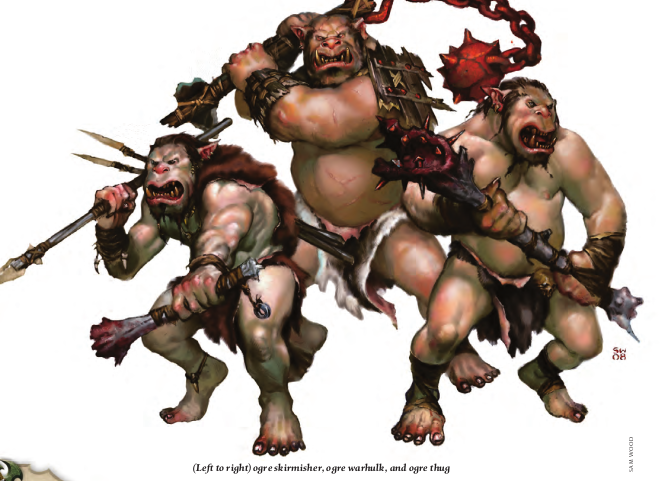
Copyright 2008 Wizards of the Coast This is part of a series! Go here to see the other entries.
Ogres have been a part of D&D since its beginnings, when they were the bridge between the Humanoid and Giant power ladders. Here, they are present in both books.
The Lore
Ogres are big, dumb, strong, and mean. So much so that there’s probably the picture of an ogre near all of these words in your typical Nerathian dictionary. They famously can’t count to ten even with all their fingers in front of them, and their greatest technological achievement is wearing the skin of their last meal as a loincloth so they can appear in official D&D illustrations.
Ogres live alone or in small nomadic bands. In both cases they settle into a region, eat all available food, and move on. They don’t build complicated shelters, instead using natural ones like caves and such. Ogres will hunt and forage if they have to, but they always prefer to raid caravans or villages if those are nearby. In combat, they use improvised weapons that allow them to employ their great strength, such as tree clubs and big rocks.
You might be thinking this sounds a bit similar to the description for hill giants that we already covered, and you’d be right. The main differences between them is that hill giants are bigger, smarter, less bestial-looking and more technologically developed, in a neolithic vs. paleolithic way. Hill giants have some agriculture and built villages/steadings of their own. It also feels like it’s easier to parley with hill giants than with ogres.
Despite their strength, ogres are easily recruited into service by monsters who are more powerful or more numerous than them. This usually happens through a combination of intimidation and food bribes. Ogres can be found working as shock troops for orc or gnoll bands, or as auxiliaries and menial labor for hags, dragons, and giants. Some of these patrons provide their ogre lackeys with combat training and improved weapons, making them more dangerous. Smarter ogres willingly seek out the mercenary life, working for money and arranging that improved gear and training by their own initiative.
The Numbers
The traditional role of ogres in older editions of D&D is as the star of a “not-quite-boss” fight. Something that’s really hard for beginning adventurers to face, but which they can defeat once they gain some XP and their players become a bit savvier. Maybe you put them near the stairs to the second dungeon level, or guarding some prime loot in a corner of the goblin lair or kobold warren. When fighting ogres became easy for a group, they knew they had made it out of the junior leagues. With some thought given to encounter design, it’s still possible to have ogres in these roles.
Ogres are Large Natural Humanoids. The Monster Vault also gives them the Giant keyword, in which is surely a callback to early D&D. They move at Speed 8, and seem to not be very compatible with magic of any kind: all the ogre varieties in both books fight exclusively with physical attacks.
There’s quite a few varieties. The MM clusters them around the late heroic and early paragon tier, the MV widens that band a little. I’ll look at them roughly on the order of level, but pairing equivalent monsters from both books where appropriate. When an ogre has equivalent versions in both books, the Monster Vault version is usually the better one, so it gets more attention.
All ogres presented here are Chaotic Evil and speak only Giant, though the MM says they might know a few words of Common such as “mine!”, “hungry!” and “kill!”.
Ogre (MV)
Ogres are the quintessential brutes, and this is the quintessential ogre. A Level 6 Brute with 90 HP and Int 4, it wields a Reach 2 greatclub in melee and throws big rocks at up to range 10.
Once per encounter the ogre can perform a Grand Slam, which does double the damage of a normal club attack and
yeetspushes the target 2 squares on a hit.A pair of these might fulfill the classic ogre role of “not-quite-boss fight” for a level 1 or 2 party. Their ranged attacks make them more dangerous than old D&D ogres, though, since the party can’t just snipe at them with impunity.
Ogre Savage (MM)
This is Monster Manual’s take on old D&D ogre. This one is a Level 8 Brute with 111 HP and the same greatclub as its MV successor. However it has no ranged attacks, and its special melee attack is an Angry Smash (recharge 6) that allows it to make two attack rolls and take the best result.
Despite being 2 levels stronger than the Vault ogre, the vagaries of the early math make this one have the same attack bonus and damage. The only difference in their basic stats are the 21 extra HP and defenses 1 point higher. You can still have that not-quite-boss fight using the Ogre Savage as written, only you might want to use one of them backed up by a troupe of weaker minions. Their lack of ranged attacks might mitigate their extra power depending on your party composition.
Ogre Hunter (MV)
This one is a little more sophisticated, though that’s not saying much since it still has Int 4. It’s a Level 7 Skirmisher with 84 HP.
The ogre hunter uses a one-handed Reach 2 club as its main melee weapon, and carries a brace of stone-tipped javelins for fighting at range (Ranged 20). It’s Hurling Charge technique (recharge 4-6) allows it to throw a javelin and make a charge if that hits.
If surrounded, the hunter can Clear the Ground by stomping really hard (Close Burst 2 vs. Fortitude; Minor Action), which pushes everyone it hits 2 squares. If anyone is hit by this attack, the ogre can move its speed. Who would have thought the words “agile” and “highly mobile” would ever apply to an ogre?
Ogre Skirmisher (MM)
Aside from being level 8 with 91 HP, this is pretty much the same monster as the Ogre Hunter above. Its damage is lower due to the math bug, Hurling Charge is an encounter power that always allows two attacks, and it lacks Clear the Ground. It also has a Skirmish trait that gives it a damage bonus on any turn where it moves more than 4 squares. I think it’s safe to say it has been entirely superseded by the MV Hunter.
Ogre Mercenary (MV)
One of those smarter ogres who works for gold. This one is a Level 8 Soldier with 93 HP and an Int of 7. It fights in melee with a Reach 2 morningstar that marks for a turn on a hit, and throws Range 10 handaxes to fight from afar.
Instead of focusing on a single target with the morningstar, the Mercenary can use a Brutal Sweep to attack everyone in a Close Blast 2, dealing a bit less damage but knocking prone on a hit. This is an at-will attack! Alternating both attacks makes the mercenary quite good at keeping the party busy.
Ogre Warhulk (MM)
A level 11 Elite Brute with 286 HP, the Warhulk is otherwise equivalent to the Mercenary above. Its flail basic attack knocks prone instead of marking, and the Brutal Sweep equivalent is an encounter power that otherwise works the same.
This results in a lackluster elite, since it only has one attack per round. If you need an elite ogre, use an upgraded version of the Mercenary above.
Ogre Juggernaut (MV)
This is a Level 10 Brute with 131 HP, representing a larger and stronger ogre than the basic level 6 version. It’s still Large as far as the rules are concerned, though.
Ogre juggernauts have the same attacks as their smaller cousins, a greatclub and rocks, which do more damage due to their higher level. Their signature move is the Juggernaut Push (Melee 1 vs. Fortitude; recharge 5-6). If this hits, the juggernaut knocks the target prone, pushes them 1 square, and shifts to occupy the vacated square. They can then keep repeating the push-and-shift loop until they have shifted their whole speed! They can stop early if that’s not practical, but for every square they push the target beyond the first they do 1d8 damage do it!
7d8 damage is in line with a level 10 “limited use attack”, but it looks extra impressive because that’s a lot of dice and your PC just got kicked all over the battlefield like a soccer ball.
Ogre Minions (MM)
When fighting an ogre becomes easy, you’ve left the junior leagues. When you routinely face hordes of them, you’ve joined the major ones. Ogre minions come in two varieties: level 11 Ogre Thugs and level 16 Ogre Bludgeoneers. Both use their considerable bulk to pad out the forces of onis, hags, and other powerful paragon-tier bosses. Aside from the level difference, they’re identical.
I’m tempted to make “Bludgeoneers” an official unit name for a bunch of ogre minions. Like Mouseketeers, but with more violence.
Arena-Trained Ogre (MV)
If you take a typical ogre and train them for a few years at the blood-sport arenas of the Black Eagle Barony, this is what you get.
These ogres are Level 14 Brutes with 173 HP and an Int score of 8. They wield greataxes in combat, and aside from their beefy basic attack they can often make Vorpal Sweeps (Close Burst 2; enemies only; recharge 6) that do a bit less damage to each target and deal ongoing 10 damage (save ends).
Simple, but effective. And while this isn’t stated in their stat blocks, those 4 extra points of Int mean this ogre is much more capable of understanding tactics and effectively coordinating with its teammates.
Sample Encounters and Final Impressions
The sample encounters in the Monster Manual are rather typical:
-
Level 8: 1 ogre savage, 1 orc eye of Gruumsh, 8 orc warriors, 2 dire boars. An ogre working as a heavy for an orc party.
-
Level 10: 1 ogre warhulk, 2 ogre savages, 2 ogre skirmishers. And this is a typical “small ogre band”.
Ogres are one of those monsters which I have a hard time finding sympathetic. They’re the embodiment of a particular type of crass cruelty and they fill that role well, even better than hill giants IMO.
Nevertheless, if your main cultural reference for ogres is Shrek then it’s perfectly possible to make them more sympathetic along those lines. While I like the default presentation I wouldn’t mind seeing them in that light either. Just keep those Pathfinder ogres away from my game.
Mechanically the Monster Vault stat blocks are better and you should use them if possible. If you can’t, updating the damage of the MM ogres and giving the Warhulk a second attack (or making it a regular instead of an elite) should make them workable enough. Ogre stat blocks can also be used to represent younger or weaker hill giants, like they were in the classic Against the Giants adventures.
-
-
Let's Read the 4e Monster Manual/Vault: Nightwalker
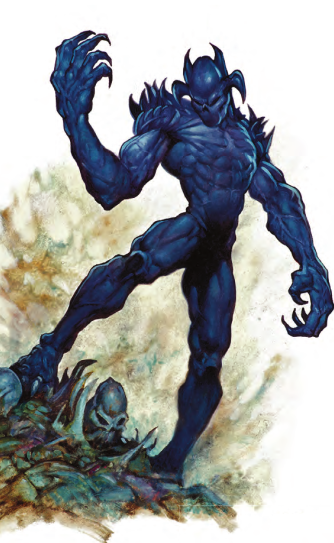
Copyright 2008 Wizards of the Coast This is part of a series! Go here to see the other entries.
I think Nightwalkers have been in the game since 3e - at least, that’s when I first saw them along with other “Night-something” high level undead. Here, they’re only on the Monster Manual.
The Lore
The Shadowfell is the antechamber of the afterlife. Whenever someone dies, their spirit spends a time here before the Raven Queen sends it to its final destination. If an extremely strong-willed evil person dies, though, they might be able to hold on and stay in the Shadowfell through sheer orneriness. These eventually become Nightwalkers.
This origin is actually quite similar to those of Devourers, evil people who also avoid being sent to the afterlife and make new undead bodies for themselves. Could it be that the two are related? Maybe a Nightwalker is what you get when a Devourer eats enough souls. Or maybe they’re simply the luckier psychopaths who got to make themselves a body of solid shadow instead of having to settle for corpse bits.
As mentioned above, Nightwalkers have bodies made out of the stuff of the Shadowfell. This gives them the ability to control the energies of that plane to some extent, which manifests as a series of cold and necrotic powers in combat. They’re also expert ritual casters. One of the rituals they know is the one that makes bodaks, though power-hungry PC wizards will be disappointed to know it only works on the Shadowfell when cast by a nightwalker on someone they themselves killed.
Nightwalkers communicate through telepathy, and understand Common. They’re highly intelligent and no doubt always have an evil scheme or two cooking, with bodaks acting as their agents in these matters.
The Numbers
Nightwalkers are Large Shadow Humanoids with the Undead keyword. They’re Level 20 Elite Brutes with 464 HP and a host of passive traits. Darkvision, immunity to disease and poison, 20 resistance to cold and necrotic, and 20 vulnerability to radiant. They walk at speed 8.
They also emit a 5-square aura of Void Chill, which does 5 cold and necrotic damage to anyone caught inside.
The nightwalker’s basic attack is a Reach 2 slam that does some physical damage plus bonus cold and necrotic damage. Once per round as a minor action they can use a Void Gaze (close Blast 5 vs Will) which does a bit of necrotic damage, pushes the targets 4 squares, and give them a -2 penalty to all defenses (save ends). This is not a fear effect, so protection from fear doesn’t work against it.
Once per encounter, it can use the dreaded Finger of Death spell (ranged 5 vs. Fortitude). This can only be used against a bloodied target, but if it hits the target immediately drops to 0 HP. Necrotic resistance is useless against this! It’s a nice thing to use with an action point as soon as someone becomes bloodied.
Sample Encounters and Final Impressions
We have two:
-
Level 20: 1 nightwalker, 4 bodak reavers. Master and minions!
-
Level 22: 1 nightwalker, 1 tormenting ghost, 3 death giants. This would be more of a gathering of equals.
Those encounters cover the basics of how you can meet a nightwalker: they bow to no master, and surround themselves with either servants (all of the bodaks) or with other creatures they respect as equals.
I like the concept of nightwalkers a lot, though I have to say I prefer the 3e illustration that included nightcrawlers and nightwings. Those shadowy indistinct shapes were a lot scarier than the thing pictured here. I can see why the crawlers and wings didn’t make it here - they were basically the same monster with different shapes and levels. It would be relatively easy to homebrew them back into the game.
-
-
Let's Read the 4e Monster Manual/Vault: Nightmare
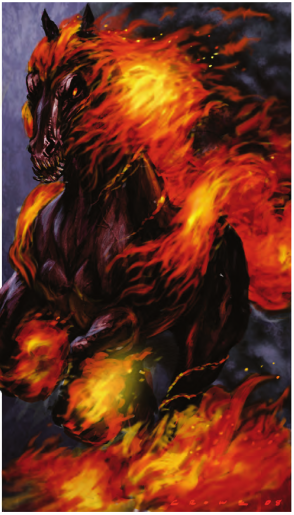
This is part of a series! Go here to see the other entries.
In the real world, a nightmare is a bad dream. In D&D it’s a bad pun that nevertheless became somewhat iconic. They’re only in the Monster Manual.
The Lore
A nightmare looks like a horse, but is darker and edgier. Night Mare, get it? These creatures are native to the Shadowfell, and the only equine thing about them is their general shape.
Nightmares are intelligent, carnivorous, and evil. In the wild they roam in packs, like wolves, and have a taste for sapient flesh. They can be ridden and are particularly prized as mounts by powerful servants of evil. Getting a nightmare to agree to work as a mount involves defeating it in combat and making it choose between service and death. Therefore, having a nightmare of your own is a sign that you’re a badass in addition to being an edgelord.
Though they are native to the Shadowfell, their high resistance to fire and fiery appearance make me think they have something of Hell in them as well.
The Numbers
We only get a single Nightmare stat block: it’s a Large Shadow Magical Beast with the Mount keyword, and a Level 13 skirmisher with 138 HP. It has Darkvision and trained Perception, and both land and teleport speeds of 10. This does mean it can teleport at will as a move action.
Nightmares have 20 fire resistance, and get +2 to AC against opportunity attacks. Their mount trait is Hell’s Ride, which grants 20 fire resistance to the rider.
Nightmares fight in melee with their flame-wreathed hooves, which do a bit of physical damage and ongoing fire damage (save ends). Their special attack is Hooves of Hell (recharge 5-6), in which they run the speed and leave a 10-foot tall wall of fire in their wake. The wall lasts for a turn and deals 10 fire damage to anyone who enters it. Anyone who attacks the nightmare while it makes this move also takes the same damage.
I imagine a nightmare has little reason to stand still while Hooves of Hell is charged. It will play Fire Tron with the PCs for as long as it can, only stopping to kick someone while it waits for the power to recharge. And unlike a Tron bike it can run through its own walls just fine, even with a rider. A whole pack of them would be, well, a nightmare to fight for PCs who aren’t resistant to fire.
Sample Encounters and Final Impressions
There are two:
-
Level 13: 1 nightmare, 1 battle wight commander (the rider), and 6 battle wights.
-
Level 13: a medusa archer and a medusa warrior riding nightmares.
It looks like the mount rules give enemy riders and their mounts separate actions, so that wight and the medusas can still attack the PCs while their nightmare mounts run around setting the map on fire. When they provoke opportunity attacks, the PCs can choose whether to target the mount or the rider. In this case I would also have an opportunity attack against the rider cause those 10 fire damage.
Despite the somewhat punny name, nightmares are cool. An evil knight type should have an evil mount to go with it, and evil fire-horses are one of the classics (the other being some kind of skeleton or wyvern).
-
subscribe via RSS