Posts
-
Let's Read the 4e Monster Manual/Vault: Panther
Copyright 2008 Wizards of the Coast This post is part of a series! Go here to see the other entries.
Panthers are real-world animals, and something like them has been in the game since the beginning. In 4e, they’re only on the Monster Manual.
The Lore
This is another one of those Monster Manual entries that focuses on fantastical versions of a mundane animal. The implied setting of D&D does have mundane panthers, but the book notes that they mostly hunt small game and avoid contact with people.
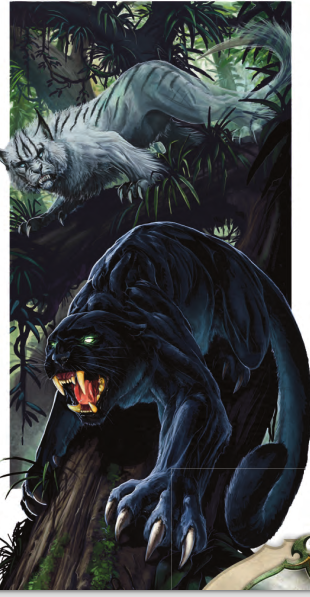
However, that setting also has supernatural panthers touched by the energies of the Feywild and Shadowfell. These are larger, stronger, and have no problem stalking humanoids that blunder into their hunting grounds. They have powers that are thematic to their home planes, and can move between them and the world at sunrise and sunset.
The Numbers
We get two stat blocks here, one each for fey and shadow panthers.
Fey Panther
This is a Medium Fey Beast, and a Level 4 Skirmisher with 54 HP. It has trained Perception and low-light vision, and moves with a ground speed of 8 and a climb speed of 6.
The fey panther’s basic attack is a Bite that also allows it to shift 1 square on a hit. Its Charging Pounce ability allows it to deal extra damage and knock the target prone on a charge.
Finally, it can also use fey step like an eladrin, teleporting 5 squares once per encounter.
These abilities add up to a fighting style where the panther tries its best to not stay engaged with a single target, using the shifts from its basic attack and the teleport from Fey Step to make sure it’s always in position to charge someone without receiving opportunity attacks.
If you really want a mundane panther, you could remove Fey Step from this one and maybe lower its level to 3.
Spectral Panther
Real-world black panthers are jaguars with a specific gene that makes them all black. D&D black panthers come from the Shadowfell!
Spectral panthers are Medium Shadow Beasts, and Level 9 Lurkers with 76 HP. They run at speed 7, and oddly seem to lack a climb speed. They have trained Perception and low-light vision.
Their name comes from the ability to assume a Spectral Form as a standard action, which turns them insubstantial and gives them a +5 bonus to Stealth (bringing the total up to +19), but makes their attacks deal half damage. Once in this form, they can use another standard action to turn Invisible. Both conditions can be ended as a free action, and invisibility also ends when the panther makes an attack.
They attack with their Claws, and when an enemy moves or shifts into an adjacent square they can also use a Tail Spike as a reaction. Both attacks deal extra damage if the panther has Combat Advantage against the target.
Overall, the spectral panther is slightly sub-par as a lurker, because it takes two turns to become invisible and the combat advantage bonus damage isn’t big enough to make up for that. You’re probably better off sticking to insubstantiality for repositioning, and relying on flanking and such to get combat advantage. Or you could change Spectral Form so it makes the panther invisible right away.
Sample Encounters and Final Impressions
We have a single sample encounter here, along with the usual statement that lots of intelligent humanoids end up keeping supernatural panthers as pets and attack animals.
The encounter is level 9: 2 spectral panthers, a dark stalker, and a pair of shadar-kai warriors.
Panthers are… okay, I guess. Their existence is a cool bit of color, but they don’t make immediately want to use them in an encounter like other monsters here did.
-
Let's Read the 4e Monster Manual/Vault: Owlbear
Copyright 2008 Wizards of the Coast This post is part of a series! Go here to see the other entries.
Owlbears have been in the game since at least BECMI, and likely since the beginning. As another rather popular and iconic monster, they are both in the Monster Manual and the Vault.
The Lore
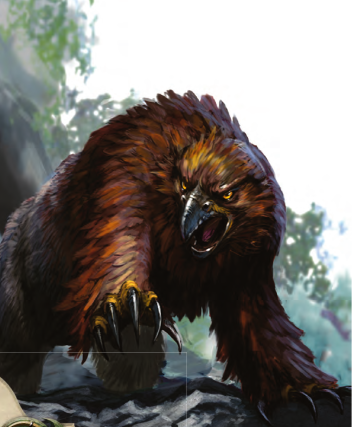
Owlbears are dangerous predators that originated in the Feywild but spread to the world ages ago. They have the strength of a bear, the cunning of an owl, and are always hungry.
The creature’s owl bits give it excellent night vision, better talons than what you usually find in a bear, and a characteristic hooting call. Their fey nature also means they have magic powers, which can vary with their specific environment but always include something related to their hoots. Owlbears get together to mate and rear their cubs, usually only sticking around only long enough to accomplish that. If prey is plentiful, they might stay together longer.
Any creature that crosses an owlbear’s territory is fair game. Some owlbears drag the carcasses of their prey back to their lairs and hang the leftovers on nearby trees and bushes in hopes of attracting scavengers who will serve as future meals.
Owlbears are difficult, but not impossible to tame. All manner of fey, goblins, and even giants might take them as guards, attack animals, or simply pets. In fact, with the Fey Beast Tamer theme introduced in the guide to the Feywild, PCs can also have their own pet owlbears!
Some of the fey skip all the boring animal handling work and use charm spells - it’s the GM’s call whether that’s a prudent thing to do.
The Numbers (Monster Manual)
Owlbears are Fey Beasts with average Int score of 2. They have a ground speed of 7, low-light vision with trained Perception. Their attacks are usually with their claws and beaks, though each variety has a different magic hoot/screech/call as well.
The MM varieties, as usual, need a damage update.
Owlbear
The basic model is a Level 8 Elite Brute with 212 HP and size Large. Its basic attack is a Reach 2 Claw, and it can make two of those per standard action. If both hit, the target is grabbed (escape DC 19 for Acrobatics or 22 for Athlethics).
The owlbear can Bite a grabbed target, hitting automatically for enough damage that even without an update it’s close to what it should be for a limited attack. It’s a standard action but it’s definitely worth it.
When first bloodied it will emit a Stunning Screech as a free action. This is a Close Burst 1 vs Fortitude which does no damage but stuns on a hit (save ends). Don’t cluster around it!
Winterclaw Owlbear
This Huge owlbear is likely adapted to live in regions of supernatural winter in the Feywild. Instead of relying on pure physical power, it uses innate ice magic. It’s a Level 14 Elite Controller with 280 HP.
Its basic attack is a Winterclaw that does a mix of physical and cold damage, and slows on a hit (save ends). It can make two of those per standard action, and if both hit the target is immobilized (save ends) with a slow aftereffect (save ends).
Its magic call trick is the Frost Wail (close burst 3 vs. Fortitude), which does cold damage and immobilizes (save ends). It recharges when the owlbear is first bloodied.
With a winterclaw owlbear you’ll want to keep everyone immobilized and preferably isolated, allowing the other monsters in the encounter to pick the PCs off one by one.
The Numbers (Monster Vault)
The main difference from the Monster Manual here is that the owlbear’s low-light vision has been upgraded to full Darkvision. They also have properly updated damage.
Young Owlbear
Essentially a non-elite version of the basic Owlbear, it’s a Level 8 Brute with 106 HP. It fights in exactly the same way, and even has the ability to make two attacks per turn and grab if both hit.
Its hoot only dazes instead of stunning (save ends).
Owlbear
A straightforward update of the MM version. Still a Level 8 Elite Brute with 212 HP, its damage has been updated but no other changes were made.
Trained Owlbear
This Large owlbear likely represents a beast that has been tamed and trained since hatching. It lacks that primal vigor of the wild variety but has better teamwork.
Trained owlbears are Level 9 Soldiers with 96 HP. They mostly fight with Reach 2 Claws but have a few other tricks.
Their Thunderous Shrieks (Close Burst 2 vs. Fortitude; recharge 5-6) do thunder damage and knock prone on a hit. If an adjacent enemy makes an attack that doesn’t include the owlbear as a target, it will use a Guardian Claw to attack them as an opportunity action. This deals the same damage as a basic attack, or a flat 5 damage on a miss.
So these owlbears will run right into the fray and occupy the attention of the enemy front-line, while their masters further back use magic or ranged attacks. Pretty straightforward soldier types, though they’ll keep some space between themselves to avoid friendly fire with the thunder shrieks.
Wind-Claw Owlbear
Likely a subspecies that’s adapted to living in windy mountain passes or similar environments. They’re Level 11 Elite Controllers with 228 HP.
Wind-claws are surrounded by a Keening Gale aura 2 that causes any enemies ending their turn inside to take 5 damage, and allows the owlbear to slide them 2 squares.
Their Wind Claws do physical damage, slide the target 2 squares, and knock it prone. On a miss the owlbear can still slide the target 1 square.
The ability that lets them attack twice is named Disembowel (it’s just “Double Attack” for everyone else). If both attacks hit, the target is stunned for a turn. I suppose this would be a literal disemboweling if the target hits 0 HP, otherwise they’re just momentarily stunned at narrowling escaping a disemboweling.
This owlbear also has a Beak Snap that hits a grabbed target automatically, but it lacks any abilities that grab the target! You can either add this ability to one of its existing attacks, or use the default Grab attack everyone gets (vs. Reflex, a hit does no damage but grabs the target).
When the owlbear is first bloodied, it lets loose a Wind Howl (close blast 5 vs. Fortitude). A hit does no damage, but pushes the targets 3 squares and knocks them prone. A miss still pushes them 1 square.
Winterclaw Owlbear
This is a straightforward update of the MM Winterclaw Owlbear, with the same level, the same abilities, and updated damage.
Sample Encounters and Final Impressions
We have two:
-
Level 7: 1 owlbear, and a trio of satyrs. These would definitely go the “charm spell” route for taming the owlbear.
-
Level 14: 1 winterclaw owlbear and 3 cyclopes. These would tame them through unceasing toil, for that is the cyclops way.
I love owlbears! Like otyughs, they’re one of those monsters that are a sure sign that you’re in a D&D world as opposed to some other fantasy setting. And sure, they’re dangerous predators in-setting, but there’s something extremely funny and even cute about the concept of a bear with an owl’s head that goes “who?”.
Mechanically, they seem to do their job so well that the Monster Vault didn’t change the original stat blocks at all aside from the damage update.
-
-
Let's Read the 4e Monster Manual/Vault: Otyugh
Copyright 2008 Wizards of the Coast This post is part of a series! Go here to see the other entries.
Otyughs have been in the game since at least AD&D 1st Edition, and are probably the game’s most unintentionally iconic monster. Fourth Edition leans into this iconic status and features them in both the Manual and the Vault.
The Lore
Otyughs are large, strange-looking beasts who feed on rotten organic matter. They love to hang out in dark places where such matter is plentiful, like fetid swamps, middens, sewers, mass graves, and so on. I think some editions make them sapient, but here they’re mostly just animals.
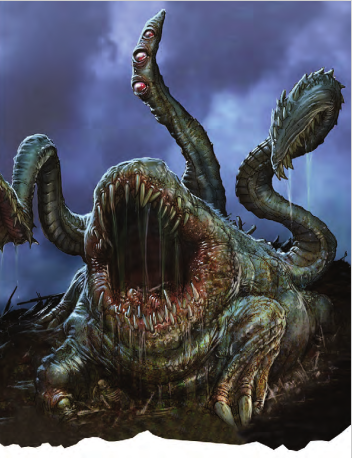
These beasts behave like ambush scavengers, something which you don’t find often in the real world. They bury themselves in mounds of filth, or submerge themselves in pools of tainted water and such. Their central tentacle contains their eyes and nostrils, so they use it to peek at their surroundings. They strike with their other two clawed tentacles at any unlucky creatures that pass by, kill them, and add them to the pile to wait until their flesh is rotten and good for eating. They will also eat whatever rot was already there, of course.
You can’t really tame an otyugh, but lots of people use them as natural garbage disposals because if you put them in your middens or sewers they’ll happily stay there. Less scrupulous people also use them as security systems, since they’ll attack any smartass adventurers who think they can invade your dungeon through its sewers.
There’s a small danger here, which is that if an otyugh’s trash pile doesn’t get renewed fast enough the thing will wander off in search of another. I imagine this isn’t a problem for a sewer in active use, but an “artificial” pile meant to house a guardian otyugh would need maintenance.
Otyughs aren’t very fast, but their brown mottled hides are excellent camouflage for their chosen habitat, their tentacles are strong and dangerous and, well, they smell like shit. It’s hard to handle a sword when you’re trying to hold your lunch in.
They also have a propensity to mutate, acquiring a coloration and perhaps other properties in line with its specific chosen environment. This makes them suceptible to external mutating energies as well, such as those of the Far Realm (or a Cocaine Wizard’s privy).
The Numbers (Monster Manual)
The MM only has one Otyugh stat block. It’s a Large Natural Beast, and a Level 7 Soldier with 82 HP. It has Darkvision and trained Perception, a land speed of 5 and a swim speed of 5. It’s immune to disease, and it pretty much has to be.
Otyughs are also trained in Stealth, and have a trait called Spying Eye for the eye-tentacle trick described in the Lore section which gives them a +10 bonus to Stealth when immersed in filth. This elevates its total bonus to +18, making it challenging to spot even for the party radar at equivalent levels.
Its Otyugh Stench is an aura 1 that inflicts a -2 attack penalty on any living enemies inside. It will mostly attack with its Tentacles, which are Reach 3, pull the target 2 squares and grab on a hit in addition to doing damage. By MM rules, the escape DC is 22 for Athletics and 16 for Acrobatics, due to the large disparity between the otyugh’s Fortitude and Reflexes.
Against adjacent targets the creature can use its Diseased Bite, which deals a little more damage than the tentacle and cause the target to contract filth fever.
This is standard Filth Fever, not a specific variant. It’s a level 3 disease whose Improve and Maintain DCs are 16 and 11. Stage 1 eats a healing surge. Stage 2 adds a -2 penalty to AC, Fortitude, and Reflex. Stage 3 keeps the penalty, eats all of your healing surges and prevents you from recovering hit points.
This is one of those cases where the first stage is an annoyance, but you really don’t want to let the disease progress to stage 3 (also known as “sepsis”).
The Numbers (Monster Vault)
We have three otyughs here, extending their viability as threats into the early paragon tier. In the Monster Vault rules, disease transmission isn’t automatic. You need to make a save after a fight in which you were exposed, and only contract the disease if you fail.
Otyugh
This one is an update of the MM Otyugh. Still a level 7 soldier with 82 HP, it fights in much the same way. I’ll note the differences.
The damage from all of its attacks has been updated. The tentacles have a fixed escape DC of 16, and the diseased bite deals extra damage against grappled targets. Spying Eye is gone as a separate trait, though the creature’s Stealth bonus of +13 means it does still get a boost here.
The bite’s disease is named Lesser Otyugh Filth Fever and has the exact same stats despite being level 7. I guess the level 3 in the MM was a typo. Its text does clarify that when you reach Stage 3, you can no longer make Endurance tests to recover naturally.
Charnel Otyugh
A specimen that likely spent too long hanging out in cemeteries or battlefields. Or maybe the pet of some lich or vampire. Still a Large Natural Beast, this one is a Level 10 Elite Soldier with 212 HP and a host of necrotic powers.
The Stench is still here, with identical effects. Its basic tentacle attack is the Charnel Lash, which works like the standard otyugh tentacle attack with an escape DC of 18 and ongoing necrotic damage on top of the other effects (save ends).
The charnel otyugh can use Life Leech against a grabbed target, a minor-action attack against Fortitude that deals 10 necrotic damage and heals the monster for 5 HP on a hit.
Its Rotting Bite also has an ongoing necrotic damage rider, and transmits Greater Otyugh Filth Fever, a level 11 version of the disease with an Improve DC of 19 and a Maintain DC of 13. Its effects are the same otherwise.
The monster can also flail its tentacles around in a Charnel Frenzy (Close Burst 3; recharge 5-6) dealing a bit less damage than the basic attack but still inflicting ongoing necrotic damage.
Neo-Otyugh
An otyugh mutated by the Far Realm, either from being exposed to a rift or from eating aberrant creatures. Unlike its lesser relatives it’s a Huge Aberrant Magical Beast, meaning its sapient! Its Int is 7, making it as smart as a hill giant.
Neo-Otyughs are Level 11 Elite Controllers with 232 HP. Their land and swim speeds go up to 7 from the usual 5. Their Stench is an aura 2 with the same effects, and they also have Threatening Reach.
Their Tentacles are Reach 4, and aside from the usual damage a hit pulls 3 squares and grabs (DC 19). The usual bite has been upgraded to a Massive Maw of Decay (close blast 2)! It does physical damage plus ongoing necrotic damage, and exposes anyone hit to Greater Otyugh Filth Fever. It also does extra damage against grabbed targets.
As if this wasn’t enough, Neo-Otyughs have psychic powers. Disgusting Lure (Ranged 20 vs. Will) is a minor-action attack that does a bit of psychic damage and a larger amount if the target doesn’t end their next turn adjacent to the Otyugh.
The neo-otyugh can also used a grabbed victim as a Body Shield when hit by an attack. This isn’t automatic, and requires an attack against the grabbed victim’s Fortitude. On a success, the attack hits the victim instead of the monster.
Sample Encounters and Final Impressions
We have two in the MM, exemplifying the two most common otyugh fight scenarios.
-
Level 7: 1 otyugh and an assortment of troglodytes. The trogs use the otyugh as a garbage disposal and will try to push meddlesome adventurers towards it.
-
Level 7: 2 otyughs and 2 carrion crawlers. Carrion crawlers are opportunists and will often hang around otyughs to steal their kills.
As I said back in the introduction, to me Otyughs are an iconic part of D&D. If I see an otyugh in a story of any type, I know it’s not just a fantasy story, but specifically a D&D one. So while I don’t exactly find them cool, I like them in that capacity.
-
-
Let's Read the 4e Monster Manual/Vault: Orcus
Copyright 2008 Wizards of the Coast This is part of a series! Go here to see the other entries.
Orcus has been in the game since at least AD&D 1st Edition, and is the strongest monster in the 4e Monster Manual. He is not in the Monster Vault.
The Lore
Orcus is the known by many titles, such as the Prince of Undead, Demon Lord of Undeath, and Blood Lord. He’s a Demon Lord, which is not a formal title but a terse way of saying Orcus is one of the strongest demons in all of the Abyss, powerful enough to challenge the gods. Orcus wants to destroy the gods themselves, particularly the Raven Queen so he can usurp her dominion over Death.
Orcus hates all life to an even greater extent than your average demon. He can’t stand to be near anything living, and even his demon servitors are undead. His domain is named Thanatos and covers an entire layer of the Abyss, being predictably composed of an endless sucession of mausoleums, graveyards, dismal moors, and other lifeless corpse-filled places. I’m guessing that where the Shadowfell is moody gothic poetry, Thanatos is death metal.
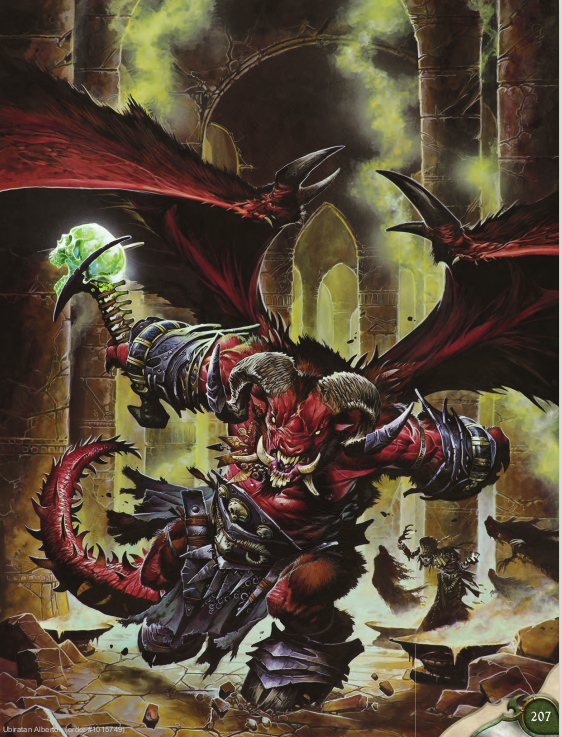
The demon lord himself seems to be stuck somewhere between life and undeath, as his corpulent form seems either alive but diseased, or undead depending on which parts you look at. He wields a heavy mace with a haft of ruby-studded obsidian and a head made from a gigantic skull, a weapon known as the wand of Orcus. There are multiple stories about the origin of the skull. Some say it belonged to a noble and just god, others to a mortal hero (in which case it was magically enlarged). In either case there is nothing of that person’s good left inside. Those killed by the Wand rise as undead loyal to Orcus.
Orcus’s main stronghold is Everlost, an obsidian palace at the center of Thanatos built over a bottomless chasm whose walls are completely covered in crypts and mausoleums. He also shares the layer with his Exarchs, lieutenants imbued with a shard of his power. One example is Dorensain the Ghoul King, who presides over ghouls and cannibalism and lives in a section of Thanatos named the White Kingdom (because it’s entirely made of bones).
There are many cults to Orcus in the world, whose membership consists of people who want to be “rewarded” with undeath, or who want to kill the world for other reasons. These cults tend to be a lot subtler than those of Yeenoghu or Baphomet, who also got name-checked in this book. They gather in secret in places like graveyards, and do things like human sacrifice, blood-drinking, and covertly spreading disease. They don’t see undeath itself as holy, but as a tool to help with the goal of extinguishing all life. Every cultist aims to become some kind of powerful undead like a royal mummy, death knight, vampire, or lich. Most don’t manage, of course, but they consider even being turned into a skeleton or zombie after death to be a good service to their demon master.
The most powerful among Orcus’ priesthood are given the knowledge to summon as Aspect of Orcus, a miniature version of the demon lord himself created from his power. Aspects have no mental link of any kind to the original, though they have the same personality. They usually disappear when the task for which they were conjured is done.
The Numbers
This entry has a lot of related stat blocks, and we’ll look at them in order of level.
Crimson Acolyte
Any of the stat blocks we already saw for humans or others could work as a cultist, but this one has some Orcus-specific flavor. Crimson acolytes are humans, and therefore Medium Natural Humanoids. They’re Level 7 Skirmishers with 76 HP. They wear leather armor.
The acolyte wields a scythe in combat, which does a mix of physical and necrotic damage and has a +2 attack bonus against bloodied targets. It also marks them as a total edgelord.
They also have an ability called Crimson Path, an at-will minor action that allows them to shift 1 square (2 when bloodied).
Their tactics are simple: use Crimson Path to get into flanking positions and scythe away, preferring bloodied characters as targets. The scythe’s damage is only 3 points short of where it should be, so fixing it is easy.
Deathpriest of Orcus
Deathpriests are Medium Natural Humanoids (usually humans) and Level 9 Controllers (Leaders) with 96 HP. They wear mail, and have speed 5. They also project an aura called Death’s Embrace, which has a radius of 10 and inflicts a -2 penalty to any death saves that happen inside.
Deathpriests start fighting at range using Rays of Black Fire (Ranged 10 vs. Reflex) that do fire and necrotic damage and grant an ally in sight a +2 bonus to its next attack. They really want to get right into the fray, though, so that they can use their Dark Blessing (Close Burst 2 vs Fortitude). This does necrotic damage and pushes all enemies caught in the burst 1 square, and gives all allies a +2 bonus to AC until the end of the encounter. After they spend their blessing, they’ll use mace attacks that do a mix of physical and necrotic damage, or retreat and go back to using their rays.
The deathpriest’s damage is a full 9 points less than it should be, and really needs a fix.
Deathprest Hierophant
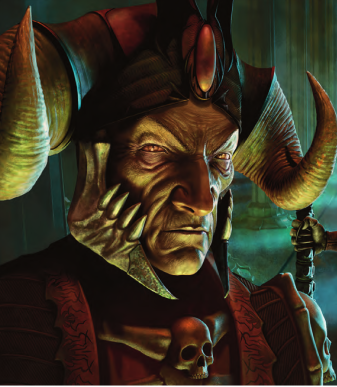
Copyright 2008 Wizards of the Coast This is likely Orcus’ most powerful living agent in any given campaign world, and well on the way to becoming a lich or something equivalent. It’s a Level 21 Elite Controller with 382 HP.
The hierophant projects an Aura of Decay out to 5 squares, which inflicts -2 to all defenses on any living enemies inside. At the time of writing this was the same as saying “all enemies”, but by the end of 4e we had like three different ways of making PC vampires, so they’d be immune.
The hierophant’s most powerful attack is Word of Orcus (close burst 5 vs. Fortitude; recharge 6), which does necrotic damage and stuns (save ends). Any undead allies in the burst also regain 15 HP. If that’s not charged, there’s the Word of Death (Ranged 10 vs. Will; recharge 4-6) which does psychic damage and dazes (save ends). And if neither is charged there’s the good old mace which does physical damage and ongoing necrotic damage (save ends).
The frequent dazes and stuns are pretty dangerous, but the hierophant’s damage is a full 20 points behind where it should be for all attacks except for the mace, which is “just” 10 points behind.
Aspect of Orcus
The Aspect of Orcus is a Large Elemental Humanoid (Demon), and a Level 24 Elite Brute with 560 HP. It has darkvision and trained Perception. It’s immune to poison and disease, has 20 necrotic resistance, and 10 variable resistance that it can switch 3 times per encounter. It runs at speed 6 or flies at speed 8 (clumsy).
The Aspect projects a Lesser Aura of Death out to 10 squares. Enemies caught inside take 5 necrotic damage, or 10 if the Aspect is bloodied. It fights with a Skull Mace that’s likely a lesser copy of the Wand: a hit deals a disappointing amount of physical damage and weakens (save ends).
More dangerous is the Tail Lash the Aspect can use on any enemy that moves or shifts to a square adjacent to it, as a reaction. This does a bit more damage than the mace, and knocks the target prone.
After all the hype in the lore section, I find the Aspect of Orcus to be a bit of a disappointment. I imagine it works well as a “Summon” when backed up by a hierophant and high-level undead. If Orcus himself sends out a lieutenant to do his work, though, he’s going to send a balor, an atropal, or Dorensain.
If you plan to use the Aspect, fixing its damage is crucial, as it’s 25 points smaller than it should be.
Dorensain, Exarch of Orcus
The Ghoul King looks like, well, a ghoul, but one that walks upright and is dressed in what passes for elegant finery in his kingdom: a coat made of human flesh over leather armor that’s also surely made from people. A crown of bones rests on his head, and he wields a staff named Toothlust, made from somebody’s spine and teeth.
Dorensain is a Medium Natural Humanoid (Undead) and a Level 27 Elite Skirmisher with 508 HP. He has super-high Initiative, trained Perception, and darkvision. Like the Aspect above, he’s immune to disease and poison and has 20 necrotic resistance. He also has 10 radiant vulnerability. He runs at speed 8.
He fights with Toothlust in combat, and the bites of that weapon deal immediate and ongoing physical damage (save ends). That fine coat is the Cloak of Mouths, whose bites do physical damage and slow (save ends). You know you’re looking at a sophisticated ghoul when he uses utensils to eat you.
Dorensain can sometimes pull off a Ravenous Frenzy maneuver (recharge 6), which allows him to move his speed without provoking opportunity attacks and make a Cloak of Mouths attack on anyone he passes by. He can also teleport 12 squares as a move action (recharge 4-6).
The Ghoul King is difficult to pin down, and apparently good at keeping his enemies slowed and vulnerable to whatever honor guard he travels with.
Orcus
The Big Goat Cheese himself is a Gargantuan Elemental Humanoid (Demon) and a Level 33 Solo Brute with 1525 HP! As I said above, he is the highest-level monster in the entire Monster Manual.
As expected, he has darkvision and trained Perception. His ground speed is 6, and he flies at speed 10 and teleports at speed 6, at-will. Orcus is immune to disease, poison and necrotic damage, and has the usual demonic Variable Resistance 10 (3/encounter). He is not particularly vulnerable to radiant damage. And then there are the auras.
The first is the Aura of Death, which is 20 squares wide and deals 10 necrotic damage to enemies caught inside. This increases to 20 while Orcus is bloodied.
The second is The Dead Rise (aura 6), which turns all covered squares into difficult terrain for enemies, even flying ones! I guess it’s due to all the grasping skeletal hands bursting out of the ground and tormented specters flying around. Any dead creature inside, except those killed by the Wand of Orcus, rise as abyssal ghoul myrmidons under Orcus’ control.
Why are creatures killed by the wand exempt from this? Because due to a little trait called Master of Undeath, victims of the Wand rise as dread wraiths at the start of Orcus’ next turn if they’re still dead by then.
The Wand of Orcus itself is not all that impressive. It’s Reach 4 and does a mix of physical and necrotic damage on a hit. You should just about double its damage to get it to expected levels.
A bit more dangerous are Orcus’ two recharge attacks. Necrotic Burst (close burst 10 vs. Fortitude; recharge 6) is very accurate, does necrotic damage and heals all undead allies for 20 HP. Touch of Death (Melee 4 vs. Fortitude; recharge 6) is the big one: a hit reduces the target to 0 HP, bypassing any and all resistances. A miss deals damage equal to the target’s bloodied value. A couple of good whacks with the fixed Wand after hitting with this, and you have a brand new dread wraith!
When an enemy moves or shifts to a square adjacent to Orcus, he can use a Tail Lash as a reaction, doing a bit less damage than the wand, stunning the target for a turn and knocking them prone.
Orcus suffers a bit from same problems that plagued 3e boss monsters, which are that he has few ranged options and is susceptible to a bunch of conditions that limit his actions. Those are less of a problem than they would have been in 3e, but you still might want to give him something like a dragon’s Action Recovery ability.
Sample Encounters and Final Impressions
We have a whole bunch!
-
Level 9: 1 deathpriest, 4 crimson acolytes, 2 battle wights. Your typical cult, with living and undead members.
-
Level 22: 1 hierophant, 5 abyssal ghoul myrmidons (minions), 2 rot harbingers, 1 rot slinger. The Hierophant and his honor guard.
-
Level 24: 1 hierophant, 3 blood fiends, 1 aspect of Orcus. An alternate configuration, and yet another indication that blood fiends should really be undead demons instead of abominations.
-
Level 28: Dorensain, 2 dread wraiths, 2 epic liches, and 10 abyssal ghoul myrmidons.
-
Level 34: Orcus, 2 atropals, and 8 lich vestiges. What, you thought the big solo was going to fight alone?
Orcus and his related monsters suffer from a lot of the problems endemic to the early Monster Manual, with the epic stat blocks getting hit the hardest as usual. However, those are all eminently fixable.
My favorite thing about this whole entry is that it’s here at all! My impression with AD&D 2nd Edition, and with 3.x, was that they viewed threats of this caliber as something the PCs weren’t expected to fight and win. They either had no stats, or they had overpowered numbers calculated to be beyond the reach of even the most powerful group. This impression is probably also colored by my memories of the largely oppressive and adversarial nature of the DMs of the time.
Orcus is, well, still quite powerful, but in a way that’s supposed to make him a suitable “last boss” for a campaign. Sure, he has an attack that reduces people to 0 HP and powers that turn dead characters into epic undead under his command… but epic PCs are demigods who can resurrect once per day on their own, and epic leader PCs are up to the challenge of keeping their buddies from dying at all. In fact the Big O might actually need a little boost to prevent stun-locking by those epic characters.
Mechanical details aside, this feels right. If I manage to reach level 30 in a campaign, I want to end it with a bang by taking out one of the big name canonical demon lords. And when the next campaign starts, I want them to stay dead.
-
-
Let's Read the 4e Monster Manual/Vault: Orc
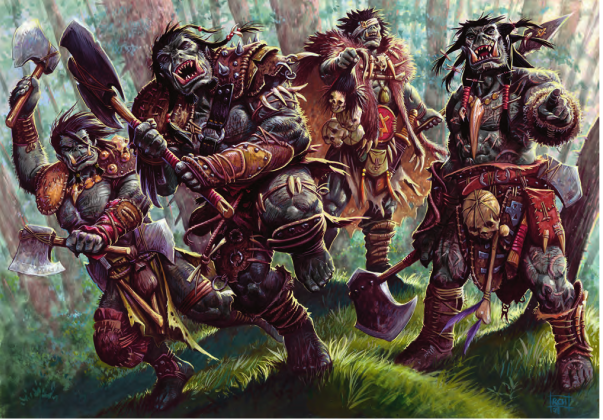
This is part of a series! Go here to see the other entries.
Orcs have been in D&D since the beginning, featuring in the Humanoid Power Ladder as the 1HD Humanoid. They’re inspired by Tolkien’s orcs, and are present both in the Monster Manual and the Vault.
The Lore
I didn’t expect this, but here we have an entry about sapient humanoids where both books agree. Neither has anything nice to say about orcs.
Orcs compete fiercely with gnolls for the title of Least Reasonable Humanoid. They worship Gruumsh, the one-eyed Chaotic Evil god of slaughter and destruction, whose commandments result in behavior that’s almost indistinguishable from that of a Yeenoghu worshipper. Being a god, Gruumsh technically doesn’t want to see the world destroyed, but the difference is lost on the poor sods on the receiving end of a raid by either set of worshippers.
Orcs organize themselves in large tribes who will usually move into a region, take over a natural cave complex or an empty town (possibly after emptying it themselves), and fortify it into a defensible base. Then they split into smaller bands of scouts and raiders to methodically plunder the surrounding region, and move on once there’s no more loot to be had. Sometimes a chief will take a liking to a given home base and order the tribe to settle in it, which means those raiding parties will range much farther out. Their preferred terrain are hills and mountains, which means they end up fighting dwarves a lot of the time.
Orcs take slaves in their raids, but never manage to keep them for long because they always end up working them to death in short order. They’re also gleefully cannibalistic towards anyone not of their tribe, even other orcs. They routinely work alongside ogres, because it’s super easy for them to bully ogres into service.
Most GMs I know tend to tone down their campaign’s portrait of orcs from the unrelenting badness described above. Eberron shows them in a much better light, having not just one but two different Lawful Good orcish cultures dedicated to guarding against aberrant and demonic invasions (respectively). Even in old D&D they were not always the opposition: hiring orcish mercenaries was a common thing for adventurers to do, and it wasn’t always assumed that the orc encampments you found in a given area were hostile and there to be raided.
The Numbers
The numbers below were built with the “unrelenting badness” version of the lore in mind, but they could be used for non-evil orcs with relatively little change. It’s also possible to turn other “natural humanoid” stat blocks into orcs by swapping signature traits around, as usual.
Orcs are Medium Natural Humanoids and typically Chaotic Evil. They have low-light vision and base Speed 6.
Their other mechanical tricks change between books. In the Monster Manual all orcs have a +2 bonus to speed when charging, and all non-minions have an attack called Warrior’s Surge, which allows them to make a melee basic attack and recover 25% of their HP. Most MM orcs are also trained in Endurance.
The Monster Vault makes the speed bonus less universal, and replaces Warrior’s Surge with Savage Demise, which allows orcs to immediately take a standard action when they drop to 0 HP. This is stronger than just making a basic attack, because allows them to charge or use special attacks.
Orc Drudge (MM)
This level 4 minion is probably the closest thing you have to the classic 1HD orc. It wears hide, wields a club, and gains the orc speed bonus to charges.
There’s a level 9 version named the Orc Warrior which is described as wearing nicer gear (scale, light shield, battleaxe), but has pretty much the same mechanics.
Orc Savage (MV)
A Level 4 Minion Brute, updating the Drudge above. Instead of a club, it carries a bunch of handaxes, which it can use for melee or ranged attacks. It also has Savage Demise, so they’ll always be able to attack at least once when they die. Makes those controller AoEs a bit more of a double-edged sword. “I fireball the horde!” “They all charge you while on fire!”
Orc Raider (MM)
A Level 3 Skirmisher with 46 HP, representing a veteran who’s a little tougher than the rank-and-file.
Raiders fight in melee with a Greataxe and throw Handaxes at range. Killer’s Eye allows them to ignore cover and concealment when making ranged attacks at a range of 5 squares or less, which will almost always be the case. They also have Warrior’s Surge, which heals them for 11 HP.
Battletested Orc (MV)
Conceptually equivalent, but mechanically different from the Raider shown above. This is a Level 3 Soldier with 50 HP. It wears scale, and wields a heavy shield and a battleaxe, with some handaxes for ranged combat.
The Battleaxe deals +5 damage on a charge and have a higher base damage than the handaxes, which means the orc will only really use the latter if there’s some sort of chasm between it and the PCs.
It can use the battlaxe for a Hacking Frenzy (close burst 1; enemies only; recharge 5-6), an all-out attack which marks everyone it hits for a turn but makes the orc grant combat advantage for the same amount of time.
Orc Archer (MV)
This archer is level 4 artillery and surprisingly dangerous! It has 42 HP, and wields a longbow.
Basic longbow attacks do physical damage out to range 30, and push 1 square on a hit. They can also fire a bunch of arrows at once in a concentrated volley (area 1 within 20 vs. AC; at-will!). Finally they carry handaxes for melee emergencies, and have Savage Demise for that one last volley.
Orc Berserker (MM)
This is a somewhat boring Level 4 Brute with 66 HP and a greataxe, which it uses to make basic melee attacks. It has no other special abilities aside from Warrior’s Surge.
Orc Reaver (MV)
This is a Level 5 Skirmisher with 63 HP. It gets the charging speed bonus.
Reavers fight in melee with a battleaxe that allows them to shift 1 square on a hit, and throw javelins at range which push the targets 1 square on a hit. Once per encounter they can use Blood-Crazed Charge to make a charge attack right after hitting with a standard one. And they have Savage Demise.
In short, these are far more interesting berserkers than the Orc Berserker.
Orc Eye of Gruumsh (MM)
A priest of Gruumsh, whose initiation ritual consists of gouging out one of their own eyeballs and eating it. This is the only instance of “intra-tribal” cannibalism allowed in orc culture.
Eyes of Gruumsh are Level 5 Controllers with the Leader keyword and 64 HP. In addition to Endurance, they’re also trained in Religion and Intimidate.
These priests fight with spears in melee, and have a variety of spells for ranged combat. Eye of Wrath (Ranged 5 vs. Will) is a minor action fear effect that inflicts -4 AC for a turn on a hit. Swift Arm of Destruction (Ranged 5; recharge 5-6) allows an orc within range to make a melee basic attack as a free action and regain 15 HP on a hit or 5 on a miss. And Chaos Hammer (area burst 1 within 10 vs. Reflex; encounter) does force damage and knocks targets prone on a hit. On a miss it still does half damage.
Warrior’s Surge and Death Strike round out its abilities. Death Strike is a watered-down Savage Demise, allowing a free melee basic attack when the orc hits 0 HP.
Chaos Hammer is a good fight-opener: it’s not a friendly burst, but if the Eye can use it before its buddies charge in, they’ll have an easier time hitting the prone PCs. After that it’s mostly a matter of keeping Eye of Wrath on as many PCs as possible and using Swift Arm on non-minion orcs. This orc’s healing abilities make it a priority target, since it can make the fight a lot harder by keeping the other orcs up for longer.
If you want to make the Eye more Monster Vault-compliant, you might want to replace the healing with some sort of accuracy and damage bonus on the granted attack.
Orc Rampager (MV)
This Level 6 Brute has 90 HP and is another variation on the “berserker” theme. It fights with a heavy flail, and its Berserk Flailing allows the rampager to deal an automatic 5 damage to any enemies that start their turn adjacent to it, as long as it can take opportunity actions. So this shuts down if you daze the rampager, for example. Rampagers have Speed 6 and no charge speed bonus.
In addition to basic attacks, the rampager can, well, Rampage. This allows it to shift up to 3 squares and make basic attacks against three enemies during the shift. It’s an at-will ability too, meaning there isn’t any reason not to spam this every round. Rampagers are death blenders even if they don’t have any edged weapons.
If they can’t reach an enemy, they can toss a Handaxe (Ranged 10) to do some physical damage and push the enemies 1 square on a hit. And finally, there’s Savage Demise for that one last rampage before they go.
Orc Pummeler (MV)
A Level 6 Controller with 76 HP, and a rare martial controller at that.
Pummelers fight with huge Stone Mauls that knock prone on a hit, and once per encounter they can do a Earthshaking Slam (Close Burst 2 vs. Fortitude) that does damage, dazes everyone it hits and automatically pushes everyone in the area of effect 2 squares.
If someone makes an opportunity attack against the pummeler, it can counter with an Intercepting Swat (recharge 4-6), which allows it to make a free basic attack against the offender. This is labeled as a Free Action, which means there’s no limit to the number of times it may be used in a round. And we also have Savage Demise.
Orc Storm Shaman (MV)
This likely represents another Gruumsh priest, but “Storm Shaman” is generic enough that you could use it as a primal caster or even a priest of some less evil god like Kord.
They’re Level 6 Artillery with 54 HP, who prefer to stay far away from their enemies and attack with Lightning Strikes (ranged 30 vs. Reflex), which do level-appropriate lightning damage to their targets and 5 to another enemy within 5 squares of that.
Once the PCs close to medium range the shaman can use a Vengeful Whirlwind (Area burst 1 within 10 vs. Fortitude; enemies only; recharges when first bloodied), which does “thunder and lightning” damage and knocks prone on a hit. After the enemy falls down, the shaman can still slide it 2 squares! On a miss, the attack does half damage and the shaman slides the enemy 1 square.
And that’s not all! The whirwind persists for a turn as a zone that deals 10 thunder and lightning damage to anyone caught inside.
The shaman fights with a scimitar in melee, but only if it has no other choice.
After the shaman is first bloodied, it starts Wind Walking until the end of the encounter, which gives it a flight speed of 8 but requires it to land at the end of every move. Savage demise completes the shaman’s repertoire.
Orc Bloodrager (MM)
Bloodragers are Level 7 Elite Brutes, likely representing champions or subchiefs. They have 194 HP, but are much harder to kill than this number indicates.
Bloodragers fight with Greataxes, have Warrior’ Surge, and can also make basic attacks as a reaction when they’re hit by adjacent enemies. And any time they hit a bloodied enemy with an attack, Blood for Blood makes them deal +5 damage and heal 10 HP.
Between their high HP pool, the trickle of healing from Blood for Blood, and the 48 HP healed by Warrior’s Surge, you’re going to be fighting the bloodrager for a loooong time. It makes sense for it to have no MV equivalent, as it relies entirely on a tactic that fell out of favor (monster healing).
Orc Chieftain (MM)
Chieftains are Level 8 Elite Brutes with 216 HP and the Leader keyword. Their leadership skills are represented as an aura 5 named Blood of the Enemy, which grants bloodied allies inside a +2 bonus to damage.
Commanders fight with Greataxes, which have the High-Crit property, and can Inspire Ferocity in an ally that just dropped to 0 HP as a reaction, allowing them to make a melee basic attack before croaking. Warrior’s Surge is its last ability, healing 54 HP.
With a bit of an update, chieftains make excellent additions to a party otherwise composed of MV orcs, since I would definitely make Inspire Ferocity stack with Savage Demise (the Ferocity attack happens first, then the action from Savage Demise).
Sample Encounters and Final Impressions
The selection on any one of the books gives us enough variety to make entire adventures with all-orc encounters, and this is what the large selection of sample encounters gives us. Rather than listing them all in detail, I’ll mention the non-orc monsters tossed in, since I would guess they’re a nice representation of typical orc allies.
Over the several encounters listed, we have the following orc allies: dire boars, dire wolves, ogres, and there’s even an oni here, though in this case I would say the oni is running the show.
Mechanically, I think the Monster Vault orcs are by far the best. Despite the name, Savage Demise is very effective and doesn’t run the risk of making fights drag on for too long like Warrior’s Surge.
Lore-wise, well, there’s a reason orcs are almost always used as the main example for why D&D’s traditional take on “savage humanoids” is problematic. I tend to prefer settings which make them at least equivalent to humans in variety, where their alignment is an individual choice and not a species-wide label. Eberron’s guardian orcs are quite nice as well. Wizards of the Coast has recently committed to improving the way they portray orcs and other humanoids, but I think we’ve yet to see the results of those efforts.
One interesting thing you could do is to use the lore above for Gruumsh worshippers of any species. It would make perfect sense for Gruumsh to be a jealous deity who demands exclusive worship even in a polytheistic setting, and requires his worshippers to follow this violent raiding lifestyle. Sure, there are orcs in there, but a little signature trait swapping you could have humans, dwarves, and even elves filling the same role.
subscribe via RSS