Posts
-
Let's Read the 4e Monster Manual/Vault: Roc
Copyright 2008 Wizards of the Coast This article is part of a series! Click here to see the other entries.
I first heard of Rocs in the Arabian Nights stories (where Sinbad meets one). In D&D, they’ve been a thing at least since 1st Edition. Here, they are only on the Monster Manual along with some other familiar monsters.
The Lore
“Roc” here refers to a large group of related creatures, all of which are gigantic birds of prey with ties to the Elemental Chaos. They’re non-sapient beasts, and behave much like their mundane counterparts but on a larger scale.
Giants love rocs, and often train for use as pets and companions. This is one of the rare cases where the giant’s pet is larger than the giant itself - all rocs are Huge, which means their size is about that of a full-grown titan.
The Common Roc is the one you’ve probably read about in the Sinbad story. An extremely large eagle-like bird that nests in mountains and flies out to hunt cattle or similar prey. Despite their size they can be trained even by non-giants, and for this reason their eggs sell on the open market for a whopping 10,000 gp. Even with such a high price, few people feel it’s worth the risk to try and steal some roc eggs. You have to find the nest, get to it, and figure out a way to bring one or more fifty-kilo eggs home intact without momma roc spotting you.
Common rocs technically have elemental ancestry, but they’ve been in the world for so long they’ve become a part of it, much like hill giants. Their relatives are another story.
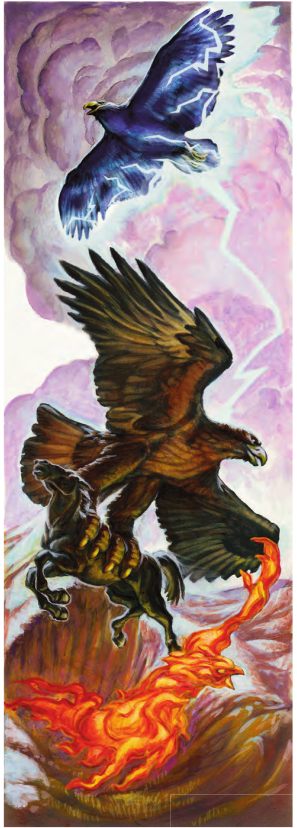
For starters, 4e phoenixes are a type of roc! Made of solid fire, they have an inexplicable hatred of undead despite being beasts, and are famous for their ability to self-immolate and be reborn from their own ashes. When a phoenix dies it might also leave behind a single scarlet feather (which is not made of fire). It can be used as a component of the Raise Dead ritual, allowing the caster to ignore its usual limitations: they can bring back someone who died up to a year ago, or grant 1 year of life to someone who died from old age.
Yeah, you heard that right, Phoenix Down is a thing. The book implies it’s only left behind by phoenixes when they die permanently, but if you want them to be a bit more common you could say it also happens even if they rise from the ashes.
You also have Thunderhawks, which are storm-themed rocs whose beaks and claws are infused with lightning, and who have some power over the wind around them. Storm giants love these things, and train them as a sport much like a human noble would train standard-sized falcons. Unlike a standard sized falcon, they’re quite useful in battle as well.
The Numbers
All rocs are Huge Beasts, with the common variety being Natural and the others Elemental. They all hop along at speed 4 on the ground, and fly at speed 10. They have trained Perception but no special ability to see in the dark, being daytime hunters. An owl roc with darkvision would be hella cool but is left as an exercise to the reader.
As usual for higher-level MM monsters, their damage is quite lower than it’s supposed to be and should be fixed if you intend to use them.
Common Roc
Common rocs (or just “Rocs”) are Level 14 Elite Skirmishers with 288 HP and standard traits. Their flight speed is tagged as clumsy, but that looks like an error to me given their main attack.
A roc’s basic attack is its Reach 2 bite, but what it really likes to do is a Claw Snatch. This maneuver allows the roc to fly its speed and make an attack vs. Reflex against a Medium or smaller target at any point in the movement. This does a little less damage than the beak, but a hit also grabs the target. The roc then flies the rest of its movement and drops the target prone on a space adjacent to its final position.
Now, with Claw Snatch it’s important to remember that diagonals are free in 4e movement. A flying roc that has just grabbed a target can climb 1 square for every square of horizontal movement it makes from that point on. So, when it drops the target at the end of the movement, they’re going to take falling damage. And if the fight happens as the party climbs a mountain intent on stealing some roc eggs, there will be lots and lots of cliffs and precipices around for Momma to drop the PCs into.
The size limitation being Medium doesn’t quite fit with the information that rocs hunt horses and cattle (which are Large). It’s an easy thing to change and shouldn’t impact fights much, since there are no Large PCs. It does mean the bird could lift a mounted PC with its mount, though.
Phoenix
Phoenixes are Level 19 Elite Brutes with 300 HP. This number is a little low, particularly when compared to the common roc’s total above, but that’s because a third of the phoenix’s total HP is hidden behind a gimmick, which we’ll see soon. They have 20 fire resistance, and Fiery Body aura 1 that deals 10 fire damage to peole who start their turns inside.
The phoenix’s bite is reach 2 and does physical damage with some ongoing fire damage (save ends). It can also use a Radiant Burst (close burst 5 vs. Reflex, recharge 6) that does radiant damage and dazes.
When first bloodied, the phoenix triggers its gimmick: Immolation. This causes an explosion (close burst 2 vs. reflex) that does fire damage, and kills the phoenix. At the end of its next turn, it rises from the ashes at full HP. This means phoenixes effectively have 450 HP. Immolation is a daily ability, so if the phoenix continues fighting after this it can be permanently killed in the usual way.
Thunderhawk
Thunderhawks are Level 22 Elite Soldiers with 420 HP. They have 20 resistance to lightning and thunder, which does indeed make them the ideal storm giant pets.
Their attacks are simple. The usual basic bite is reach 2 and does a mix of physical and lightning damage, with extra bonus thunder damage when used in a charge. As a minor action, they can cause a wind rush (close burst 2 vs. fortitude) that does no damage but knocks prone on a hit.
So after an initial charge, the thunderhawk will keep hovering just above its enemies, keeping everyone prone so its buddies can move in for the kill and biting as appopriate.
Sample Encoutners and Final Impressions
We have one sample encounter for each bird. You’re not really expected to fight them by themselves:
-
Level 14: 1 roc, 2 hill giants, 2 galeb durh rockcallers.
-
Level 19: 1 phoenix, 3 assorted fire archons. It’s only undead they hate - fire elementals might still tame them.
-
Level 22: 2 thunderhawks and 2 bralanis of autumn winds. It’s not just storm giants!
I’m a little surprised to see all big birbs share the same entry, but it makes sense. I liked the common roc’s “drag and drop” ability, and thunderhawks are cooler than I expected from my initial glance at their small stat block.
The phoenix is a bit weirder. I’d expect its immolation-and-resurrection act to happen when it hit 0 HP, not its bloodied value. I guess they didn’t do that because it would require a bigger exception (“the phoneix has 225 HP and no bloodied value”), but it doesn’t stop you from doing it in your home game if you wish. Not having a bloodied value is itself a kind if minor defensive ability, since it denies some PC their bonuses against bloodied enemies.
-
-
Let's Read the 4e Monster Manual/Vault: Rat
Copyright 2008 Wizards of the Coast This article is part of a series! Click here to see the other entries.
Rats have of course been in the game since its beginnings. They have an entry of their own in the Monster Manual and are present in the animal appendix in the Monster Vault.
The Lore
Rats are real world animals and have been historically reviled both for their propensity for eating people’s food stores and for carrying disease. That last one is something of an undeserved reputation, as the worst diseases are actually carried by fleas and not by the rats themselves.
Calling someone a “rat” is usually an insult implying cowardice, selfishness, and treachery, and D&D tends to ascribe these traits to rat-like monsters. Rats themselves are such a classic staple of low-level D&D play that they’re a bit cliche. “Clearing rats from a basement” was used as the tutorial quest for so many D&D-like video-games that the phrase has come to mean “trivial, boring and predictable adventure” on the tabletop.
In 4e, individual mundane rats are pretty much harmless to an adventurer, but they can be somewhat dangerous in large numbers, forming swarms which are likely more aggressive than their real-world counterparts. This being D&D, rats also come in Giant and Dire varieties, and these are indeed a lot bigger and more dangerous than their real-world counterparts.
The Numbers
Between both books we have no less than 5 rat-related stat blocks! Some of them are conceptually equivalent, but different enough that I think they’re worth discussing separately.
All rats are Natural Beasts, possess low-light vision, and have a climb speed.
Rat Swarm (MM)
A swarm of mundane rats is a Level 2 Skirmisher with 36 HP. As a swarm it takes half damage from single-target attacks and 5 extra damage from AoEs. It also has a Swarm Attack aura 1 that allows it to make a basic against any enemies who starts their turn inside. The swarm moves at speed 4 and climbs at speed 2.
Their only attack is a Swarm of Teeth that deals immediate and ongoing physical damage (save ends).
Realistically I think a rat swarm would be more interested in running away than fighting human-sized opponents, but this is D&D! Maybe someone is controlling them, or maybe they’re just plain mean. A swarm intent on fighting will likely park itself in a PC’s space and let the aura do most of the work, while using their standard attacks to put extra pressure on a specific PC.
They’re less dangerous than needlefang drake swarms because they can’t knock people down, but are otherwise a good example of a basic swarm monster.
Scurrying Rat Swarm (MV)
While conceptually the same monster than the MM Rat Swarm, this entry has a completely different stat block.
This rat swarm is a Level 1 Skirmisher with 27 HP and a ground speed of 6 (climb speed is still 2). It has the standard swarm resistance/vulnerabilities, and a Swarm trait in its stat block that helpfully summarizes the other rules it follows.
Its Swarm Attack aura 1 does a bit of automatic damage and slides enemies inside 1 square. The Swarm of Teeth basic attack does more base damage, and does extra damage if the rats moved at least 2 squares this turn.
This results in a rather more skirmisher-y monster that will keep running around for the damage bonuses rather than parking itself somewhere. Opportunity attacks are a minor concern for it, because it’s going to take half damage from most of them.
Giant Rat (MM)
Big enough to be a threat all by themselves, giant rats are Small in size, though probably on the smaller side of that. They’re Level 1 Minion Brutes with a speed of 6 (climb 3) and a basic bite attack that does “minion” damage. That’s all!
In practice you’ll still want to use a “swarm” of them, only now you’re tracking each rat individually. They’re about equivalent to the classic giant rats of editions past, which had like 1/4 HD.
Dire Rat (Both)
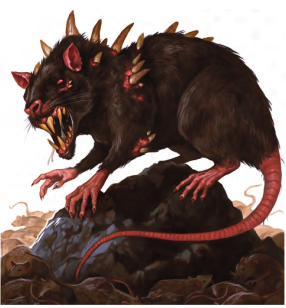
Dire Rats are even bigger than giant ones, and have that spiky aesthetic common to all D&D dire animals. They’re aggressive enough to actively start fights with the PCs even when they’re not cornered, and unlike their less terrible counterparts they do spread nasty diseases directly. There’s some disagreement as to their size category: the MM says Medium, the MV says Small. Either way we’re well into Rodent of Unusual Size country. Their speed is 6 (climb 2).
These beasts are simple Level 1 Brutes with 38 HP. Their only attack is a basic bite that does physical damage and spreads Level 1 Filth Fever. As usual for disease-vector monsters, infection is automatic under MM rules, and only happens if you fail a save after the combat under MV rules.
Sample Encounters and Final Impressions
The sample encounter is level 3: 2 kobold slingers, 2 rat swarms and 3 dire rats.
So yeah, if you were wondering who would train attack rats, there you have it. Kobolds do it, and goblins certainly do it too since they’re supposed to be adept beastmasters. Dire rats also tend to obey wererats.
I was never a rat enthusiast, and these stat blocks don’t sway my opinion. At the same time, I guess I’d feel like something was missing if the monster book didn’t have rats. The MV versions are slightly better, though there’s not much difference in damage for level 1 monsters.
-
Let's Read the 4e Monster Manual/Vault: Rakshasa
This post is part of a series! Go here to see the other entries.
Rakshasas are inspired by Indian mythology and have been in the game from the days of AD&D 1st Edition. In Fourth, they’re in both the Monster Manual and the Monster Vault.
The Lore
Rakshasas are evil spirits encased in flesh. In their natural forms, they look like humanoids with the heads of great predatory cats, usually tigers. Their hands are also “inverted”, with the palms located where the back of a human’s hand would be and vice-versa. This looks odd, but doesn’t impact their dexterity in any way.
A rakshasa’s greatest desire is to accumulate lots of wealth and power and to spend eternity surrounded by luxury and vice. They have absolutely no moral qualms when it comes to achieving these goals, of course. Rakshasas are highly skilled at fighting, arcane magic, and many other skills they had time to hone during their centuries of life.
While each individual’s abilities vary as much as those of player characters, each Rakshasa has enough skill at illusion to be able to disguise itself as any humanoid. They use this to infiltrate mortal society in order to achieve those positions of power. Why go to the trouble of building a kingdom yourself when you can just gank some king and replace him? And then maybe kill his family off so you can replace them with your own buddies and hangers-on?
In other words: you know all those nasty rumors people spread about doppelgangers? Turns out it’s the rakshasas who do most of those things. And since the doppelganger entry describes them as mostly just people trying to live peaceful lives, I wouldn’t be surprised if the rakshasas were responsible for pinning their own misdeeds on innocent doppelgangers. A setting that includes both cat-folk and rakshasas will also see the former shoulder some of the later’s bad reputations.
Fighting rakshasas is difficult. First you have to figure out who it is. Then you need to deal with its entourage of lackeys (unwitting or not). And only then will you fight the beast itself. Even if you kill one, it will reincarnate elsewhere in the world after a period of time wandering as a tormented, bodiless spirit. Reincarnated rakshasas come back as full adults with all of their memories and abilities, and are quite likely to try to get some payback on whoever killed them. Legends say a rakshasa can only be truly slain by a blessed weapon that pierces its heart.
The Monster Manual says that the origins of Rakshasas are shrouded in mistery, but that most sages believe they descend from demons who escaped from the Abyss and er, spawned in the world. Rakshasas themselves scoff at this notion. Demons are too uncouth to have produced such refined creatures as they!
The Monster Vault gets more specific: a Rakshasa is what happens when a Deva goes bad. Devas are a playable race introduced in the Player’s Handbook 2, and occupy roughly the same narrative space as aasimar from previous editions but in a cooler way. They have that “immortal spirit encased in flesh” thing going on, and reincarnate as fully formed adults when they die, with little memory of their past lives.
Devas have ties to the Astral Sea and to the forces of good, but when a Deva turns to evil they come back as a Rakshasa when they next reincarnate. Theoretically, if a Rakshasa repents and rejects its evil ways, it will become a Deva again in its next incarnation, but such an event has yet to be recorded.
The Numbers
Rakshasa are Medium Natural Humanoids, with a land speed of 6 and low-light vision. Their signature ability is Deceptive Veil, a minor action illusion that allows them to disguise themselves as any medium humanoid. Piercing the disguise requires an opposed Insight test versus their Bluff. Obviously, all Rakshasa have pretty good Charisma and are trained in Bluff. The MV version puts less emphasis on skills and has a fixed DC equal to 20+the level of the rakshasa. Given they’re usually Paragon-tier, this leads to “spot the doppelganger” levels of difficulty.
There’s no less than six different stat blocks for rakshasas across both books, five in the MM and one (plus two updates) in the MV.
Rakshasa Warrior (Both)
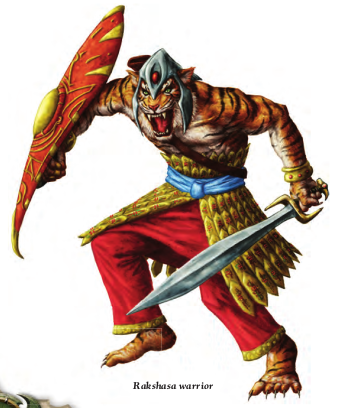
Copyright 2008 Wizards of the Coast What passes for a “foot soldier” among Rakshasa, you can likely find them acting as elite bodyguards for their higher-ranked overlords. Warriors are Level 15 Soldiers with 142 HP and all common Rakshasa traits. Both versions are good physical combatants, and the MV one has a few more magical tricks at its disposal.
Warriors wear scale armor and wield heavy shields and longswords. Their longsword attacks have them roll twice and use either result, meaning they always have 5e Advantage on them. A hit does some damage and marks the target for a turn.
They can also attack with their claws, which are just a weaker basic attack in the MM but have an ongoing damage (save ends) rider on the MV, meaning you actually have a use for them there.
If a marked enemy within 5 squares shifts or attacks someone else, the warrior can use a Tiger Pounce to close the distance and make a claw attack. The MM version shifts, the MV one teleports.
The MV Warrior also has an Illusory Ambush minor-action encounter power that performs a complex switcheroo: it turns the warrior invisible, creates an illusion of it on the same square, and allows it to shift its speed. The transition is indistinguishable to observers and the effects last for a turn or until the illusion is attacked.
Rakshasa Archer (Both)
Archers are level 15 Artillery with 110 HP and all common traits. They fight in melee with their Claws (which have a small ongoing damage rider in the MV) and at range with their ornate longbows. They can make two basic longbow attacks against different targets as a standard action. The MV version also applies 5e Advantage to its basic longbow attacks.
Instead of making a normal or double attack, the archer can opt to use a Ghost Arrow (Ranged 20 vs. Reflex; recharge 5-6) which does necrotic damage and prevents the target from spending healing surges (save ends).
Aside from Deceptive Veil the MV version also has Illusory Escape, which pulls the same switcheroo as the warrior’s power, but triggers when the archer is hit by a ranged attack. It recharges when the archer is first bloodied.
Rakshasa Mage (MV)
Rakshasa Mages are Level 16 Controllers with 153 HP, all common traits, and a whole lot of illusion spells. They make it almost impossible for the PCs to keep to any sort of formation, since all of their abilities do something even if they miss.
The mage’s most common attack will likely be Misleading Visions (area burst 1 with 5 vs. Will; enemies only), an illusion that does psychic damage and slides the targets 4 squares on a hit. On a miss, it still slides them 1 square.
A bit less often, it will intensify those illusions into Visions of Terror (area burst 1 within 5 vs Will; enemies only; recharge 5-6), which do greater psychic damage and immobilize (save ends). On a miss, they still do half damage and slow for a turn.
They can also create Persistent Images as minor actions. These may represent any Medium or smaller object or creature, and can be animate, but produce no noise. They appear with 10 squares of the mage, and it’s a DC 22 Insight check to realize they’re illusions. That’s easy for mid-paragon characters, but they still have to take the time to analyze the illusion. The image lasts for a turn, but the mage can both sustain it and move it 6 squares with a single minor action.
If the PCs manage to cut through all the bullshit and close to melee range, they’ll find the rakshasa mage is quite proficient with its Claws, which do respectable damage and teleport 3 squares on a hit. Even a miss still teleports the target 1 square.
Rakshasa Assassin (MM)
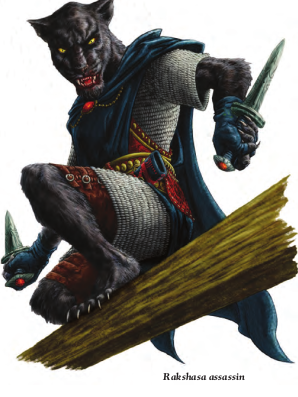
Copyright 2008 Wizards of the Coast This black panther Rakshasa is a Level 17 Skirmisher with 160 HP and all standard traits.
Assassins fight with paired shortswords, and they can perform two basic melee attacks per standard action. They also deal extra “sneak attack” damage with combat advantage. The quotes are important here - if they attack twice, both attacks get the bonus damage, unlike what happens with PC rogues.
Aside from the usual Deceptive Veil, they also have a couple of ninja skills. Shadow Form gives them phasing during any turn in which they move more than 2 squares. Phantom Distraction (close burst 1 vs. Will; recharge 5-6) is a minor action that does no damage but dazes for a turn on a hit.
Rakshasa Noble (MM)
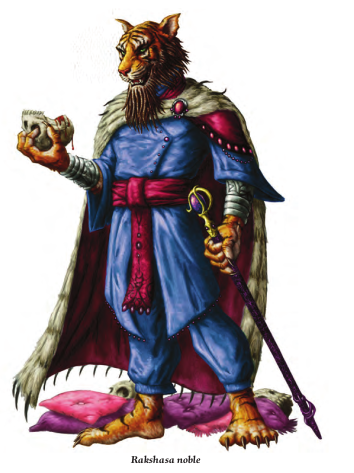
Copyright 2008 Wizards of the Coast Nobles are basically slightly stronger mages with a different illusion repertoire, and are the people warriors, archers, and assassins serve. They’re Level 19 Controllers with 178 HP and all standard traits. Their native speed goes up to 7.
As a minor action they can use a Phantom Image (recharge 5-6) to essentially give 5e Disadvantage to all attacks made against their AC or Reflex that turn. If either result is a critical, though, it’s the one that counts. There’s a bit of increased risk there.
The noble’s main attack spells are Mind Twist (Ranged 20 vs. Will) and Phantom Lure (Ranged 10 vs. Will). The first does psychic damage and dazes (save ends). The second does no damage and slides the target 5 squares.
Every so often the noble can cast a Frightful Phantom (Ranged 5 vs. Will; recharge 5-6), which does a heap of psychic damage, pushes the target 5 squares and stuns it (save ends).
If all else fails, the noble has to resort to its weak Claws, which do a bit of damage and blind for a turn on a hit. They’re more of an aid to get away from melee range than a proper attack.
Rakshasa Dread Knight (MM)
This is at the level range that could represent one of Eberron’s feared Lords of Dust. It’s a Level 24 Soldier with 220 HP and all common traits. Dread Knights project an Aura of Doom (5) that cuts surge-based healing in half for any enemies inside.
Thei fight with Longswords in melee that have that “roll twice and use the better result”/”5e Advantage” bonus, and also mark for a turn. Dread Knights can use a standard action to make three such attacks against the same target, and if at least two hit the victim is also dazed (save ends). That’s a lot of d20’s hitting the table at once.
They can also use Claw attacks, though these are nothing special. They could benefit from an ongoing damage rider like the MV updates.
For utility, aside from Deceptive Veil they can use a Knight Move to fly 6 squares as a move action, though they must land at the end.
Dread Knights are a bit mechanically simpler than I imagined, but they’re still dangerous and won’t be alone when encountered.
Sample Encounters and Final Impressions
We have a whole bunch of sample rakshasa encounters here, ranging from level 15 to 24. They all follow a similar theme, being basically what you fight at the end of the adventure after uncovering the rakshasa plot and getting past the unwitting entourage. The groups consist either of all-rakshasa Evil Parties, or 1-2 rakshasa and a group of dangerous pets or other equally evil co-conspirators (yuan-ti, cambions, devils).
I’m a cat person, so I quite like these villains based on looks alone. You want to pit your party against Shere Khan, you use a Rakshasa. Given their decadent nature and tendency to collaborate with devils, you might also be able to use them as a metaphor for how big corporations have an affinity for fascism. If rakshasa existed in the real world, people like Zuck, Musk and Thiel would be serious candidates for being evil tigers in disguise.
-
Let's Read the 4e Monster Manual/Vault: Quickling
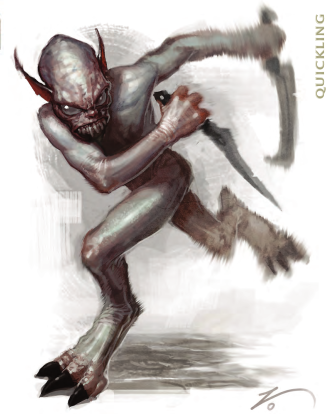
Copyright 2008 Wizards of the Coast This post is part of a series! Go here to see the other entries.
Quicklings have been around since AD&D 1st Edition, where they appeared in the Monster Manual II. Here, they appear only in the Monster Manual.
The Lore
Quicklings are wicked fast and just plain wicked. They’re little serial killers who like to knife others for food, loot and sport. The last two mean they definitely don’t restrict themselves to hunting animals.
Their preferred tactics are clever ambushes, and they do their best to never stand still in a fight. Quicklings often ally with fey and other creatures that share their proclivities, and I imagine they’re not above working as mercenaries.
The 4e illustration is a lot more monstrous than the one in the AD&D Monster Manual II, which was just a little foppish dude. One interesting bit of lore in 1e is that quicklings might be brownies who delved too deep into forbidden magics. You can certainly use that explanation if you want to, but it’s also entirely appropriate for them to be their own species of Feywild nightmare creature.
Speaking of that, Quicklings often leave the Feywild and stalk the world looking for good “opportunities”. They’re highly intelligent and so might be down for whatever evil scheme your villains are hatching this week even if they’re not the main opposition.
The Numbers
We get two stat blocks for quicklings here. Both are Small Fey Humanoids with low-light vision and a fantastic land speed of 12. Their AC and Reflex are also notably higher than the expected for their level.
Quickling Runner
This Level 9 Skirmisher has 96 HP and all common quickling traits. It also gains a further +4 bonus to AC against opportunity attacks.
The runner’s basic attack is a short sword, which it can also use in a maneuver called Quick Cuts. This allows the runner to move its speed (12) and make two basic attacks at a -2 penalty at any two points during the move. This is an at-will attack, but it cannot be used while the quickling is immobilized or slowed.
To bring the runner’s damage up to the new baseline, you need to either update its base sword damage or remove the -2 penalty from the Quick Cuts attacks. Quick Cuts is going to be its most frequent attack, and you should be trying to move past the party’s front line and into the ranged squishies to apply it. That +4 against OAs sure helps.
Once per encounter the quickling can perform a Fey Shift, shifting 10 squares as a standard action. It’s likely to use this to escape when it sees the fight isn’t going in its favor. If this was a move action instead, it would be a good initial maneuver to get to those squishies from ambush.
As a minor action, it can also Maintain Mobility (recharge 4-6), which automatically ends any immobilization applied upon it.
Quickling Zephyr
Not just a higher level runner, the Zephyr is a bit more subtle. It’s a level 14 lurker with 82 HP and all common quickling traits. It also fights with a short sword which is even more in need of a damage update than the runner’s.
As a move action, the quickling can use Blinding Speed (recharge 4-6) move its speed and become invisible, which lasts for a turn or until it attacks. It’s a cheap way of getting combat advantage, despite not being always available. The zephyr’s Unstoppable trait allows it to ignore all difficult terrain and to run across any solid or liquid surface, so it can be safely employed in the gnarliest of maps.
If it attacks with combat advantage, the zephyr deals some additional sneak attack damage, though that would also need a boost to be in line with the new math.
Sample Encounters and Final Impressions
We get a single level 9 sample encounter: 1 quickling runner, 1 eladrin twilight incanter, and a feymire crocodile.
Going by lore and level, quicklings should also be able to work well with banshrae, lamias, hags, and the occasional ogre, troll, or oni.
The stat blocks we’re given do roughly half the damage the new math says they should, but once you update them they’re quite usable. The quickling’s speed can certainly be played up for a bit of horror. “You see a quickling in the distance. You blink and it’s right next to you, its sword already in your spleen.”
-
Let's Read the 4e Monster Manual/Vault: Purple Worm
Purple Worms have been in D&D since at least the days of BECMI, and are likely inspired by the sand worms of Frank Herbert’s Dune. They’re in both the Monster Manual and Monster Vault.
The Lore
Believe it or not, purple worms were not created by some drug-addled wizard or vengeful primordial. They’re entirely natural creatures, just like cats and dogs. Or drakes. Or behemoths. Or bullettes. Yeah, the world of D&D is kind of a dangerous place.
Large enough to swallow a giant whole, purple worms burrow through the Underdark and through rocky and mountainous terrain on the surface. They’re not always hungry, but their feeding strategy is gorging themselves about once a week so the end result is more or less the same. They’re such efficient tunnelers that you can’t tell they’re coming until they’re almost directly underneath you. They also have a knack for showing up precisely when people think things can’t get any worse. Large Underdark settlements are always protected by a perimeter of anti-worm wards, and when these settlements war with each other sabotaging those wards is a popular move.
Unlike the Dune sand worms, purple worms can burrow through solid rock just fine, and in addition to their cavernous maws some have a venomous stinger on the tip of their tails. They dig by eating the rock or soil and quickly excreting it, though stuff like refined metal, precious ores and gems have a tendency to stick in the worm’s gut for longer periods. So if you manage to kill one, its gut may contain treasure!
Purple worm tunnels are very large and permanent, and they don’t reuse them. An area rich in food might have several purple worms hunting it, and will end up looking like a labyrinth. Worm tunnels tend to become important natural roads in the Underdark, and it’s not uncommon for smaller creatures to move into them right after the worm passes them by. Instant ecosystem!
These beasts are impossible to tame, but people keep trying to use magic to control them. Drow and illithids can’t resist their potential as a weapon, and dwarves can’t resist their potential as a construction tool. I mean, a purple worm could likely have dug the tunnel under the English Channel in a fraction of the time the real-world construction crew took.
Of course, it’s pretty much inevitable that these spells will wear off at the worst possible time, leading to disaster. After digging the tunnel, that same purple worm would have likely delivered a much quicker and less painful Brexit by eating Britain.
The Numbers (Monster Manual)
Purple Worms are Natural Beasts with the Blind keyword. They have both tremorsense 20 and blindsight 10, plus a respectable burrow speed with Tunneling. We have two stat blocks here.
Purple Worm
The basic model is Huge, and a Level 16 Solo Soldier with 780 HP. As a blind creature, it’s immune to gaze attacks, and also immune to illusions. It crawls at speed 6, and burrows at speed 3.
The worm’s basic attack is a Reach 3 Bite that, unlike most basic attacks in the book, targets Reflex. No amount of armor is going to protect you from it! A hit does damage and grabs the target (Athletics DC 34 or Acrobatics DC 30 to escape).
Once the worm has grabbed a target, it can “worry” it with its Clamping Jaws, which has the same accuracy vs. Reflex and damage as a basic bite but does half damage on a miss.
It can also try to Swallow them. This targets the Fortitude of the victim. On a hit, the target gets swallowed and is now inside the purple worm. The victim is considered dazed and restrained, and only has line of sight and effect to the worm. Also, no one has line of sight or effect to the victim.
While swallowed, the victim can only make basic attacks, and takes 10 physical and 10 acid damage at the start of the worm’s turns. The only good news here is that the worm’s AC is like 8 points lower from the inside. The only way to escape is to kill the worm, which causes the victim to be regurgitated.
The worm can’t bite other people while it has a target grabbed in its jaws, but it can fight normally after swallowing. There’s no mention of how many victims fit in its gullet. “One” is the merciful answer, but “1 Large or 2 Medium or 4 Small” is traditional.
Elder Purple Worm
Elder Purple Worms have grown to size Gargantuan (the largest possible under the rules). They’re large enough to swallow titans! Elders are Level 24 Solo Soldiers with 1145 HP and the same immunities as the younger specimen. Their land speed is 8 and their burrowing speed 4.
The elder’s attacks are exactly the same as those of the basic worm, with bigger numbers. Their AC is 7 points lower from the inside, and their digestive damage is 20 physical and 20 acid per turn. Again there’s no mention of how many creatures fit in the worm’s gullet. The traditional answer would be “1 Huge or 2 Large or 4 Medium or 8 Small”, but it might be a tad unfair to allow it to swallow the whole party.
The Numbers (Monster Vault)
Purple worms in the Vault are fairly different, and generally more adequate for use as solo encounters. We also get two stat blocks, and both are Huge Natural Beasts (blind).
Adult Purple Worm
Adult Purple Worms are Level 14 Solo Brutes with 560 HP. Not sure if I mentioned this before, but the new monster math also gives solos less HP. Their tremorsense and blindsight are both range 10, and they both crawl and burrow at speed 6.
As a MV Solo, this worm has some traits that help it stand up to a paragon party: Ponderous allows it to take immediate actions while stunned, dazed, or dominated; and Bloodied Frenzy allows it to take an extra minor action in its turn while bloodied.
The basic Reach 3 Bite now targets AC, and has no riders to its considerable damage. All the gizzard gimmicks are now packed into the Devour Whole attack (Melee 3 vs. Fortitude). A hit here does similar damage to a bite and swallows the target.
Being swallowed here is a little less nightmarish than for the MM version. The restrictions on line of sight and effect still apply, and the victim is off the board and so obviously can’t move around. However, they are no longer dazed or restrained, and can use any of their attacks against the worm. They can even try to crawl out of its gullet as if escaping from a grab, rolling against a lenient DC of 21.
On the other hand, the worm’s defenses are the same from the inside now. Swallowed victims take 30 acid damage at the end of their own turns, and any close or area attacks used from inside the worm also target all other creatures swallowed by it. While we still get no word on what’s the limit for those, we do have explicit confirmation that there can be more than one. So you can choose between the traditional answer and “no limit”!
This worm also has a lot of other options to bring pain to the party, all of them minor actions. Fling (Melee 3 vs. Fortitude) deals damage and slides the target 4 squares; Regurgitate spits out a swallowed victim, making it appear within 4 squares of the worm and take a chunk of automatic damage; and the Poison Stinger (Melee 3 vs. Fortitude) mentioned in the Lore section does a bit of physical damage and 15 ongoing poison damage (save ends). With Bloodied Frenzy active, it can do all three and still swallow someone.
You also have Thrash, a reaction that triggers whenever an attack hits the worm. It’s a Melee 3 attack vs. Reflex, targeting one or two creatures, doing the same damage as the bite and pushing them up to 6 squares. This is why it has Ponderous!
Purple Worm Tunneler
This specimen is quite a bit faster, and likely the one you want to use for your Eurotunnel/Brexit combo. It’s a Level 19 Solo Skirmisher with 728 HP. Its land and burrow speeds are 8.
The tunneler has the same Ponderous and Bloodied Frenzy traits as the basic model. Its Bite does damage and allows it to shift half its speed on a hit. Devour Whole also works the same, with an escape DC of 24.
As a move action, the tunneler can Barrel Through its foes, shifting its speed and making an attack against the Reflex of every enemy it passes adjacent to. A hit here does a bit of damage and pushes the target 2 squares.
The tunneler also has a bigger stinger, since its minor-action attack is Stinger Impalement (Melee 3 vs. AC). This does more physical damage than the basic worm’s stinger, slides the target 4 squares, and deals 10 ongoing poison damage (save ends). There’s no limit to the number of times per round it may do this, so you’re looking at up to three impalement attacks plus a devouring when the worm is bloodied.
Finally, it also has Thrash, which works the same way with bigger numbers.
Sample Encounters and Final Impressions
The Monster Manual has a level 18 sample encounter: 1 purple worm, and 2 savage minotaurs.
Purple worms don’t cooperate with anyone, of course, but they’ll often be attracted by fights against other monsters and try to eat everyone present, just like Bullettes but on a bigger scale. In other words, purple worms are just the thing to use on a party who’s all happy that they’ve outgrown bullettes.
I like purple worms! I don’t think they’re exclusive content, but they’re still a very D&D kind of monster. In previous editions I kinda felt they suffered from the same problem as dragons, looking so powerful that people rarely put them in their games. Here, I have a better handle of when they’re appropriate.
subscribe via RSS