Posts
-
Let's Read the 4e Monster Manual/Vault: Sahuagin
Copyright 2008 Wizards of the Coast This article is part of a series! Click here to see the other entries.
Sahuagin have been in the game since at least AD&D 1. Here, they are present in the Monster Manual, and get an update in Dungeon 193.
The Lore
Back when I talked about Kuo-Toa, I mentioned I had a hard time distinguishing between the various types of “fish people with spears”. At last, we have a chance to figure out what makes kuo-toa and sahuagin different.
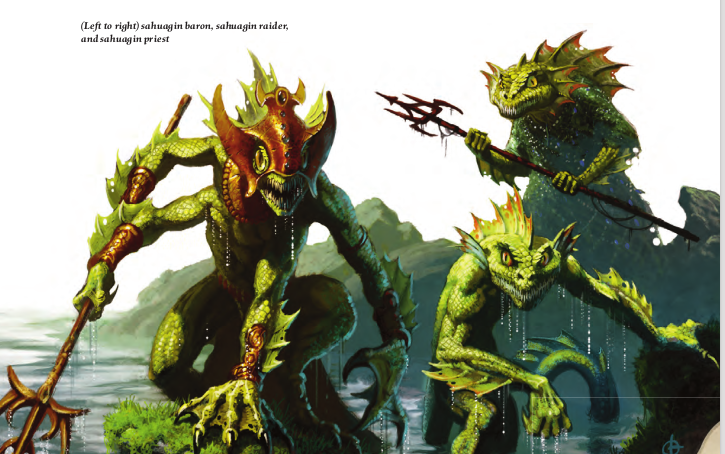
Sahuagin are also known as sea devils because they tend to be murderously hostile to everyone who isn’t them. These fish people are said to share several characteristics with sharks (though you can’t really see it in the illustration).
They build settlements in coastal waters using materials like stone and coral. These range in size from small villages to cities with six thousand inhabitants or more. Sahuagin society is patriarchal and heavily hierarchic: each village is ruled by a baron; princes rule groups of up to twenty villages; and each sahuagin kingdom is ruled by a king living in one of those cities.
These kingdoms seem to claim both their surrounding waters and the nearby coasts as territory. Though sahuagin sometimes trade with other people living in this territory, they’ll almost always raid their settlements and ships instead, taking what they want.
Sahuagin are deeply religious and I guess a lot of their orneriness comes from their choice of deity: they venerate Sekolah, a shark god who is one of Melora’s exarchs. Female sahuagin have an hierarchy of their own that emphasizes their role as priests, teachers, and loremasters. The main tenets of their culture and religion can be summed up as: “always be the hunter and not the hunted”; “if an action is successful, then it is right” and “meat is meat”. That last bit means they have no qualms about eating anyone, even their own when they get too weak to hunt.
Despite such brutal teachings Sekolah is still a god. Both it and its favored people hate demons with a passion, particularly Demogorgon and Dagon. So yeah, there might come a time when the party finds itself on the same side of a battle as a bunch of sahuagin.
One last bit the MV touches on is that the sea devils are very prone to genetic mutation, so lots of them have some deviation from the “typical” sahuagin form. Some of these are very prized, such as the one that gives an individual four arms and marks them as suitable for the mantle of nobility. A rare and reviled mutation is the one that produces “malenti”, sauhagin so deformed and ugly by the standards of their society that they almost resemble greenish sea elves. Considered pariahs in saghuagin society, they’re employed as ambassadors and spies to people who think they’re pretty. Their true mission is almost always to set up a backstab rather than to engage in any diplomacy in good faith.
So, in the end, what distinguishes a sahuagin from a kuo-toa? Both are deeply religious and universally hostile fish people who like hafted weapons, but:
-
Sahuagin inhabit the surface world, Kuo-toa the Underdark.
-
Sahuagin use tridents, kuo-toa use spears and harpoons.
-
Sahuagin worship Sekolah, Kuo-toa worship aboleths and/or some cthulhoid entity.
-
Sahuagin are scaly, kuo-toa are slimy.
-
Sahuagin have pretty infiltrators, kuo-toa do not.
The Numbers
Another difference is mechanical: kuo-toa are levels 14-16, while sahuagin are levels 6-10. So there is a kind of power ladder for fish people too.
Most sahuagin are Medium Natural Humanoids, though the four-armed nobles are Large. All have the Aquatic keyword, low-light vision, a land speed of 6 and a swim speed of 6 or 8.
Most sahuagin fight with tridents, which can be used in melee or thrown. The MM version has range 3/6 when thrown, and the MV version has range 5. The MM makes it explicit that the trident must be retrieved to be used in melee again, since most sahuagin only carry a single one into combat. It wouldn’t be hard to say they have two so they can thrown one as they approach.
Their signature ability is Blood Frenzy, which gives them a +1 to attacks and +2 to damage against bloodied enemies, and is an extra incentive for them to gang up on such targets.
Aside from the updated damage, the stat blocks from Dungeon are identical to the MM originals.
I’m including a small bonus here: a stat block for sharks. Though the Monster Manual lore for sahuagin mentions sharks several times, it includes no stats for sharks anywhere within it, leaving that as an exercise to the reader. The Monster Vault, despite not containing sahuagin, has stats for sharks in its animal appendix.
Shark (MV)
This can stand in for any species of shark large and aggressive enough to target humans or pal around with Sahuagin. It’s a Medium Natural Beast with the Aquatic keyword, and a Level 5 Brute with 75 HP. It swims with speed 8, and if the PCs ever push it into dry land it will only be able to flop around at speed 1 (clumsy). It has low-light vision, though you should probably give it some form of blindsense as well if you want to be realistic.
Sharks attack with a bite, of course, and the Aquatic trait means they’ll pretty much always have a +2 attack bonus on that. They also have a Blood Frenzy trait which gives them a further +2 to attacks and +4 to damage against bloodied creatures.
Sahuagin Guard
These are Level 6 Minion Brutes, with all the standard traits above. Their swim speed is 6.
Like pretty much all sahuagin, they fight with tridents, which can be used in melee or thrown, and have no other special attacks.
Sahuagin Raider
A non-minion version of the Guard, it’s a Level 6 Soldier with 70 HP. It fights with the same weapons and tactics, and has an extra ability: Opportunistic Strike, a reaction that allows it to attack a flanked enemy that shifts.
They’ll cooperate with other raiders and melee monsters to keep enemies flanked.
Sahuagin Priest
Priests are level 8 Artillery with 70 HP. They have all standard traits and their swim speed is 8.
They have the usual trident that can be used in melee or thrown, but they also have much better ranged options. Water Bolt (ranged 10 vs. AC) does physical damage, and has double the range and a damage bonus when used underwater. Spectral Jaws (ranged 20 vs. Will) makes shark jaws appear and bite into the target. This does a good chunk of physical damage, and inflicts both ongoing physical damage and a -2 penalty to all defenses (save ends both). It recharges when the target makes its save.
All of those magic attacks benefit from Blood Frenzy, by the way.
Sahuagin Baron
Barons are Large, and have four arms. They’re Level 10 Elite Brutes with the Leader keyword, 256 HP, and a swim speed of 8. They emit a Blood Healing aura 10 that heals every ally inside that starts its turn adjacent to a bloodied enemy for 5 HP.
Barons fight with the usual trident but also with their claws, which count as a second basic attack. Baron’s Fury allows them to attack with the trident and two claws per standard action.
Barons upgrade the usual Blood Frenzy to Blood Hunger, which gives them +2 to attacks and +5 to damage rolls against bloodied enemies.
We get no stats for princes or kings, but it’s possible they’d use the baron stats, maybe with a few added levels.
Sample Encounters and Final Impressions
Most sahuagin encounters will be against all-sahuagin groups, since they’re pretty xenophobic. The main exception, surprisingly, is vampires: they and the sahuagin apparently bond over their shared love of blood. Underwater encounters might involve pet sharks, too.
-
-
Let's Read the 4e Monster Manual/Vault: Rust Monster
Copyright 2008 Wizards of the Coast This article is part of a series! Click here to see the other entries.
Rust Monsters are a D&D original, inspired by some cheap plastic “dinosaur” figures Gygax had lying around and intended to use as miniatures. In 4e they first appear in the Monster Manual 2 and later in the Monster Vault, so we’ll be peaking ahead a bit.
The Lore
Rust monsters came about naturally, even though plenty of people swear they were created by a spiteful god who thought mortals had too much shiny stuff. Everyone hates these things.
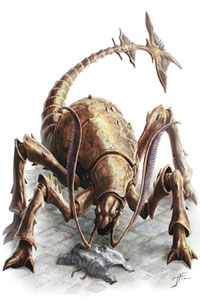
Rust monsters feed on metal, by secreting powerful enzymes which dissolve it and slurping the slurry. Normally they target ore veins and leech the metal out of them, but items made of processed metal draw them like blood in the water draws sharks. Since food is usually scarce, rust monsters tend to have only one or two young per brood, but when they find a plentiful source of metal like a lode or a civilized settlement, their broods increase in size to make use of that bounty.
It’s not just adventurers who curse these creatures! They get into civilized settlements and mines and eat away at all the metal tools, fittings, and support beams if you let them. Some dwarf and duergar settlements develop complex wards to keep them at bay, but their effectiveness is limited - some rust monsters have a knack for finding holes in them.
The bright side of all of this is that rust monsters can be a source of residuum, that precious substance which is used to fuel magic rituals and enchant items. You see, most of them can’t digest magic, so any magic impregnating the metal they eat ends up stored in their bodies as clumps of residuum. This is enough incentive for some people to go out hunting rust monsters, despite the risks to life, limb, and loot.
Some rust monsters are able to digest residuum, which causes them to grow much larger and to crave magic as much as they do metal. These enhanced monsters are known as Dweomer Eaters.
A Note on Residuum.
Residuum gets introduced in the PHB, so I haven’t talked about it too much here. It’s basically concentrated, crystalized magic: I imagine it as rainbow-colored sparkly dust. The rules measure it by its monetary value (for example, “100gp worth of residuum”), so I imagine it’s extremely valuable for its weight and only found in tiny quantities.
When you disenchant a magic item using a ritual from the PHB, you get a fifth of its monetary value back as residuum, which ensures you can always get some benefit even from items no one in the party wants. The substance can be used in place of the traditional components for any ritual, no matter what its power source is. And of course, Enchant Item is a ritual, so you can use it to make other magic items as well.
The Numbers
Most rust monsters are Medium Natural Beasts, though Dweomer Eaters are Large. They have low-light vision.
In earlier editions rust monsters could destroy metal weapons, armor and items instantaneously, but this has become a more gradual process in 4e. Even so the MM2 has this big box about being careful with rust monsters, because players loathe losing their magic loot even more than they fear losing their PCs.
Usually, at most one of the party’s items risks total destruction at the antennae of a rust monster per fight, though that danger multiplies if you’re fighting more than one and the penalties it inflicts can make fighting the other monsters in the encounter more difficult than they would otherwise be.
Rust Monster (Both)
Basic rust monsters are Level 6 Skirmishers with 66 HP. Their speed is 8, so you can’t easily run from them once they catch the scent of your expensive gear.
A rust monster’s bite does physical damage and rusts any heavy armor the target might be wearing. Rusting armor has a -1 penalty to AC, and multiple bites increase this to a maximum of -5. This only lasts until the end of the encounter.
Rusting Defense means attacking the monster with a metal weapon also rusts it, which inflicts a -1 penalty to attack rolls and is cumulative to a maximum of -5.
Rusted weapons and armor return to normal after the end of the encounter, so this is not quite as bad as it looks. However, the monster can target a rusting weapon or suit of armor with its Devour Metal ability (melee 1 vs. Reflex), which destroys the item in question on a hit!
If the destroyed item was magical, you’ll be able to retrieve residuum from the monster’s belly equal to the full value of the item, which doesn’t necessarily ensure you’ll get your item back but is still a bit of a consolation prize.
The main difference between books, aside from the usual damage update, is in how Devour Metal works. The MM2 version only affects magic items of 10th level or less (or nonmagic items), and is an encounter power. The MV version is actually more dangerous: it has no level limit and recharges when the monster misses with it, which means it can keep trying until it manages to destroy something.
Fighting a rust monster still produces that funny inversion effect where the squishies wearing cloth and bearing wooden weapons move to the front line and the fighters cower in the back, but now the fighters aren’t instantly doomed the moment the monster slips by the squishies.
Gluttonous Rust Monster (MV)
This Level 8 Brute has 110 HP, Speed 6, and all the abilities of the basic rust monster above.
In addition, it has a Gluttonous Bite encounter power (melee 1 vs. AC) which does more damage than the basic bite and rusts the target’s weapon and armor at the same time. On a miss, it does half damage.
Young Rust Monster Swarm (Both)
This is what you get when a couple of rust monsters nests close to a large source of metal. The swarm is a Level 9 Soldier with 92 HP. As a swarm, it takes half damage from single-target attacks and 10 extra damage from area effects. It can also squeeze through any opening wide enough to allow a single rustling through.
The swarm has Rusting Defense and its Swarm of Bites also rusts armor. Its Swarm Attack aura 1 deals 5 damage to enemies caught inside and, if they have a rusting item on them, slows them for a turn.
Dweomer Eater (MM2)
Dweomer Eaters are Large, and Level 11 Skirmishers with 110 HP. They work pretty much like standard rust monsters, with bigger numbers. There is one important difference, though: their rusting abilities target not metal, but magic.
This means that any magic armor or weapon used by the party, no matter what material it’s made from, is at risk when fighting a dweomer eater. Mundane items are fine, but that is scant consolation for a level 11 party typically clad in +2 or +3 armor and weapons. Yes, if you hit them with spells channeled through a magic implement, the implement rusts even if it’s made of wood or crystal.
You can still extract residuum equal in value to any items destroyed by a dweomer eater from its corpse, at least.
Sample Encounters and Final Impressions
The encounters we have in the MM2 place rust monsters alongside creatures which don’t usually employ metal weapons, such as lizardfolk that fight unarmed or with magic, and certain faeries. I don’t think you can train a rust monster not to eat your metal weapons, so people who rely on steel won’t be using them as pets.
I like rust monsters! The original versions terrified me as a player, but the kinder implementation here feels just right. A single mistake won’t cost you your hard-won loot, and the GM gets to have a bit more fun by prolonging the dread.
PCs with Enchant Item can make magic items with a maximum level equal to their own, so the residuum refund from a slain rust monster makes the loss of such an item temporary. You usually find items of a higher level than that as treasure, though. The Essentials rules also introduce the concept of item rarity, which makes certain items impossible to re-create via ritual. Both of these things mean some losses are indeed permanent or at least very difficult to replace.
-
Let's Read the 4e Monster Manual/Vault: Rot Harbinger
Copyright 2008 Wizards of the Coast This article is part of a series! Click here to see the other entries.
I think rot harbingers first appeared in 3e as Angels of Decay, in one of its undead-focused supplements. Here, they are only on the Monster Manual.
The Lore
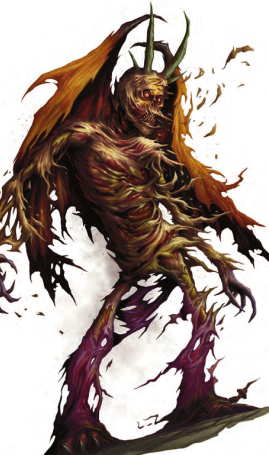
In 4e, rot harbingers are still sometimes called angels of decay, though that’s the less common name for them. Though they resemble angels, the two are not directly related.
Rot harbingers are one a type of undead that were never alive in the first place. Once upon a time Orcus decided to travel outside the Abyss for reasons that have been lost to time. The gods took this opportunity to try and kill him, and sent a host of angels to do the deed. The angels failed, and all of them perished at the claws of the demon lord. When Orcus returned to the Abyss, he made the first rot harbingers from nothing as a kind of “fuck you” to the gods that tried to kill him.
Most such monsters still serve Orcus, but some have managed to escape his control and find new employment with other masters. All of them are quite unpleasant, with their lust for inflicting agony and death being literally the thing that keeps them animate.
The Numbers
Rot harbingers are Medium Elemental Humanoids with the Undead keyword. They’re immune to disease and poison, have 10 necrotic resistance, and aren’t specially vulnerable to radiant energy. They run at speed 6 and fly at speed 8 (clumsy). We get two stat blocks here, and they’re simple enough that I’m not going to give them their own sub-sections.
The standard Rot Harbinger is a level 20 soldier with 193 HP. It fights with its claws, which mark for a turn and do ongoing necrotic damage (save ends) in addition to their standard physical damage. That’s their only attack.
There’s also the Rot Slinger, which is level 22 Artillery and has 165 HP. Its claws also do ongoing necrotic damage, and it fights at range by shooting Orbs of Decay (Ranged 10 vs. Fortitude) which do necrotic damage, weaken, and inflict a -2 penalty to saves (save ends both).
They’re best used in groups, with standard harbingers providing a serviceable front line and the slingers hanging back. They pair well with monsters that inflict (save ends) effects, due to the penalty they inflict.
Sample Encounters and Final Impressions
We have two:
-
Level 21: 1 deathpriest hierophant, 3 slaughter wights, and 2 rot harbingers.
-
Level 22: 2 harbingers, 2 slingers, and a voidsoul specter.
In other words, Thanatos is probably crawling with these things, and they make perfect servants to high level necromancer types even if those necromancers aren’t part of the Orcus franchise. They’re good candidates for the “regular foot-soldier” monster in an all-undead epic adventure.
-
-
Let's Read the 4e Monster Manual/Vault: Roper
Copyright 2008 Wizards of the Coast This article is part of a series! Click here to see the other entries.
Ropers are D&D originals as far as I know, and have been in the game since at least AD&D first edition. They’re one of a number of monsters meant to look like innocuous bits of scenery which Gygax and other authors likely invented as their players became savvy to their usual opposition. They’re on both the Monster Manual and the Vault in this edition.
The Lore
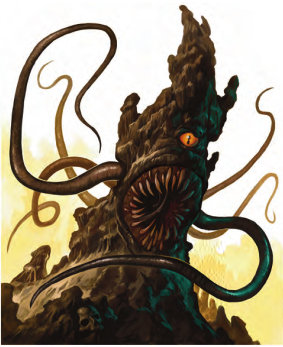
Ropers are ambush predators who live in the Underdark and sometimes in caves closer to the surface. Their rocky skin and conical shape makes them very similar to the sort of geological formation you can find in these environments, and they can slowly crawl and position themselves in either cavern floors or ceilings. Unlike many Underdark denizens, their distant origins lie in the Elemental Chaos rather than in the Far Realm. They’re technically earth elementals!
A roper will sit tight and look like a stalactite/stalagmite until some likely prey wanders into the reach of its long tentacles, at which point they’ll whip out, grab the victim, and pull them into the creature’s maw. Aside from their natural camouflage and weapons, ropers have another thing going for them: they’re sapient and actually fairly intelligent. While most will eat anything and anyone, some have specific tastes in prey, such as humans or elves.
In both cases, a roper might make deals with other creatures that live near its chosen hunting grounds, promising not to eat them in exchange for being allowed to position itself at a prime spot in their territory. If that territory gets invaded (either by one of the many hostile Underdark factions or by PCs), the roper and its allies will generally cooperate in its defense, with the roper getting to eat the bodies later.
The Numbers
Ropers are Large Elemental Magical Beasts with the Earh keyword. They all have darkvision and are immune to petrification. They have ground and climb speeds of only 2, with Spider Climb allowing them to stick to ceilings. This means they’re not going to be moving much during a fight, but they can position themselves just fine outside of it.
All ropers can do something grabby with their tentacles and something horrible to grabbed victims, but the exact mechanics vary per stat block. Tentacles usually have a fantastic melee reach of 10.
The Monster Manual only has the one roper stat block, but the MV has three. We’ll look at them in order of level.
Impaling Roper (MV)
A relatively simple creature compared to its relatives, the Impaling Roper is a Level 10 Lurker with 84 HP and the standard traits described above. It’s trained in Stealth.
Its Tentacles (melee 10 vs. Reflex) do very little damage, but also grab on a hit (escape DC 26). Grabbing a victim grants the roper Resist 20 to all of that victim’s attacks for a turn. Anyone (including the victim) can attack the grabbing tentacle, which has the same defenses as the roper. A hit here does no damage but causes the creature to release the victim.
If the victim is still grabbed when the roper’s next turn comes up, it can Impale them (melee 10 vs. Reflex). A hit pulls the victim adjacent to the roper, does a ton of physical damage, and ends the grab. A miss does the same thing, but only half damage.
I’m guessing this roper looks more like a round spiky rock than the usual conical shape.
Cave Roper (MV)
This is a Level 12 Elite Controller with 252 HP and all standard roper traits. It’s pretty much the classic roper.
Cave ropers have a couple of passive traits: Tentacle Release is the same “attack the tentacle to free a victim” mechanic we had as part of the Impaling Roper’s basic attack. Stony Body is what allows the roper to disguise itself as a rocky formation by closing its eye and retracting its tentacles. The Perception DC for spotting the ruse is 28.
The roper’s Tentacles (melee 10 vs. reflex) do level-appopriate damage and grab the target with a DC 20 escape DC. While grabbed, the target is also weakened. With Double Attack it can make two tentacle attacks in an action.
They can also Bite an adjacent grabbed victim, an attack vs. AC that does a ton of damage on a hit and half that on a miss. This roper’s bites don’t end the grab.
To bring those victims within bite range, the roper can use minor actions to Reel them in, an attack vs. Fortitude that pulls the victim 5 squares on a hit.
Roper (MM)
The Monster Manual roper is a Level 14 Elite Controller with 284 HP. It’s functionally identical to the Cave Roper above, with the main differences being from mechanical adjustments between books. The DC to spot its Sony Body disguise is 30, and since there’s no listed DC to escape is grabs, you have to use either its Fortitude of 29 or its Reflex of 21 depending no which skill you choose.
There’s nothing here you can’t get in a better format by leveling up a cave roper to level 14.
Crag Roper (MV)
Crag Ropers are Level 15 Elite Soldiers with 304 HP. They have all the standard traits mentioned above, plus the usual Stony Body (DC 30 to spot). They also get a Lashing Tentacles aura 5 to support their soldierly role: any enemy inside is considered marked.
I think there might be some mistake in the crag roper’s attacks. Their tentacles skip the grabbing mechanics and just pull the target 5 squares in addition to doing damage. However, their bites can only target grabbed targets, and they have a Reel ability, both of which work like the cave roper’s. They can also make two tentacle attacks per action.
As written, the crag roper has a hard time using either Reel or its bite, since it has to resort to a generic, damage-less grab action to grab someone. I would suggest either replacing the pull effect from the tentacles with a grab, or removing both Reel and the targetting restriction from the bite, making it into a Melee 1 attack with the same stats and effects.
The crag roper’s final attack is Tentacled Retaliation, a reaction that triggers when a marked enemy tries to ignore the roper’s mark and attack someone else. It gives the monster a free tentacle attack against the enemy.
Sample Encounters and Final Impressions.
We have two level 14 encounters in the MM, one with a roper collaborating with a mind flayer and its two war troll thralls, and one with a drow war party. This tells us ropers will work with anyone who gives them a good deal, and have no specific allegiance to any of the big Underdark factions.
Ropers are fine, I suppose, but I never really saw them as the sort of monster that absolutely must be present in a book. Even though I kinda get the editorial intention of the Monster Vault, I’m still a bit baffled as to why it dedicates so much space to the roper as opposed to, say, fomorians, which are not present here at all.
-
The Stormtrooper Armor Conundrum
Do you know what is the second hardest thing to convert when adapting Star Wars to the tabletop? Stormtroopers1. From an in-character perspective they vastly outnumber and outgun the scrappy rebel protagonists, with deadly blaster carbines and that iconic heavy armor. Yet in the actual narrative they almost never hit a shot and always get taken out in one hit from one of the heroes.
Their poor aim has actually made it into GURPS as an optional cinematic rule named “Imperial Stormtrooper Marksmanship Academy”, which reduces the deadliness of enemy shooters. But the armor thing has tied people’s brain in knots, because it can’t be explained away with a joke. Why does their armor do nothing?
There are almost as many explanations and solutions to this as there are Star Wars adaptations. Some say “all armor is bad, actually” and have PCs rely on plot protection. Some have an armor system but go out of their way to explain why trooper suits specifically are actually bad. And some have an armor system that rates trooper armor highly but then go on to state that fun shootouts from the movies are lies and legends.
Me, I think I hit on a solution that allows me to keep those fun fights while still having armor be cool.
Imperial Stormtrooper Armor Drills
This is a cinematic rule meant for science fiction settings where highly effective armor is common, but you want the PCs to have fun battles against armies of heavily-armored mooks. Star Wars and stormtroopers are the most obvious examples, but it also works for settings such as Waframe’s with its Grineer soldiers.
Under this rule, armor worn by “mook” or “fodder” enemies has no protective value, and is mostly a cosmetic detail! Any solid hit will take them down, regardless of whether it would have penetrated their DR under standard rules. Armor worn by PCs and other important characters still uses all the default rules.
This allows you to frame a particularly badass trooper as a real threat and have them survive several attacks without giving them different protective gear. It also allows PCs to loot armor from a fallen mook and have it actually provide benefit beyond a temporary disguise.
Optionally, you could perhaps take this a bit further and subject certain stormtroopers to the Inverse Ninja Rule. See a full platoon of troopers gunning for you? Easy. See one trooper approaching? Danger!
-
The first is the Force, but we all know that. ↩
-
subscribe via RSS