Posts
-
Let's Read the 4e Monster Manual/Vault: Shambling Mound
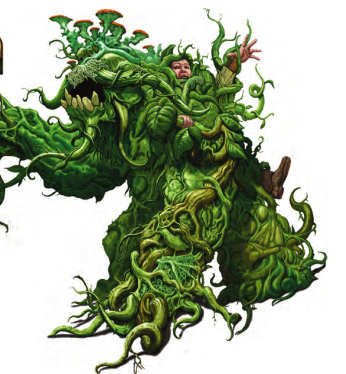
Copyright 2008 Wizards of the Coast This article is part of a series! Click here to see the other entries.
Shambling mounds are one of D&D’s most enduring plant monsters, being present in every edition since at least BECMI. Here, they are only on the Monster Manual, but they got an update in Dungeon 196.
The Lore
Animated piles of vegetable matter who roam the world’s swamps and marshes, shambling mounds are carnivores that draw prey into themselves using their ropelike tendrils. Then they feed by boring countless tiny roots into their trapped victim’s body.
These creatures are nonsapient, but clever enough to pose as piles of mulch until suitable prey wanders by. They’re not primarily ambush predators, though - particularly hungry shambling mounds will go on the hunt.
Shambling mounds are not only immune to electricity, but actually healed by lightning. I imagine this was a pretty big deal in editions past for those levels where Lightning Bolt was one of the wizard’s premier attack options. It’s a bit less of a problem now, except maybe for the party’s storm sorcerer. This also suggests the creatures like places where lightning storms are common, such as monsoon-blasted mangroves right next to those temples guarded by nagas. Sages speculate that the monsters are actually created when lightning hits a mass of plant matter in such places, though they don’t know what other factors might be involved in the process.
Some shambling mound varieties have a further affinity to lightning and are able to store it in their bodies for use in combat.
The Numbers
Shambling mounds are Large Natural Animates with the Plant keyword. They have Darkvision and Swamp Walk, some level of Regeneration, and are immune to lightning damage. They also have a Lightning Affinity trait that heals them for 10 HP whenever they’re hit by a lightning attack.
Aside from a damage update, the stat blocks from Dungeon are identical to the ones in the MM. We get two shambler stat blocks:
Shambling Mound
The classic model is a Level 9 Brute with 120 HP and the standard traits described above. Its land speed is a plodding 4, but due to Swamp Walk it won’t be hindered by difficult terrain in its native environment. They have Regeneration 5.
It attacks with its tendrils, and can make an Enveloping Double Attack at will. This allows it to make two basic attacks, and if both hit the same Medium or smaller target, it makes a further attack against their Fortitude.
A hit on that one pulls the target into the shambling mound! While in there, the victim is restrained and no other creature has line of sight or effect to it. At the start of the mound’s turns, those tiny boring roots drain the victim’s blood, dealing 10 damage and restoring 10 HP to the mound. Up to two such victims can be caught in this way. All of this is (save ends).
A shambler with 2 victims inside heals 25 HP per turn! And since no one has line of effect to the victim, those cleric powers that allow free saves don’t work on them - they have to roll a natural save to escape, or have access to those save powers themselves. The Restrained condition would still allow them to attack at a penalty, but that same “no line of effect” clause means they can’t attack the shambler.
Stormrage Shambler
This is the one with batteries included. Stormrage Shamblers are Level 11 Elite Controllers with 238 HP and the standard traits listed above. Their land speed is a brisk 8, still with Swamp Walk. They have Regeneration 10.
These shamblers project a Lightning Aura 2 that deal lighning damage to those enemies caught inside.
Like the basic model, they also fight with their tendrils and can make Double Attacks, but don’t have the enveloping mechanics. Instead, the tendril attacks deal extra lightning damage when they’re bloodied. They can also fire a Lightning Blast once per encounter (Close Blast 3 vs. Reflex), which obviously do a bunch of lightning damage, half on a miss.
They still have Lighning Affinity, with the added note that they can’t use it to heal themselves.
Sample Encounters and Final Impressions
There’s one sample encounter: Level 9, 1 shambling mound, 3 assorted vine horrors, and 2 dryads. In Soviet Nerath, salad eats you.
I like shambling mounds! Don’t think I ever used one, but I should really remedy that. The standard model is a bit more dangerous than its level implies, since there are few ways to grant extra saves to an enveloped victim and the extra healing they provide can make the fight last longer.
-
Let's Read the 4e Monster Manual/Vault: Shadar-Kai
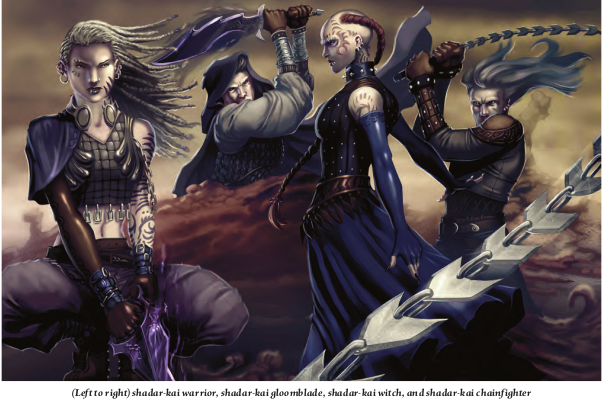
Copyright 2008 Wizards of the Coast This article is part of a series! Click here to see the other entries.
I believe shadar-kai originated in 3e, though they were completely different there. Here, they are only on the Monster Manual.
The Lore
Just as the Feywild contains fantastical reflections of wordly life forms, so does the Shadowfell present its own menagerie of dark reflections. The Shadar-kai seem to be the shadowy counterparts of humanity, being similar in shape and build but with ashen grey skin and black orbs for eyes. They live in the Shadowfell, venerate the Raven Queen and achieve a level of goth that can’t be found in the middle world.
Shadar-kai culture and society are described as pitiless and meritocratic, and merit is measured by the great deeds you have to your name more than by wealth or personal connections. Note that great doesn’t necessarily mean good. Causing great chaos and suffering in the world is a great deed. So is murdering your rivals if they are themselves badass. Acting in the name of the Raven Queen counts, and isn’t a guarantee the service in question will be nice. Even a Good shadar-kai is likely to be a very gloomy and humorless individual. “Perky goth” is not really something they do.
Another significant trait of shadar-kai culture is that they do not fear death, for they know the Raven Queen will see to their souls when they shuffle off this mortal coil. This might make them seem more extreme in all they do to someone from a more standard fantasy culture. Another monster entry ahead will hint that shadar-kai desire immortality despite not fearing death, so maybe this focus on great deeds has something to do with that. If you die anyway, at least people will remember how badass you were.
Other sources would go on to make shadar-kai Dark Eldar-like, justifying the piercings and body art saying they pursue extreme sensation as a way to stave off the soul-draining malaise of the Shadowfell. I think this is going a bit overboard, personally. “They really like percings” should be reason enough for shadar-kay to have them!
The Numbers
Shadar-kai are typically Unaligned, which means the ones you meet might be evil, good, or doing something totally ortoghonal to your goals. Just like humans! I think they even got a playable writeup in Heroes of Shadow, though I don’t have that book so I can’t confirm.
Their signature traits are low-light vision (a necessity in the Shadowfell) and Shadow Jaunt, an encounter power which allows them to teleport up to 3 squares and become insubstantial for a turn. All their other abilities derive from training and vary per stat block.
Shadar-kai Chainfighter
This is a Level 6 Skirmisher with 68 HP and speed 6. It wields a Reach 2 Spiked Chain in combat and its special attack is the Dance of Death (recharge 6). This allows it to shift 6 squares and make up to three basic chain attacks against different enemies along the move. These attacks deal a bit of bonus necrotic damage.
This stat block might also be reskinned into a lower-level khyton devil. Despite the similar chain theme, khytons and shadar-kai aren’t actually related here.
Shadar-kai Gloomblade
A swordsman that uses shadow magic to supplement its techniques. It’s a Level 6 Lurker with 54 HP and Speed 5. It wears chain and wields a Greatsword.
As a move action the gloomblade can use Veil of Shadows to become invisible until the end of its turn and move its speed. This can only be used while it’s unbloodied. This pairs with the Gloomstrike passive trait, which adds a “blinded for a turn” rider to attacks made against targets that can’t see the gloomblade.
This makes them good at focus fire - use the Veil to get close to the chosen victim, and keep hitting them with Gloomstrike to keep them blind and vulnerable. If you miss, use the Veil or Shadow Jaunt to get away and try again.
Shadar-kai Witch
This Level 7 Controller has 77 HP and is all about shadow magic. It fights in melee with a Blackfire Touch (vs. Reflex) that does fire and necrotic damage. At range it uses Beshadowed Mind (ranged 10 vs. Will; recharge 4-6) to cause necrotic damage and limit the target’s sight range to 2 squares (save ends).
Once per encounter it can cast a spell named Deep Shadow, animating the shadows around itself. This works as an aura 2 that provides concealment to allies, and deals 5 damage to enemies caught inside. It can be sustained with a minor action, but dissipates if the witch uses Shadow Jaunt or moves more than half its speed in a turn.
Shadar-kai Warrior
The warrior is a Level 8 Soldier with 86 HP. It wields paired katars and can make a double attack in its action. Its main special technique is Cage of Gloom (recharge 5-6), in which it makes a basic katar attack that causes shadowy tendrils to materialize and envelop the enemy. This is a secondary attack against Reflex, and a hit restrains the target (save ends).
Sample Encounters and Final Impressions
Two encounters:
-
Level 6: 2 chain fighters, 2 gloomblades, 1 mad wraith. These are likely not loyal servants of the Raven Queen, who dislikes undead.
-
Level 8: 1 witch, 1 warrior, 2 rot scarab swarms and 1 spectral panther. The panther is likely a pet, and the scarabs either opportunists or controlled by magic.
I kinda like shadar-kai. Their extreme gothness is a very distinctive look, and I find it less annoyingly edgy than what Pathfinder did with Khytons. I also like that they’re unaligned, meaning it’s common to find them as either enemies or allies.
-
-
Let's Read the 4e Monster Manual/Vault: Scorpion
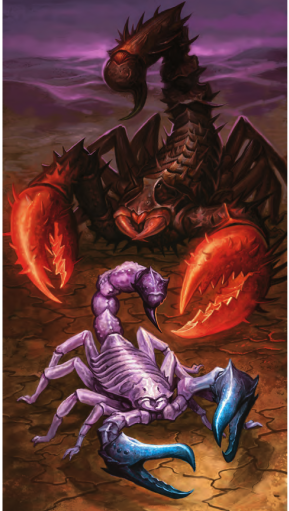
Copyright 2008 Wizards of the Coast This article is part of a series! Click here to see the other entries.
Giant bugs and bug-like things have been a staple of D&D since the beginning, and those have always included some kind of scorpion. Here, they’re only on the Monster Manual.
The Lore
These aren’t your tiny mundane scorpions, but monstrous human-sized or horse-sized varieties that have dangerous magic running through their claws in addition to murderously venomous stingers.
They don’t have any elaborate origin, and are just another example of the patently unfair fantasy wildlife you find in the 4e implied setting.
Like their real-world counterparts, these beasts are predators, and they go for any appropriately-sized prey that wanders into their hunting grounds. Some sapients try to use them as guard or attack animals, a process which likely involves less training and more keeping these things chained and pointing them in the intended target’s general direction.
The Numbers
Stormclaw Scorpion
A man-sized scorpion with taser claws! It hunts by night and likes to nest in dark places, which usually means desert tombs and ruins.
This is a Medium Natural Beast, and a Level 1 Soldier with 32 HP. It’s the Minimum Viable Giant Arthropod, in the same class as a fire beetle. It has Resist 10 lightning and tremorsense, and moves at speed 6.
Its Claws do physical damage and grab on a hit (escape DC 14 or 12), and a grabbed target takes 5 lightning damage at the start of their turn. The sting targets Fortitude, does physical damage plus ongoing poison damage and immobilization (save ends both). It can target the grabbed victim but can also be used against anyone else.
When an enemy grabbed by the scorpion escapes, it can use its sting against them as a reaction.
Hellstinger Scorpion
A horse-sized scorpion from Hell! It’s native to the third and fourth Hells, and also found in certain humid and hot regions of the world. Its claws are red-hot.
This is a Large Immortal Beast and a Level 13 Soldier with 130 HP. It has Resist Fire 20 and speed 8, as well as tremorsense.
Aside from the bigger numbers and the different element, the hellstinger scorpion fights exactly like its electrical counterpart. Targets grabbed by the claws take 10 fire damage at the start of their turns and the ongoing damage from the stinger is “poison and fire”.
Sample Encounters and Final Impressions
There are two encounters here: 1 stormclaw scorpion and a bunch of kobolds, and 1 hellstinger scorpion and a bunch of devils. That tells you all about who uses them as weapons.
Scorpions are okay, I guess. Their fighting style is distinctively scorpion-like, but once you fought one type of monstrous scorpion you know what to expect from the others.
-
Let's Read the 4e Monster Manual/Vault: Satyr
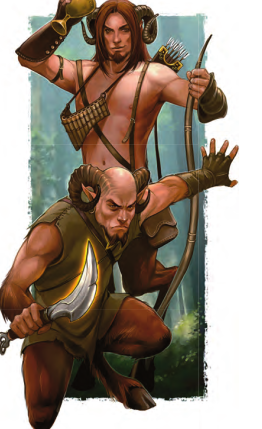
Copyright 2008 Wizards of the Coast This article is part of a series! Click here to see the other entries.
Satyrs were inspired by Greek myth and have been in the game since at least the days of BECMI. Here, they are only on the Monster Manual, but they get an update in Dungeon 196 and become a playable character option in Heroes of the Feywild.
The Lore
According to the MM, satyrs are self-centered, greedy and decadent fey who live to party. They’ll usually behave in a friendly manner to passing strangers and invite them for a spot of good food and drink. If they’re in a good mood, the offer will be genuine. If not, the satyrs will rob and maybe kill their guests once their guard is down. That food and drink doesn’t come cheap, y’know. Conversely, they’re always on the lookout for danger and trickery even while partying their hardest, for such is life in the Feywild.
Heroes of the Feywild, which includes satyrs as a PC option, is a bit softer on them. It says satyrs are by nature both curious and skittish, despite their hedonistic streak. So they’ll tend to investigate things from a distance and rely on their charm magic to defend themselves if it comes to that. A lot of their bad reputation comes from bad encounters between somewhat xenophobic humans and the first satyrs who crossed over from the Feywild.
Even the MM says satyrs are Unaligned despite its unflattering description of them, so the stat blocks in this entry could be used as NPC allies as easily as they could be enemies who do live up to the bad reputation.
A curiosity: all satyrs are male. Their mothers are usually the always-female nymphs, whose sons are satyrs and whose daughters are other nymphs. The raunchiness and propensity for sexual harassment of mythological satyrs has been excised from both depictions, though you could add it back to particularly villainous individuals.
The Numbers
Satyrs are Medium Fey Humanoids with speed 6 and low-light vision. Everything else varies per stat block, and we get two.
Satyr Rake
This is a mobile rogue-type, wearing leather and carrying a short sword and short bow. It’s all about running around the party and setting up sneak attacks with its clever feints.
Rakes are Level 7 Skirmishers with 80 HP. The sword and bow are its basic attacks, and it will prefer the former once the PCs get in melee range. They do extra damage with all attacks if they have combat advantage.
A rake can employ a Feint (melee 1 vs. Reflex; minor action) to make a target grant combat advantage for a turn, so it’s dangerous even without a flanking buddy. It can also make a Harrying Attack (recharge 5-6) which allows it to make two basic attacks and shift 3 squares between them.
Aside from the updated damage, the only difference between the MM and Dungeon versions is that the MM Feint is at-will, and the one from Dungeon recharges when the satyr hits with a basic melee attack. This gives the target a breather from the constant feinting if the satyr misses.
Satyr Piper
A mystically-inclined archer who can produce several mental effects with its music.
Pipers are Level 8 Controllers with the Leader keyword. Their basic melee attack is a gore with their horns, which does some damage and knocks the victim prone so the piper can move away. Their main weapon is the longbow, but they’ll switch to playing the pipes when the enemy gets close enough.
These Wooden Pipes take a standard action to play and can be sustained with further standard actions. Their musical magic works in a close burst 5 and can be either an attack vs. Will that dazes enemies for a turn or one of three effects that grant allies attack and damage bonuses, free shifts, or free saves. I think the piper can select a different effect for a given turn without having to stop the music.
While pipers have to choose between being leaders or combatants, they’re very effective leaders. The beneficial songs work on every ally in the burst at once! A piper accompanying a squad of melee bruisers, or a cluster of artillery monsters, can really increase their threat level.
Sample Encounters and Final Impressions
The sample encounter is level 8 and features a piper, three rakes, and a displacer beast.
Satyrs fit perfectly as those irresponsible fey who like to “tame” fey beasts via charm magic instead of doing it the hard way, so you can justify them having any sort of pet. They also gladly team up with other sapients who have the same tastes (whether for partying or robbery, depending on the satyr).
-
Let's Read the 4e Monster Manual/Vault: Salamander
Copyright 2008 Wizards of the Coast This article is part of a series! Click here to see the other entries.
Salamanders have been a part of the game since AD&D 1st Edition at least, and also play a part in Mystara. In 4e, they’re present only on the Monster Manual.
The Lore
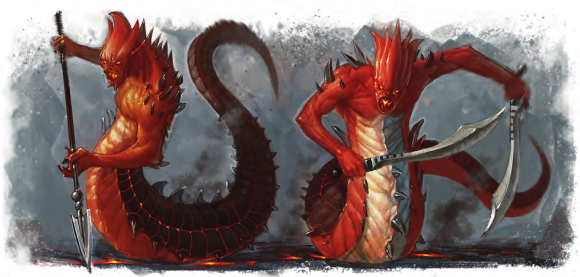
Salamanders are sapient fire elementals who live in the hotter regions of the Elemental Chaos. As a people they tend to be cruel, greedy and authoritarian. Their society is feudal, ruled by an European-style hierarchy of nobles: dukes and duchesses, kings and queens, and so on.
Salamanders will gladly serve more powerful masters such as efreets, giants and dragons if the pay is right, and they do so with unflinching loyalty. They also expect the same from their own underlings. Either in the service of these masters or for their own benefit, salamanders often raid the natural world through planar rifts in order to plunder it and take slaves.
These slaves from the world make up the bottom ranks of salamander society, and include not only mortals but also magma beasts and other “weaker” elementals.
The Numbers
Salamanders are Large Elemental Humanoids with the Fire and Reptile keywords. They have a land speed of 6 and 20 fire resistance, but no special senses and no special vulnerability to cold.
They use weapons to fight, but can also do something with their powerful snake tails and employ some sort of fire magic that varies with the specific salamander. Their weapons have ongoing fire damage riders, and they’re fast enought to attack twice per action.
More details below:
Salamander Lancer
This Level 14 Brute has 171 HP and fights with a Reach 3 Longspear that does physical damage and ongoing fire damage. It can spin the spear around to form a Whirlwind of Fire that does the same damage in a Close Burst 3 and recharges on a 6.
It can also attack with a Reach 2 Tail Lash that’s a little weaker than the spear and slides the target 1 square. I suppose it will mostly use that for the slide, since the spear is better in all other respects.
Salamander Firetail
A Level 14 Skirmisher with 138 HP, this one fights with a Reach 2 scimitar with an ongoing fire damage rider. It can make two such attacks per standard action, and has the same Tail Lash as the Lancer.
Its special attack is the Trail of Fire, which allows the salamander to move its speed and leave a brief trail of fire behind it. Anyone it passes adjacent to takes 10 fire damage, but the trail doesn’t persist on the map after that.
Salamander Archer
Another straightforward monster, it’s Level 15 Artillery with 114 HP. Its longbow has the usual ongoing fire damage rider and it can attack twice per standard action.
The archer uses its tail as an emergency melee weapon: it can use it either in a Tail Lash that does fire damage with no special effects or a minor-action Tail Thrust vs. Reflex that does no damage and pushes the target 1 square. That last one is actually the better bet, as it would allow the archer to immediately follow it up with two arrows to the offender’s face.
Salamander Noble
A level 15 controller with 152 HP, the noble is the first salamander whose primary weapon its its tail.
Tail Crush is its basic attack, doing fire damage and grabbing the target on a hit (escape DC 27). The grabbed victim automatically takes this attack’s damage at the start of its turn.
The noble will use its Longspear to attack the other PCs while it has a victim grabbed, which works pretty much like the Lancer’s spear above. No Double Attack here, though.
Finally, the noble can cause a Fire Cage (ranged 10 vs. Reflex) to sprout around a target. A hit immobilizes and deals ongoing fire damage (save ends) without blocking line of sight to the target so the archers can keep shooting it.
Sample Encounters and Final Impressions
The sample encounters have salamanders working alongside fire archons, a beholder eye of flame, red dragons, and lots of azers. The latter are either giant envoys, or slaves of the salamanders themselves.
I think salamanders work well as fire elemental opposition that’s okay to beat up. An azer is probaly fighting you against its will, but a salamander isn’t.
subscribe via RSS