Posts
-
Let's Read the 4e Monster Manual/Vault: Vampire
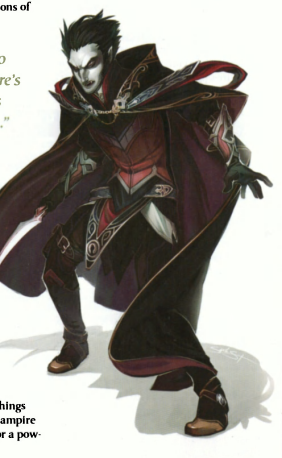
Copyright 2012 Wizards of the Coast This article is part of a series! Click here to see the other entries.
Legend has it that vampires were an even earlier addition to D&D than the cleric class - the first cleric was designed specifically to counter Sir Fang, a vampire PC. As monsters, they were the second most powerful rung in the Undead Power Ladder, below liches. As expected of a creature with such a long history, they are present in both the Monster Manual and the Monster Vault.
The Lore
Vampires in media and folklore are an incredibly varied lot. Each source has a slightly different type of vampire than the rest, including D&D.
As the Monster Vault says, vampires “rule the night”. They’re powerful sapient undead with an insatiable hunger for the blood of the living, which gives them a big incentive to interact with the living often. A lich will stay in its lair and perform experiments for years on end. A ghoul is content to squat in its hole and brood hungrily until someone wanders by. A vampire has to hunt. A particularly ambitious vampire will get itself a “flock” to rule over, and extract blood as tribute.
I imagine that the scholars who study the subject always argue over whether a vampire is the same person it was in life. They retain their memories and intelligence, and they answer to the same name; however, the baroque curse that propels them also makes them wholly evil, no matter what they were like when alive. And while it also imbues them with great and terrible power, it takes away some of the abilities they had in life.
There are as many superstitions surrounding vampires in D&D’s implied setting as there are in the real world, and very few people know which are true and which are not. You know all of them: garlic, running water, fear of holy symbols, and so on. Aside from a vulnerability to sunlight (and other radiant damage, to a lesser extent), most of these are fake. Perhaps these falsehoods are even spread by the vampires themselves. The good news is that you can still fight and even kill them with the usual adventurer arsenal of weapons and magic, it’s just really hard.
The other true vampire fact is that they’re tied to their grave or place of death. Vampires need to rest during the day, and they must do so either inside their coffins or crypts, or under the earth of the place where they died if they didn’t get a formal burial. A vampire who’s prevented from resting in this way will become less and less rational as the days pass, until it enters a self-destructive feeding frenzy that lasts until it’s either slain or finally manages to get some shuteye.
All of the above applies to what Fourth Edition calls vampire lords, which are the typical sophisticated vampires of editions past. You also have vampire spawn, which tend to be weaker and have a personality that can be summed up as “angry and snarly”. Spawn are created when a vampire spawn drains someone dry - the corpse rises a day later as a spawn under the complete control of its sire. A victim incapacitated by blood drain but not killed will enter a coma and rise as a spawn in the same way.
Creating another vampire lord requires an elaborate magic ritual. This ritual is named “Dark Gift of the Undying”, and must be performed by a vampire lord on a mortal victim. There’s an exchange of blood before the victim is killed, and then the corpse must be buried and numerous prayers and invocations to Orcus recited over it. A day later, the victim will rise as a new vampire lord. This process is draining for the sire, so it’s not done lightly. The MV adds that it’s also possible, but rare, for someone who would rise as a spawn to become a full vampire instead.
In both cases, the turning can be prevented with a casting of Raise Dead before that one-day interval has elapsed. If the victim is merely comatose instead of dead, Remove Affliction will also work to prevent the transformation and allow the victim to be healed normally.
The concept of vampire player characters has enjoyed enduring popularity ever since a certain other game introduced it in the early 90’s. So when Heroes of Shadow came out late in Fourth Edition it added like three or four different ways to play a PC who could call themselves a vampire (including a full Vampire class). Unlike the Monster Manual/Monster Vault varieties, these didn’t have to be evil. I’d be inclined to say the Orcus-worshipping ritual described here only produces evil vampires, so the non-evil ones in your setting are likely to have other origins.
The Numbers
Monster Manual Vampires are built using templates, in a way similar to death knights and liches. By the time of the monster vault the concept of rigid monster templates had been dropped, so vampires there are built from scratch following similar guidelines.
Both types of vampire are Medium Natural Humanoids with the Undead keyword. They have Darkvision and the usual undead traits: immunity to disease and poison and resistance to necrotic damage (10). Most also have some vulnerability to radiant damage as well. They also tend to have a high running speed, and a climb speed with Spider Climb.
I think it’s fun to point out that back in the AD&D days, vampires didn’t actually drink blood, or even bite. Instead, they drained your life energy by punching you in the face. Around the time the Ravenloft setting became popular, they published a variant that behaved more like you’d expect from a horror movie vampire.
Here, the Monster Manual vampires do explicitly drain your blood, but this isn’t described as a bite in their stat block. The Monster Vault vampires eliminate this remaining ambiguity, and have bite attacks.
Vampire Spawn Fleshripper (Monster Manual)
These Level 5 Minion Skirmishers are fairly basic. They have the usual undead immunities and resistances, darkvision, a speed of 7, and a climb speed of 4. They attack with a claw that does necrotic damage, with a small damage bonus against bloodied targets.
They’re also Destroyed by Sunlight: a spawn that starts its turn in sunlight can only perform a single move action that turn. If this isn’t enough to get them out of the light, they are destroyed at the end of that same turn. So you get a dramatic slow death out of them instead of having them pop like soap bubbles.
The MM also has a Vampire Spawn Bloodhunter which is level 10 and exactly the same with bigger numbers.
Elder Vampire Spawn (Monster Vault)
This Level 10 Minion Soldier is a little more interesting than the MM spawns. It has everything they have, but its attacks are a little different.
The claw does physical damage and grabs on a hit (escape DC 18). The spawn can then bite the grabbed victim. A hit does more damage than the claw and dazes the target until the grab ends - and bites against a dazed target hit automatically. So after the first bite hits, there’s no need to make another attack roll for a while.
Vampire Night Witch (Monster Vault)
As a Monster Vault vampire, the Night Witch is built from scratch and doesn’t use the template rules. It’s a Level 10 Controller with 98 HP and all common vampire traits, plus Vulnerable 5 Radiant.
Like all non-minion vampires, the night witch is Burned by Sunlight, taking 5 radiant damage whenever she starts her turn exposed to direct sunlight. Does the vulnerability get added on top of this?
The night witch fights with Claws that also slide the target 3 squares on a hit. She can also cast a Dream Lure (ranged 5 vs. Will) to do psychic damage at range, daze the target, and pull them 3 squares. Against dazed or similarly impaired targets (stunned, unconscious, dominated) she can bite, which does high physical damage and heals her for 15 HP on a hit.
Once per encounter, when the night witch takes damage while bloodied, she can vanish into shadow, becoming invisible until the end of the encounter or until she attacks. This is a nice escape hatch and can allow the night witch to be a recurring opponent.
Vampire Lord (Monster Manual)
Built using the template rules, this is a Level 11 Elite Lurker with 186 HP who used to be a human rogue. It has all the vampire traits mentioned in the Numbers intro, plus Vulnerable 10 Radiant and Regeneration 10 that doesn’t work while the vampire is exposed to direct sunlight. Sunlight exposure doesn’t harm it further than this. Its speed is 8, and it has Spider Climb 4.
This blood-sucking rogue deals extra damage with all of his attacks when he has combat advantage. He fights with a short sword, and what is probably a printing error has also given him a spiked chain. He also has a couple of rogue powers; Deft Strike allows him to move up to 2 squares and make a melee basic attack. Imperiling Strike is an encounter power that does a bit more damage than the basic sword and inflicts a -3 penalty to all of the target’s defenses for a turn.
After that come the template powers. Blood Drain (melee 1 vs. Fortitude) requires combat advantage, does more damage than any of the “rogue” attacks, and heals the vampire for 46 HP. It recharges whenever an adjacent creature becomes bloodied. Dominating Gaze (ranged 5 vs. Will) does no damage but dominates on a hit, (save at -2 ends). As an after-effect, the target is dazed (save ends). Fortunately only one creature can be dominated at a time. And finally, Mist Form is an encounter power that does what the name implies. In mist form, the vampire is insubstantial and has a fly speed of 12, but can’t attack. It lasts for 1 hour or until the vampire ends the effect as a minor action, so it’s another “escape hatch” power.
Any vampire built using the template is going to have all three powers in the preceding paragraph. This one also has a Second Wind that works like the player version, and recovers 46 HP.
Master Vampire (Monster Vault)
A Level 12 Lurker with 98 HP, this monster follows the same concept as the Vampire Lord. It has all standard vampire traits, with no radiant vulnerability.
Of course, it’s still a vampire and is still Burned by Sunlight, taking 10 damage on any turn it starts exposed to it. It also has Regeneration 10, which shuts down for a turn if the vampire takes radiant damage (from sunlight or any other source).
The master vampire fights with claws like a proper monster, and has a Dominating Gaze (ranged 5 vs. will) that dominates for a turn. Its bite is like that of the Night Witch but heals it for 20 HP instead of 15.
It has the Vampire Lord’s Mist Form power, and it can also turn into a Cloud of Bats (though not at the same time). That last ability is at-will, and works very similarly to Mist Form with the following differences: it only lasts for a turn, the fly speed is only 8, and the vampire gains a +5 bonus to Stealth in this form. This is clearly what it uses to “lurk”, though it doesn’t gain extra bonuses beyond CA when it attacks from hiding.
Sample Encounters and Final Impressions
The sample encounter is level 12 and has 1 vampire lord along with an entire undead retinue: 1 battle wight commander, 3 battle wights, and 6 vampire spawn bloodhunters.
I like vampires as monsters. Looks like the vampire lord/master vampire is tough to put down even in its Monster Vault incarnation, where it has both Regeneration and a draining bite. It’s the MM variant that easily crosses over into “annoying” territory, since Blood Drain heals a lot more and it has Second Wind.
5e makes a huuuge deal out of Count Strahd, the game’s Dracula expy, but in his original incarnation he was explicitly described as a vampire who was only a bit more powerful and clever than what’s average for these monsters. You could easily stat him up in 4e by making him an Elite or Solo Controller with the Vampire Master’s gaze, bite, and transformation powers, plus a strong claw/slam attack and some necromancy-themed powers or rituals. He should be part of an encounter of the party’s level +3 or +4, suitable as a final boss battle.
-
Let's Read the 4e Monster Manual/Vault: Unicorn
Copyright 2008 Wizards of the Coast This article is part of a series! Click here to see the other entries.
Unicorns are actually one of the creatures I associate most strongly with D&D, since my first contact of any sort with it was the 80’s cartoon with its adorable unicorn mascot. They’ve been in the game since at least BECMI, and likely since it’s beginnings. Here, they are only present in the Monster Manual.
The Lore
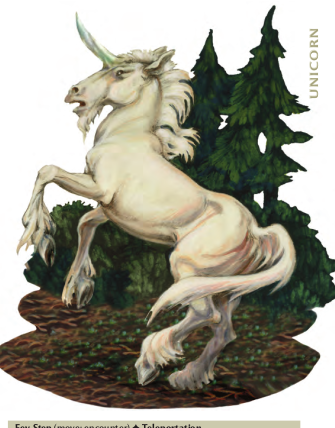
Unicorns are horse-like creatures that originate in the Feywild, though some of them also live in the world. Lots of depictions of them tend to take a horse and stick the famous spiral horn on its forehead, but mythological unicorns had other fantastical traits: their hooves are split like a goat’s and not uniform like a horse’s, and their tail is a bit lion-like with a small tuft at the tip. They also sometimes had goat-like beards.
The illustration here nails most of those details, though it still has a horse-like tail. And its horn is not a cute and delicate spiral at all, but rather something built to split a fool from crotch to sternum.
Unicorns are sapient and very intelligent, and have a similar relationship to their natural habitats as that of dryads or treants. They also have an extra reason to distrust mortal intruders, as their horns are widely reputed to contain potent mystical and healing properties. This makes them frequent targets of hunting expeditions financed by Cocaine Wizards.
Your typical unicorn has a light-colored coat and mane, but sometimes you get what is known as a Dusk Unicorn. They’re dark-colored, have black horns, and are all-around stronger and more majestic. The birth of a dusk unicorn is considered a portentous omen among the fey.
The Numbers
We get stats for “standard” and Dusk unicorns. Both are Large Fey Magical Beasts, with low-light vision and a high land speed from their horselike build.
Unicorn
The basic model is a Level 9 Skirmisher with the Leader keyword and 93 HP. It projects an aura of Fey Warding (2) that grants allies within a +2 bonus to all defenses. Its land speed is 8.
Unicorns attack with their hooves up close, but if they have a running start they’ll instead use a Piercing Charge, which as you might guess counts as a charge. A hit does roughly double the damage of a basic kick, pushes the target 1 square, and knocks them prone.
Unicorns can also channel magic through their horns and produce a variety of effects. Fey Beguiling (ranged 5 vs. Will) is a charm spell that forbids the victim from attacking the unicorn and forces them to make opportunity attacks with a +2 bonus against anyone in reach who attacks the unicorn (save ends). So remember all those legends of people whose purity charms unicorns and turns them into friends? It’s actually the other way around! The power can only be used if the unicorn doesn’t have a currently charmed victim.
The creature’s other powers are a Fey Step encounter power that works exactly like the eladrin version, and a Horn Touch encounter power that allows the touched ally to spend a healing surge or roll a save against an effect a save can end.
Dusk Unicorn
These magnificent specimens are Level 12 Elite Controllers with the Leader keyword, 236 HP, and speed 9. Dusk Unicorns work exactly like the basic model, but with bigger numbers and a couple of different powers.
Instead of Fey Beguiling they have Fey Wisp (Area Burst 5 within 10 vs. Will; at-will; no damage), which creates dancing lights in the burst’s origin squares and pulls any enemies it hits 3 squares towards the lights.
And in addition to Fey Step, they have Twilight Teleport (close burst 5; encounter) which affects only willing allies within range and teleports them to somewhere else within the dusk unicorns’ line of sight. Yes, only the starting square has to be within range - the end point can be anywhere visible!
So you could have something cheesy like a dusk unicorn scrying the party or looking through a scope, and using that to teleport a bunch of allies right on top of them. Or you could have this power be the centerpiece of an heroic sacrifice, as the unicorn transports is allies to safety before being overwhelmed by the enemy. That works better if the teleported allies are the PCs.
Sample Encounter and Final Impressions
The sample encounter is short and to the point: 1 dusk unicorn and 3 banshrae warriors. Either the unicorn is a psychopath, or the banshrae are unusually nice.
I like unicorns! These follow the 4e maxim of being potentially usable in a fight against Good PCs, since they are Unaligned and might have goals that conflict with those of the party. In previous editions, if you’re fighting a unicorn it means something went horribly wrong.
Mechanically it seems they have so many signature traits (horn and hoof attacks, Fey Step, Horn Touch, Fey Warding) that it might be easier to make custom unicorns by adjusting their level and messing with the minor secondary magic powers.
-
Let's Read the 4e Monster Manual/Vault: Umber Hulk
Copyright 2008 Wizards of the Coast This article is part of a series! Click here to see the other entries.
Umber Hulks have been in the game since at least AD&D 1st Edition. Here, they’re present in both the Monster Manual and the Vault.
The Lore
Umber Hulks are insectoid predators native to the Underdark, through which they roam by digging tunnels with their powerful claws. Tunneling is slow and hungry work, so they need a lot of energy.
Umber Hulk are curious explorers and their tunnels are stable, so they end up being an important part of the Underdark’s ecosystem. While Purple Worm tunnels form the “avenues” and “highways” of that subterranean realm, hulk tunnels form its side roads and streets, linking larger passages and caves together.
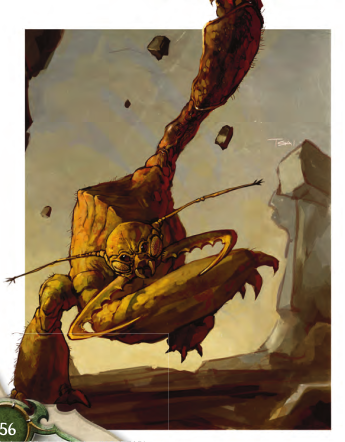
Lacking in both natural stealth or speed, umber hulks like to hunt by tunneling until they’re about to break through into a larger space, and using their tremorsense to wait for approaching prey. Then they finish bursting through the wall and enter combat. Once engaged, they use the psychic powers granted by their peculiar second set of eyes to attack their victim’s mind, making then an easier target for their claws. Contrary to what it might seem, the psychic eyes are the large faceted pair, not the tiny, beady one. Those they use to see.
Hulks are sapient and Unaligned, but not very smart at Int 5. They can’t speak, but can understand Deep Speech, so it’s possible for PCs to negotiate with them and avoid violence if they know the language and think to do that. Unfortunately, they’re another one of those creatures that often gets enslaved by the evil empires of the Underdark, and avoiding violence with those is a little trickier.
The Numbers
Umber Hulks are Large Natural Magical Beasts, with Darkvision and Tremorsense 5. They usually have a speed of 5, and a burrowing speed of 2 with the Tunneling enhancement.
They fight with their big claws and their psychic gaze, though the exact effects of those vary per stat block.
Umber Hulk (Both)
The basic model is a Level 12 Elite Soldier with 248 HP. Its gaze confuses victims and makes them wander around aimlessly, making them easy prey for its large, grabby, rending claws. The two books model this a bit differently.
In both cases, the hulk’s basic attack is a claw, and it can make a Double Attack with it. If both attacks hit, the hulk grabs the target. The Monster Vault escape DC is a generous 20, but the MM DC is either the hulk’s Fortitude of 33 or its Reflex of 28.
The difference lies in what happens after the monster grabs a victim. The Monster Manual version (with the higher escape DCs) does ongoing 10 damage to the grabbed victim. The Monster Vault umber hulk can instead use a standard action to Rend the victim and do an automatic 40 damage to it, which is like an automatic hit of its usual double attack.
Their gaze works the same in both versions: It’s a Close Blast 5 vs. Will, targetting enemies in the area. It does no damage, but slides the targets 5 squares and dazes them (save ends).
Umber Hulk Tunneler (Monster Vault)
This specimen is a Level 15 Skirmisher with 148 HP. Since it’s not as beefy as the basic model, it relies on snatching a chosen victim and running away with it, using its gaze to keep the victim’s friends at bay.
The basic claw attack is a bit weak, but the tunneler can use Double Attack to make two of them against the same target. If both hit, the tunneler can shift up to 5 squares and pull the victim along with it.
Its eyes can cast a Rebuffing Gaze (close blast 5 vs. Will). The targets it hits take 2d6 damage whenever they enter a square closer to the hulk during their next turn. So it’s more of a disincentive to move closer than a prohibition, and an PC who’s feeling lucky can risk taking up to 10d6 damage to charge in anyway. At levels 12-15, this is significant but not necessarily lethal.
Umber Hulk Bewilderer (Monster Vault)
This variant relies on its psychic powers more than on its claws. It’s a Level 15 Controller with 148 HP.
The basic claw attack is once again kinda weak, but it does double damage against stunned targets. The bewilderer can employ a Stunning Gaze (close blast 5 vs. Will; recharge 5-6) as a standard action to stun those enemies it hits for a turn, and it can use a Staggering Gaze (close blast 5 vs. Will) as 1/round minor action to do a bit of psychic damage and slide the target 5 squares.
Bewilderers can punch above their weight class if they focus on a single PC, and if you have more than one such umber hulk they multiply each other’s firepower. I’d say include at least two in an encounter group where you want them to be.
Deep Hulk (Monster Vault)
This is an umber hulk from way deeper into the Underdark - it’s a stronger version of the basic model, a Level 17 Elite Brute with 404 HP.
“Umber Hulk but more” describes this creature perfectly. Most of its attacks are versions of those from the MV basic hulk with bigger numbers: the claw, the grabby double attack, and the rending (which does 60 damage).
The Deep Hulk’s gaze gets upgraded to a Maddening Gaze (close blast 5 vs. Will). This attacks every enemy in the blast, as usual. Those that get hit must spend a standard action on their next turn making a basic attack against an ally in range. If there’s no ally in range, they must charge the closest ally. I guess it’s a “maddening” gaze because it will make your players pretty mad even though it only lasts for a turn.
Oh, the gaze is an at-will attack, so a deep hulk can open the fight with it, spend the next turn clawing a PC, and from them on alternate the gaze with the claws (or the rending). It won’t even give up too much damage potential if the party includes lots of people with good basic attacks.
Shadow Hulk (Monster Manual)
The concept of this monster is the same behind the Deep Hulk: a bigger, badder Umber Hulk from deeper in the Underdark. The implementation is quite different, however.
Shadow Hulks are Huge Shadow Magical Beasts, which hints that they might have been mutated by magical leaks from the Shadowfell somewhere down there. They’re Level 17 Solo Soldiers with 860 HP. Their land speed is 6, their burrowing speed 4, and they have phasing, which means they might not actually burrow much.
Shadow Hulks attack with their claws, have the grabby double attack, and bite the grabbed victim for 15 ongoing damage. While bloodied, they can also make claw frenzy attacks (close burst 3 vs. AC; recharge 6) which do the same damage of the basic attack over an area. They also have the Deep Hulk’s Madening Gaze, which they can use as an at-will minor action 1/round.
I think I get why we got the Deep Hulk in the Monster Vault instead of a more direct conversion. Fighting 860 HP of umber hulk with higher AC and accuracy than normal, and who can both claw and use a maddening gaze every round, is a bit much. Still, if your players are cocky, you can update the Shadow Hulk and throw it at them.
Sample Encounters and Final Impressions
The sample encounter is level 13, 2 umber hulks and 2 drow warriors.
The hulks from the Monster Vault are much better than the ones from the Monster Manual. If you have the Vault, you can disregard the MM versions entirely.
I like Umber Hulks! They’re a big dumb brute monster with some really interesting tricks to go with he usual physical attacks. Fighting them requires a bit more thought because of that.
-
Let's Read the 4e Monster Manual/Vault: Troll
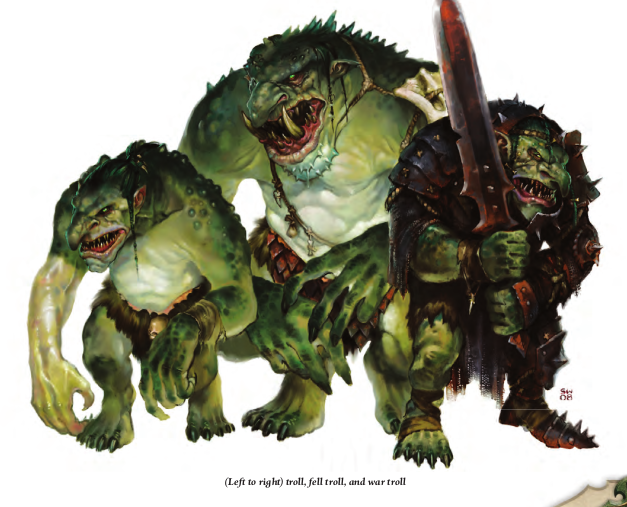
Copyright 2008 Wizards of the Coast This article is part of a series! Click here to see the other entries.
D&D Trolls are inspired by the writings of Poul Anderson and have been in the game since the beginning. Here, they are present in both the Monster Manual and the Vault. I’m telling you in advance: I’m not gonna make jokes about rude Internet posters.
The Lore
Trolls are large humanoid creatures with amazing regenerative powers, able to survive just about anything and thrive just about anywhere. This same remarkable metabolism makes it so trolls are always hungry and in search of food. They’ll eat anything that’s smaller than themselves and made of meat.
The only things that can temporarily overwhelm a troll’s regeneration are fire and acid. One of these is required to kill a troll permanently - it can come back from anything else. This makes them pretty much fearless in combat. Trolls attack even when they’re outnumbered and when the enemies seem strong, because they’re confident in their survival. Even the presence of fire and acid doesn’t get them to back off right away, though in this case they might retreat if they get too hurt.
I imagine this made trolls into dangerous puzzle monsters back when they were new, but now pretty much any D&D veteran is going to know about their weaknesses. Many arcane characters have easy sources of fire or acid at hand, and other “caster” types might have an encounter power or two that deal those types of damage. If your wizard is one of those charop types that went all in on psychic and force spells, though, you’re in for a tought fight.
If you have no other source of fire you can “kill” the troll with conventional weapons and stick a lit torch in it to finish the job, but even that is easier said than done. And adventurers these days tend to prefer those alchemical glow-sticks as light sources, so they might not even have torches available if they don’t know a troll is around!
Trolls are sapient, but not very smart. Still smarter than ogres, though. Tricking the typical troll is easy, provided you can get it to talk to you instead of immediately ripping you apart and eating the pieces. All sorts of villains and tyrants like to recruit trolls into their forces, since they’ll readily work for a bit of money and a lot of food. Such trolls are all too glad to receive additional training and gear from their bosses, and though they make for undisciplined and rowdy soldiers, they’re deadly in a fight.
Evil wizards also love trolls, for a different reason. They can survive all sorts of disturbing magical experiments, which tend to result in weird mutants much stronger and much less mentally stable than a standard troll.
It’s perfectly possible for there to be trolls who aren’t evil and who don’t eat other sapients, though even them they’d have a hard time coexisting with those sapients since they require large hunting areas to sustain themselves. Even nice trolls are likely to make their home in the wilderness far away from any settlements.
The Numbers
Trolls are Large Natural Humanoids, and their signature traits are Regeneration and Troll Healing.
As I explained in a previous entry, 4e Regeneration is more or less equivalent to 3e’s Fast Healing: the monster recovers the specified amount of hit points at the start of its turn as long as it has at least 1 HP remaining. For MM trolls, this is either 10 or 15 depending on the stat block. For MV trolls, this is 5 across the board. Troll regeneration stops working for a turn if the monster takes fire or acid damage.
Troll Healing is what makes them immortal: if a troll is reduced to 0 HP by anything other than fire or acid damage, it recovers the specified amount of HP and rises again at the start of its next turn. It can still be killed before it rises if it takes fire or acid damage while down.
In addition to these, they can usually do something interesting when their basic attack bloodies a target. Being Large creatures, all their attacks have Reach 2. They only speak Giant, which is another barrier to nonviolent communication.
Troll (Both)
The basic model is a Level 9 Brute with 100 HP. The MV version has regeneration 10 and troll healing 10, while the MV version has regeneration 5 and troll healing 15. Both have speed 8.
Trolls attack with their claws, and if their basic attack bloodies the target they get to make another one against it as a free action. They have no other special abilities, being quintessential brutes.
Battle Troll (Monster Vault)
A troll who received extra training and equipment from its patrons. It’s a Level 12 Soldier with 124 HP. Its speed is reduced to 7 by armor, and its regeneration/troll healing values are 5/15.
The battle troll wears scale and fights with a broadsword, which marks the target for a turn. If a broadsword attack bloodies the target, the troll can make another free attack against it. It can also use the sword to make sweeping strikes which hit in a Close Blast 2 and knock targets prone.
Bladerager Troll (Monster Vault)
The product of twisted Cocaine Wizard experiments, this is a troll who had tons of sharp blades implanted all over its body. It’s a Level 12 Brute with 151 HP, Speed 7, and Regeneration 5 without Troll Healing.
The bladerager attacks with its augmented claws, which can also perform a Bladerager Rend once per encounter for massive immediate damage and ongoing 10 damage (save ends). A miss does half the immediate and ongoing damage. If the basic claw attack bloodies a target, the Rend recharges.
When the bladerager reaches 0 HP, it explodes into a cloud of shrapnel! This Death Burst targets affects a Close Burst 2 around the troll, doing a bit less damage than the rend to everyone caught by it.
Ghost Troll Render (Monster Vault)
This troll died but didn’t even notice. It’ll still try to eat you. You can make any regular troll into an elite of sorts by having one of these rise up from its corpse.
Ghost Trolls are Level 13 Brutes with 161 HP and the Undead keyword. They have a flight speed of 7 with Hover and Phasing, and are immune to disease and poison. Lacking a body, they no longer regenerate and are instead Insubstantial. This means they take half damage from anything but force attacks. Getting hit by a radiant, fire or acid attack makes them substantial for a turn.
Their basic attack is a Spirit Claw that targets Reflex, and they can perform a Terror Strike (melee 2 vs. Will) that does a massive amount of psychic damage and slows on a hit (save ends). The first failed save turns that slowed status into unconsciousness, which ends on a sucessful save or if the victim takes damage. This is an encounter power that recharges if it misses, so chances are the ghost will scare someone this way during the fight.
War Troll (Monster Manual)
An earlier but slightly more flexible version of the MV Battle Troll. This one is a Level 14 Soldier with 110 HP. It wears plate, wields a greatsword, but also carries a longbow and a quiver full of arrows. Its speed is 7 and its regeneration/troll healing values are 10/15.
It has the same greatsword and sweeping strike attacks of the Battle Troll, and it also has Threatening Reach (2) and can use Blood Pursuit as a reaction to shift 1 square closer to a bloodied enemy within 2 squares who shifts. It can also fight at range with its Longbow, of course.
Fell Troll (Monster Manual)
The biggest and baddest among trolls. They’re Huge, and Level 20 Elite Brutes with 360 HP. Their speed is 10, their regeneration/troll healing values are 10/20, and they gain a +1 to attacks and a +2 to damage against bloodied enemies.
Their basic attack is a Reach 3 claw, and they can use Reach 3 backhand slams as a 1/round minor action for extra damage and to push fools up to 4 squares.
Sample Encounters and Final Impressions
I don’t think it’s possible for a game to call itself D&D without including green regenerating trolls in its bestiary. Non-D&D games can still have them, of course: GURPS Dungeon Fantasy does.
The Monster Manual has three sample encounters:
-
Level 9: 3 trolls and 2 destrachans. The destrachans are slightly smarter than the trolls.
-
Level 16: 2 war trolls, 1 night hag, 5 grimlock minions, a drow priest, and a drow blademaster. A group so diverse it could be an evil adventuring party.
-
Level 19: 1 fell troll, 2 enormous carrion crawlers.
War and battle trolls can be found alongside anyone who is willing to pay them. The others would be found with more trolls, and with creatures they might have decided to keep as pets. Mechanically, they need that company to make for more interesting fights, because their abilities aren’t very varied on their own.
Adding some trolls to a “wilderness” region you’re populating might work as a fine explanation for why all those other deadly monsters don’t spill out and overwhelm nearby “points of light”. If anyone would hunt and eat bullettes, dire boars, roaming gricks and maybe even the occasional drow scouting party, it’s a bunch of trolls.
-
-
Let's Read the 4e Monster Manual/Vault: Troglodyte
This article is part of a series! Click here to see the other entries.
Troglodytes appear on the Rules Cyclopedia, so they’ve been around at least since BECMI and likely since the beginning. Here, they are in both the Monster Manual and the Vault.
The Lore
Troglodytes are sapient reptilian humanoids native to the Underdark, one of the notable minority that seems to have evolved there instead of being a Far Realm or surface import. They secrete a foul-smelling mucus over their scaly hides, and seem to be resistant enough to disease that they don’t really care about personal hygiene on top of that. Their settlements present the unprepared visitor with a nightmarish olfactory experience.
Troglodytes reproduce by laying eggs, with the female laying close to a hundred of them at once. Only a minority of those will both hatch and survive to adulthood, which they reach in two years.
Troglodyte culture is at a paleolithic level of technological development, and though it’s egalitarian when it comes to gender it’s extremely xenophobic. Anyone not of the same tribe is an enemy to be killed and eaten, or captured and sacrificed to Torog (god of suffering and imprisonment) in an long, torture-filled ceremony. Troglodyte tribes fight each other as bitterly as they fight anyone else - when two tribes move into the same area, the most likely outcomes are for one of them to be annihilated or for the two to be so weakened they ironically end up merging under a strong leader. When resources grow scarce in their current territory they will gladly raid the surface.
It makes a little bit of sense for troglodytes to be this horrible when you think about it. Any less powerful Underdark culture is likely to grow a xenophobic streak when their most frequent neighbors are drow, duergar, and mind flayers. And if these three big empires base all of their power on slavery and torture, it’s not inconceivable that a culture they prey on would try to do the same, and venerate the god that presides over these things.
None of this stops the Big Three from regularly enslaving troglodytes and using them as muscle. I imagine it could also be possible to find bands of troglodytes who aren’t xenophobic Torog worshippers and who are on friendlier terms with other species. Perhaps they might even live on the surface.
This is another instance where the Monster Vault breaks out the full Lovecraftian Racism Vocabulary, calling them “degenerate reptile folk”, “loathsome primitives”, and so on.
The Numbers
Troglodytes are Medium Natural Humanoids with the Reptile keyword. They have darkvision and a land speed of 5. Their signature trait is of course Troglodyte Stench, an aura (1) that inflicts a -2 penalty to the attacks of any living enemies inside.
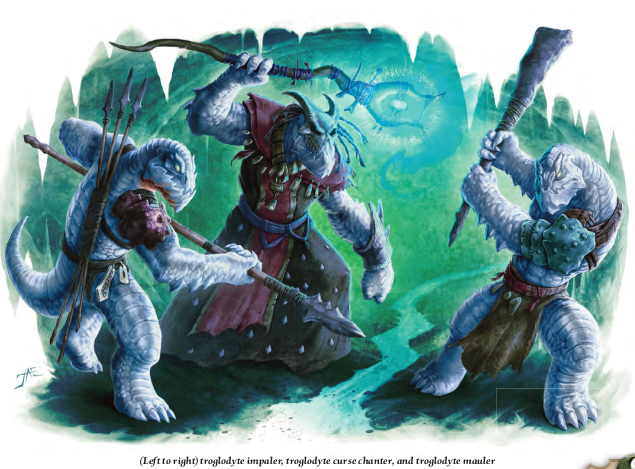
They mostly fight with claws or stone weapons, though they also have spellcasters who use Torog-themed magic. We have a total of 6 unique stat blocks between the two books (4 each, with 2 appearing in both).
Troglodyte Mauler (Both)
The Monster Vault version is by far the best one, so we’ll start with that.
A Level 6 Soldier with 74 HP, the mauler fights in melee with a greatclub and with its claws, both of which are considered basic attacks. Both are equivalent damage-wise, but the club marks for a turn on a hit. The mauler also carries a pair of javelins for throwing at range 10.
If the mauler has combat advantage against an enemy, it can use a minor-action bite against them 1/round. This targets Fortitude, damages, and makes the target regain only half HP from healing for a turn. Bacteria, baby!
The Monster Manual version is a lot less interesting, since its damage suffers from the bug and it lacks the javelins and the bite.
Troglodyte Grunt (Monster Vault)
Grunts are Level 6 Minion Skirmishers, with all the standard troglodyte traits. They fight with clubs that do minion-level damage and allow they to shift 2 squares as an effect. When targeted by area attacks they can scatter as an interrupt, shifting up to 2 squares to a place outside the area of effect.
That last bit should give you some laughs the first time the party wizard smugly tries to hit them with an area spell.
Troglodyte Thrasher (Monster Vault)
Thrashers are Level 7 Brutes with 100 HP. They don’t bother with weapons, and fight with their claws. They also have a Tooth and Claw at-will attack that does roughly half the damage of a basic claw, but can attack one creature twice or two creatures once. If one of these attacks bloody the target, the troglodyte can make a basic claw attack against them.
So depending on how you spread Tooth and Claw around, you could end up doing three times the damage of the basic claw in a round (1.5 times base damage to each of two targets you just bloodied)!
Troglodyte Impaler (Both)
Impalers are Level 7 Artillery with 69 HP. They fight with spears in melee and throw javelins at range (they start with 6). The MM also gives them a useless claw attack.
Aside from making basic attacks, the impaler can use a javelin to make an Impaling Shot (ranged 10 vs. AC; recharge 3-6), which does the same damage and restrains the target (save ends) by going right through it and into the ground.
Troglodyte Curse Chanter (Monster Manual)
A spellcaster, likely a priest of Torog or a primal caster who communes with underground spirits. It’s a Level 8 Controller with the Leader keyword and 93 HP.
The curse chanter wields a quarterstaff and also fights with claws, but the real firepower comes from its magic. It can shoot poison rays (ranged 10 vs. Fortitude) that do poison damage and weaken (save ends). It can call down a cavern curse (ranged 5 vs. Fortitude; recharge 3-6) that inflicts ongoing necrotic damage and slows (save ends both). It can bless its allies with Tunnel Grace (close burst 10; minor action 1/round; recharge 4-6) to give them +5 speed for a turn. And it can sing a chant of renewal (close burst 5; encounter) to heal all bloodied allies in range for 15 HP.
Troglodyte Warrior (Monster Manual)
These are Level 12 Minions, which makes them suitable to represent enslaved cannon fodder in the service of drow or mind flayers. They have the common traits of darkvision and the stench, and a basic club attack, being otherwise unremarkable. You’re better off leveling up the Grunts from the MV and using those instead.
Sample Encounters and Final Impressions
Most of the MM’s sample encounters are assorted troglodytes, though sometimes they’ll have a rage drake or some gricks as pets. There’s also one that includes drow and a gaggle of troglodyte warriors.
Narratively, it feels like Troglodytes flesh the Underdark out a little bit, but the way the books refer to them does them no favors. In the end I feel like using them in a subterranean campaign mostly so I can defy their awful canonical description, which I guess is something.
Mechanically, most of their statistics are interchangeable with those of other humanoids. Replace their signature abilities with darkvision and the stench aura, and you have an instant novelty troglodyte. The reverse is also true.
subscribe via RSS