Posts
-
Let's Read Hell's Rebels Adventure 2: Lucky Bones

This article is part of a series! Click here to see the rest.
Time to finally end Turn of the Torrent! When we last left off, we had just finished exploring level 1 of the complex under the Lucky Bones casino. Now it’s time to descend to level 2.
Lucky Bones: Lower Basement
This is a literal dungeon! It’s here that the Spiders kept their captives while waiting to ransom them or sell them into slavery.
The most important thing about the Lower Basement is that it’s almost completely flooded, and will remain so until the PCs clear it. The ring of swimming from Adventure 1 and cloak of the manta ray from level 1 of this same dungeon will surely be useful, though in the end the whole party needs a way to breathe underwater if they want to venture here.
Potions and scrolls of water breathing are available in the open market in Kintargo, and if Octavio is in friendly terms with the PCs he might ask the seers back at the Shrine of Saint Senex for their wands of wather breathing. Once that’s taken care of, the party still needs to mind the many combat penalties they’ll get against this level’s aquatic denizens.
Things get a bit more expensive in Dungeon Fantasy, since its water breathing spell has a duration in the scale of minutes instead of hours. A wizard who happens to have learned it at skill 20 could keep it on indefinitely on themselves. They’d need skill 25 to cover the whole party.
Item-wise, there’s an alchemical amulet of water breathing in DFRPG Magic Items that costs $23.400 and works for as long as it’s worn. If your party isn’t rich enough to buy one for each PC, you could introduce a more reasonably-priced alternative that only lasts for about as long as the Pathfinder potion.
Opposition in this level is a band of skum spies sent here by an aboleth necromancer to spy on Kintargo. The aboleth doesn’t have any designs on the city, it’s just sending spies on general principle. The skum “foot soldiers” are led by the wizard Ungol-Pagh, and either brought or befriended a bunch of other sea monsters to act as guards down here. They’ve also captured a group of sea elf rangers who came in here to search for their missing ally, the opera singer Shensen (who vanished in the initial Thrune purges before Adventure 1 started).
Here’s our condensed room key:
D1. Flooded Warehouse: Completely submerged in cold and still but mostly clear water. Large square stone pillars, a pile of algae-caked rubble. Five skum lounge here and will likely see the PCs as soon as they come in. They attack on sight and fight to the death1. Secret passage in a hollow pillar leads to D2 and requires a very hard Perception check to find. Obvious exit to D8 and up the well back to C16. If the party leaves, any surviving skum relocate to D8.
D2. Hidden Passageway: Accessible from secret door in D1. Corridor with stairs that rise out of the water and lead to D3.
D3. Vault Door: Accessible from D2. This area is above the water level. Large iron door with a fiendish (pun intended) combination lock that requires three hard lockpicking tests to open. Failure triggers a large blade trap embedded in the door that attacks the intruder for a boatload of cutting damage. The skeletal corpse of Guildmaster Baccus lies at the foot of the door (he fumbled the combination).
Baccus wears several magic items, which we’ll look at in detail later. He also clutches three keys to the chests inside the vault, and carries a fragment of a devil-summoning book2 containing a word that can cause great pain to the drowning devil on this level of the dungeon.
D4. Gray Vault: Accessible from D3. Three heavy iron chests; skeleton of a human woman with eight spidery legs protuding from her back. The locks on the chests are even harder to open than the ones on the vault door, but Baccus’ corpse has the keys.
The skeleton belongs to the vault’s former guardian, a jorogumo from Tian Xia3. It’s inert and harmless, but serves as foreshadowing for the next adventure. The chests contain quite a bit of money and loot, as well as a couple of cursed surprises. We’ll look at them in detail below, but bear in mind that some of the cursed items may alert the surviving Gray Spider leader that her old lair has been breached.
D5. Shells and Pillories. Accessible from D1. Low ceiling, completely flooded. Whiping posts, rusty empty cages, well leading to D11, doorway leading to D6, secret door leading to D7. Two piles of shells in this room are actually a pair of Shell Sentinels, amorphous seashell golems who animate and attack any intruders (meaning any non-skum).
D6. Acisazi Prisoners. Accessible from D5. Completely flooded. Several cells, currently containing a five person squad of sea elf rangers from the Acisazi tribe. If freed and given equipment, they will gladly help the PCs clear this level. They’re weaker than the PCs, but work well underwater and are valuable as support. The party gains XP for each elf who survives to the end of the adventure.
The elves came here looking for Shensen’s help against an aboleth wizard threatening their village - the same wizard who sent the skum here. Helping the village is an excellent way to gain outside support for the Silver Ravens, and is covered in the next adventure.
The PCs have about two weeks from the moment they enter the level to rescue the elves. It’s unlikely they’ll take that long, but at the end of this time the prisoners are taken away to be turned into more slaves for the aboleth.
D7. Pump Room. Accessible through secret door in D5. The skum know about this door. Completely flooded. Contains a huge, broken magical pump. Repairing the pump will take three days, some money and the services of a skilled enchanter (like Hetamon Haace). It also requires recovering a missing part from room D10.
Once repaired, the pump will drain areas D1-D9 and D12. Fixing it gives the party a large XP award and is one of the main goals in the adventure, after clearing this level.
D8. Smuggler’s Cave. Accessible from D1. Completely flooded. A cave with a submerged dock. Four skum lounge here with two trained reefclaws. Any survivors from D1 will retreat here as well. An alarm spell will go off as soon as the PCs enter from D1, alerting the skum leader in D12.
Reefclaws look like lobsters with eel backsides. They attack with grabby poisonous claws and constriction.
Also here are two watertight barrels containing still-functional bottles of air.
D9. Sewer Access. Accessible from D8. Small submerged cave, tunnel leads off the map and into a Kintargo sewer. Guarded by a devilfish in league with the skum. A devilfish is a sapient (but stupid) seven-armed octopus the size of a horse that attacks with tentacles, a bite, and a cloud of poisonous blood.
D10. Pump Valves. Accessible from D8. Completely submerged. Several pipes with magical valves connect to the pump in D7. One of the pipes is missing a valve, pried out by the skum and currently in possession of their leader in D12.
D11. Disposal Cave. Accessible from D10 or from well in D5. Completely submerged cave, walls encrusted with filth and sludge, huge pile of refuse in the center beneath the well. The refuse pile is the nest of an advanced globster whom the skum have been feeding. It investigates any noises and attacks if not immediately fed, fighting to the death.
A globster is a huge, blubbery underwater ooze. This one is particularly huge and blubbery.
D12. Observation Post. Accessible from D8 or from secret passage in D13. Underwater cave, walls partly covered with glowing lichen. The leader of the skum, a skum wizard named Ungol-Pagh, carves notes about his spying on the walls for future reference and attacks the PCs as soon as he becomes aware of them.
Ungol-Pagh is a level 7 wizard, meaning he’s slightly stronger than a PC wizard would be at this point. He has lots of charm and paralysis spells, plus a wand of lightning bolt with 12 charges, which is surely the thing you want to have when fighting underwater.
D13. River Access. Accessible from D8. Underwater cave links to a river outside Kintargo, and is guarded by a drowning devil originally summoned by Guildmaster Baccus. The devil summoning text found on Baccus’ corpse in D3 contains a word that causes this devil great pain. The devil is currently aligned with the skum, whose leader promised to find a way to free it from its binding.
Drowning devils have this name because they like to drown others. They’re Large, look like four-armed eels, are fully amphibious, and have all sorts of waterbending powers that make them oodles of Fun (TM) to fight underwater.
The Loot
The magic items on Baccus are a +2 mithral chain shirt, a handy haversack full of money, a +1 lawful outsider bane mithral dagger, and a ring of protection +2. I guess this is officially the point where the PCs are supposed to upgrade to +2-tier gear. And that dagger is a handy weapon against devils!
The first chest in the vault contains a whole lot of money. The second a whole bunch of potions and poisons, including a vial of oil of life distilled from the Philosopher’s Stone4. And the third has a bunch of magic items: cloak of elvenkind, folding boat, wand of alter self with 23 charges. The cursed objects mentioned earlier are also in this chest: a set of prisoner’s dungeon rings, and a robe of powerlesslness disguised as a robe of bones.
When someone puts one of those rings on, the wearer of the jailer’s dungeon ring that completes the set will instanly become aware of their location and status. That wearer is Hei Fen, the last surviving Gray Spider, who will deduce from this that her old hideout has been breached. I don’t know what a robe of bones is supposed to do, but it doesn’t really matter because what this robe actually does is act as a wearable No Mana/No Sanctity zone. Once worn, both the rings and the robe can only be removed by magic like Remove Curse.
The skum wizard has the already mentioned wand of lightning bolts, plus a headband of intellect +2, amulet of natural armor +1, and a lesser extend metamagic rod.
Delving the Dungeon
Stealth is almost impossible here, just as it was in the cultist hideout on level 1. There’s a bunch of skum right by the entrance, and it looks like any sounds of combat would carry well enough under water to attract the attention of anyone nearby.
The “brutal raid” approach is the only viable one, at least as I see it. The most logical response for the skum when they first see the party is for the level’s whole contingent to converge on the intruders! Here is how things will likely play out:
-
PCs arrive on D1, the five skum there start a fight.
-
The four skum on D8 notice the fight almost immediately, as there’s no barrier between the two rooms. Three of them plus their two pet reefclaws join the fight immediately, one runs to warn Ungol-Pagh. Depending on how you judge things, this could be accomplished by manually triggering the alarm spell, which reduces the wizard’s response time a bit.
-
Ungol-Pagh runs towards the fight as soon as he’s finished buffing himself, arriving in a few rounds.
The skum are all fanatics who fight to the death, so there’s no reason for them to retreat and turtle up, save perhaps to lure the party to one of the other monsters.
I don’t think any of the other monsters on the level would leave their territories to fight in room D1, but that still leaves the PCs facing down nine skum soldiers, two reefclaws, and Ungol-Pagh. If they’re really efficient they might turn this into a fight against three distinct waves of enemies, but this is likely to become one big subaquatic furball.
Well-prepared PCs could still take all the enemies here in one go, particularly if they’re Dungeon Fantasy delvers, but now I see why some of the text expects the PCs to retreat and take multiple tries to clear this level.
Clearing the skum and their allied monsters out of level 2 makes it possible for the PCs to fix the pump and make the place habitable to air-breathers again. Unless the party takes a serious beating from the defenses in this level, they should also clear it in time to rescue the aquatic elf rangers, which gives them a direct lead to the next adventure in the path.
That’s it for the final dungeon in Turn of the Torrent! The next post is going to look at what the PCs likely accomplished in the adventure as a whole, and the consequences of it.
-
-
Let's Read the 4e Monster Manual/Vault: Berbalang
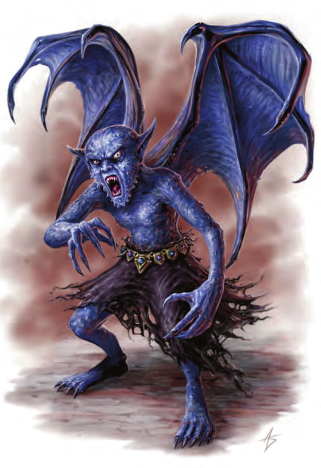
Copyright 2008 Wizards of the Coast Berbalangs are ghouls from filipino myth, and were first made into D&D monsters in an old issue of White Dwarf back in the OD&D days. Here, they’re only on the Monster Manual.
The Lore
Despite the impy look of the picture, Berbalangs are Medium! They’re Immortal Humanoids and Evil, but are not devils. The book doesn’t say much about their in-setting origin, but what little description is there implies berbalangs live in the world and not on the Astral Sea. They’re definitely sapient with Int 14, and speak Supernal.
They feed on the flesh and bones of dead humanoids, but that’s just a carrier for their real source of nourishment: the memories of the deceased. The creature relives those memories when it sleeps, and derives sustenance from them. It doesn’t matter whether the corpse is fresh or centuries old, the memories encoded in its physical form will still serve as food just fine.
Some berbalangs take up residence in remote villages, where they make a deal with the local leadership: instead of burying their dead, they offer them up to the monster, presumably in exchange for protection against other threats. If no one has died of natural causes recently, the berbalang instead demands a sacrifice.
Berbalangs are solitary, but will occasionally share their lairs with other monsters that like dwelling in tombs and crypts.
The Numbers
Berbalangs are Level 10 Solo Skirmishers with 408 HP. Their AC and Reflex are strong for their level, and their Will is slightly weak. They have a ground speed of 6 and a flight speed of 8.
The only reason I don’t consider them the most gimmicky monster I saw so far is because I just reviewed beholders. You see, the berbalang’s main ability is Summon Duplicate, an at-will minor action. While not bloodied, the creature can create up to four psychic duplicates of itself. Creating a duplicate costs the berbalang one quarter of its current hit points, which become that duplicate’s HP. So a healthy berbalang can create three duplicates with 104, 76 and 57 HP respectively, leaving itself with 171.
The duplicates have all the same statistics of the original, and the damage of their attacks is psychic. They act as fully independent combatants and can be targeted by PCs normally. A berbalang can use a standard action to either absorb a duplicate and regain 50 HP, or detonate it. The resulting explosion affects every enemy adjacent to the sacrificed duplicate with an attack that does psychic damage, and which dazes even if it misses. This also causes 25 damage to the original berbalang.
Once per round the creature can also deflect all damage and all negative effects from an attack that hit it to one of its duplicates.
Its basic melee attack is downright prosaic next to all this: a claw attack that suffers from the usual math problems. In a given turn, every duplicate will get one of these, and they get sneak attacks against enemies flanked by two of them.
The suggested encounter is level 12: a berbalang, a gibbering mouther, and a skeletal tomb guardian walk into a bar.
A lone berbalang might make an interesting boss battle against a level 7-8 party, at the end of an investigative adventure where they find out it’s enslaving a village.
-
Video Game Shields in GURPS
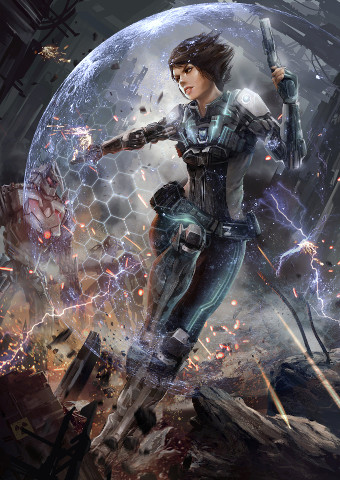
I laugh at your bullets in a slightly different way! (image source) As we saw in a recent post, force screens in GURPS work in a manner that is almost, but not entirely unlike that of energy shields in popular game franchises like Borderlands, Mass Effect, or Warframe. If you’re familiar with these games and read GURPS for the first time, the differences might trip you up a bit.
Energy shields in these games usually work like a separate pool of HP. Attacks that hit your character take directly from this pool, which lets nothing through until it’s completely depleted. Once that happens the character must avoid getting hit for a few seconds before their shields start to regenerate, which in turn takes a few more seconds. Games that give players a lot of insight into their numbers tend to also provide lots of options to tweak your shield recharge delay and recharge rate. Still, recovering your shields is always easier than recovering your “real” HP, which requires healing items or powers.
These games also feature multiple damage types of varying effectiveness against each type of defense. An attack that’s good at damaging shields will usually be worse at damaging HP (and/or armor, if that’s a thing in the game), and vice-versa.
How would this look like in GURPS? Let’s make an attempt to adapt these mechanics.
Campaign Option: Energy Shields
This is a campaign option for settings which use force screens, making them work in a more “video-game-like” fashion (described above). It’s good for campaigns meant to emulate the games I discuss at the beginning of this post. If you’re instead trying to model something like Star Trek shields, use the default rules from Ultra-Tech instead.
Under these rules, Force Screens still provide the listed DR for the equipment in question, but this DR is considered fully Ablative and ignores all armor divisors. If an attack lowers the screen’s DR to 0, any excess damage is lost. Attacks with the Surge modifier cause double damage to force screens, and they protect from radiation as if it was damage. This does mean that an attack that does “rad sur” damage would do triple damage to a force screen.
Shields recover at the usual rate of 10% per second, but they only start recovering after the user spends 2 seconds without being hit by further attacks. If the user is hit while the shield is mid-recovery, it takes another 2 seconds before it can start again.
Shield Overflow: GMs who don’t want to bother with the bookkeeping can eliminate both the 2-second recharge delay and the “no overflow” property of force screens. This means that damage in excess of the shield’s DR applies to the user, but the screen begins recovering on the very next turn.
All force screen variants from Ultra-Tech p. 191-192 except Kinetic and Energy can still apply to force screens using this rule1.
Examples
Remember Tom Tomorrow and the Robber Baron? Let’s see how their many confrontations would have happened under this rule. As before, Tom Tomorrow has a DR 60 personal force screen and a DR 30/15* armored space suit, and the Baron has an increasingly absurd modern arsenal.
During the First National Bank robbery, each shot from the Baron’s 9mm pistol (damage 2d+2 pi) would reduce the DR of Tom’s Force Screen by 9 on average. It would take 7 shots to disable the force screen entirely, but until that happens Tom is completely safe from the Baron’s gunfire. Tom can’t just stand there and laugh at the villain anymore, but he can still easily make the arrest.
During the Second National Bank robbery, each shot from the baron’s assault rifle (damage 5d pi) would reduce the DR of Tom’s Force Screen by 18! It will only take four of them before Tom’s shields are down, forcing him to be a lot more careful this time around. He can still take a lucky burst and survive unscathed, but likely has to hide behind some hard cover once or twice to let his shields recover. He’s still quite a bit safer than a mundane cop would be, though.
During the Third National Bank Robbery, the Baron’s antitank grenade (damage 4d(10) cr exp) would reduce the screen’s DR by 14, but Tom himself would be completely unaffected by the explosion! The Baron would likely be so surprised by this Tom would easily be able to handcuff him for the third and final time.
If the Baron somehow got ahold of a death ray (6d burn rad sur), each shot from that weapon would do 63 damage to Tom’s shields on average, meaning a single shot would be enough to destroy them! Tom himself would still be unaffected, but subsequent shots would threathen him directly until he had a couple of seconds to let his screen recharge at least a little. Luckily for him and for Paragon City, futuristic beam weapons are totally outside the Baron’s idiom.
-
Well, you can allow them if you really want to, but that will lead to a setting like Gun Gale Online, where everyone only uses weapons that ignore shields. ↩
-
-
Where I read the 4e Monster Manual/Vault: Beholder
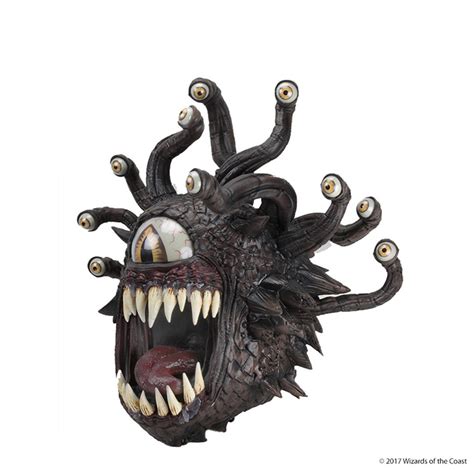
Hi there, fellow kids! (image source) This post is part of a series! Go here to see the other entries.
You probably heard of beholders before. You know, floaty spheres with a toothy mouth and an arbitrarily large number of eyes. They’re kind of a big deal. I believe they’ve been in the game since at least the BECMI era, and were one of the handful of creatures declared off-limits by Wizards of the Coast when they opened the door for third-party content through the OGL.
As classic boss monsters who nevertheless don’t quite get the same level of hype as dragons, it’s quite possible more D&D players have faced beholders than have faced the monster mentioned in the game’s own title.
Both the Monster Manual and the Monster Vault contain stats for beholders. We’ll look at both in parallel.
The Lore
The lore bits in the monster manual say barely more than the first two sentences in this article. Beholders are among the most feared monsters of all, and are so egotistical they normally can’t get along even with others of their kind. They like to rule over “lesser” creatures, a category which includes pretty much anyone other than themselves.
The Monster Vault elaborates on the above. It says beholders come from the Far Realm, but that unlike lots of other aberrant creatures that either cross over into our world by accident or to cause destruction, they come here as conquerors. There are many beholder varieties, and this diversity is further increased by the fact that some of then are changed by the passage from the Far Realm into the world.
All beholders are anti-social megalomaniacs, though, believing themselves the rightful rulers of everything they see (and yes, the book does make the pun that they see a lot with all those eyes). Beholders don’t really have allies - they have minions they lord over or masters they constantly plot to overthrow, Starscream-like.
Other interesting beholder facts gathered by osmosis from other editions:
-
Their flight is natural, not magic (their organisms contain pockets of lighter-than-air gas).
-
Beholders reproduce asexually, by nightmare. By this I mean that when a beholder has a particularly bad nightmare, that nightmare will manifest physically and take the form of a new beholder. No wonder they’re so antisocial. Each beholder is some other beholder’s literal worst nightmare.
You decide which of these are true in your game, of course.
The Numbers
Beholders are aberrant magical beasts. All are highly intelligent and of Evil alignment. They move via flight, and can hover. With all those eyes, they’re trained in Perception, have darkvision, and all-around vision, which means they can’t be flanked.
Their signature ability are the infamous eye rays, both from the little eyes on stalks and from the large central one. Each variety has a different set. They’re all ranged attacks, but they don’t provoke opportunity attacks from PCs. Let’s look at them sorted by level:
Beholder Gauth
This is a fun-sized version from the Monster Vault. The only Medium beholder, it’s Level 5 Elite Artillery with 102 HP. As a standard action it can bite or fire two of its eye rays at different targets, chosen from its list of four possible options:
-
The fire ray targets Reflex and does fire damage.
-
The exhaustion ray targets Fortitude, does somewhat less necrotic damage and weakens.
-
The sleep ray targets Fort, does no damage and slows, with the condition worsening to unconsciousness on the first failed save.
-
The telekinesis ray targets Fort, does no damage and slides a target 4 squares.
As a minor action, it fires a beam from its central eye that targets Will, does no damage and immobilizes.
The gauth’s non-damaging beams means it works better when together with other monsters that can take advantage of them. I guess that as the weakest beholder, it’s either going to rely more on its servants, or it’s going to be made a servant of a more powerful villain.
Beholder
The classic model, from the Monster Vault. It’s a Large aberrant magical beast, and a Level 9 Solo Artillery menace with 392 HP. It flies a bit slower than the gauth (Speed 4 instead of Speed 6), which fits since it’s more of a battleship than an agile corvette.
For its standard actions, we have the standard bite, which does decent damage but it’s not likely to see use if the beholder has its way. The main attraction are its ten different eye beams. It gets to fire any two of its choice against different targets per standard action.
- Charm: Targets Will, no damage, dominates for a turn.
- Wounding: Targets Fortitude, straight necrotic damage.
- Sleep: Targets Will. No damage, immobilizes, and that turns into unconciousness after the first failed save.
- Telekinesis Targets Fort, slides 4 squares.
- Slowing: Targets Reflex, does necrotic damage and slows.
- Brilliant: Targets Will, does radiant damage and blinds.
- Terror: Targets Will, does psychic damage and pushes the target its speed.
- Petrifying: Targets Fort, does no damage but petrifies right away! This is a (save ends) effect, so it’s not quite fight-ending but it’s still scary. After you save from the petrification, you’re still immobilized until you pass another save.
- Death: Targets Fortitude. More necrotic damage than the wounding ray. If it bloodies the target (or hits an already bloodied target) it sets off a chain reaction: the target becomes dazed; on the first failed save, that turns into dazed and weakened; on the second, the target dies.
- Disintegration: Targets Fortitude, does untyped damage and 10 ongoing damage.
Once the beholder is bloodied, it gains an Eye Ray Frenzy that recharges on a 6 and allows it to make 3 beam attacks instead of 2.
Those are just the standard actions. As a minor action, the beholder can use its traditional anti-magic central eye, a close blast 5 attack that targets Will and does no damage, but prevents affected targets from using encounter and daily powers for a turn. Yes, it can prevent purely martial characters from using their special tricks, but that’s easily intepreted as a sort of enervating effect instead of or in addition to the usual magic-dampening.
Finally, any enemy that starts its turn within 5 squares of the beholder gets tagged by a random eye ray a the start of the enemy’s own turn. That’s why they’re numbered! Roll 1d10 and watch your players pray they only get the vanilla wounding beam.
Beholder Eye of Flame
This one exists only on the Monster Manual. It’s Level 13 Elite Artillery, with 204 HP. It has the same “hit everyone nearby with a random eye ray” power as the classic Beholder, but here it’s written up as an aura. It flies at speed 6, and is all about fire.
Being a MM1 monster, it shows some of the early rough design issues: its bite is ridiculously weak instead of doing level-appropriate damage like the two previous beholders. It has three different eye beams, and can use two of them against different creatures per standard action. At least one of those must be the fire ray, but the other can be chosen freely.
- Fire: Fire damage vs. Reflex.
- Telekinesis: As above.
- Fear: Targets Will, and works similarly to the fear ray from the classic beholder, but bestows an additional -2 penalty to attacks (save ends).
It minor-action Central Eye power automatically gives a target Vulnerable 10 to fire, and makes them take 5 ongoing fire damage if they take fire damage from any source. This is a (save ends) condition, so the eye of flame will try to saddle every member of the party with it eventually. That more than makes up for its lack of eye ray variety.
When bloodied, and once again when it dies, the eye of flame lets loose a fiery burst that targets Reflex and deals fire damage to everyone on a Close burst 2. I guess its buoyant gasses are more flamable than usual.
Beholder Eye Tyrant
The strongest of the lot, and present in both the Monster Manual and Monster Vault. The two versions are mostly identical aside from updated math.
The Eye Tyrant is a Level 19 Solo Artillery weapons platform, essentially a vastly up-gunned classic beholder. The bite on the MM version is evey more ridiculously weak than that of the Eye of Flame, but the MV version strengthens it to what’s expected for a level 19 monster (MM: 2d6+1; MV: 4d8+7).
The Eye Tyrant’s ten eye rays are slightly different:
- Searing: Targets Reflex, straight radiant damage.
- Withering: Targets Fortitude, necrotic damage and ongoing 10 necrotic damage.
- Sleep: Targets Will, no damage but causes instant unconsciousness (save ends).
- Telekinesis: identical to the classic beholder’s.
- Hold: Targets Reflex, no damage but restrains the target (save ends). Restrained is Immobilized’s big brother: the former only roots you to the spot, the latter prevents all action.
- Confusion: Targets Will, does no damage but forces the target to charge the nearest ally it can charge.
- Terror: The MM version is similar to the classic beholder’s. The MV version does psychic damage and makes the target move its speed away from the eye tyrant. This is different from a push because the target chooses where they end up. And it that destination is still within 4 squares of the beholder, the target takes psychic damage again!
- Petrifying: Targets fortitude and induces gradual petrification: slowed, worsening to immobilized and petrified with failed saves. Petrification this time is permanent.
- Death: Like the classic beholder’s but with lots more necrotic damage.
- Disintegration: Like the classic beholder’s, but ongoing damage is 2d20 instead of a flat 10.
The eye tyrant’s eye ray frenzy allows it to fire four beams instead of the usual 2 on a recharge 6 timer.
Its minor-action Central Eye blast dazes on the MM version, and disables encounter and daily powers on the MV version. It still has random eye rays.
Final Impressions
I’ve never used beholders in a game before, but I still have fond memories of them from the D&D cartoon and arcade games. Their 4e stat blocks give me pretty much the same feel as the ones from previous editions, since those also had the entire explanation for what each eye ray did as an itemized list.
Fourth Edition shies away from instant save-or-die effects, so beholders end up with a lot fewer of those. Still, the classic beholder has one in the new “gradual doom” flavor, and the Eye Tyrant has two. The level 9 beholder is nastier than it seems too, because it’s a suitable boss battle for a party of level 6 adventurers who won’t have easy access to resurrection yet.
-
-
Force Screens, How Do They Work?
I laugh at your bullets! (image source) Energy shields are a popular science fiction trope, appearing in enough stories to feature in GURPS Ultra-Tech as Force Screens and Force Shields. However, I didn’t have a very clear idea of how they worked until recently.
The text describing them is a bit… fuzzy, probably because this was one of the first supplements written for GURPS Fourth Edition. The “real” explanation makes sense, but it does require quite a bit more deduction, research and/or knowing the rules by heart than latter additions to the system. To make it easier on you, here’s the complete picture of how GURPS Force Screens work, to the best of my knowledge:
GURPS Force Screens come in “Barrier” and “Conformal” varieties, where the first represents the sort of shields used by starships or cities, and the second represents the kind worn by individuals and very common in video games. They both work the same way rules-wise.
Force Screens provide DR to the person or thing they protect (the “user”). They protect all of the user’s hit locations, even the eyes. Anything that hits the user must contend with the force screen’s DR first, separate from any other DR from armor. Every 10 points of rolled damage from the attack reduces force screen DR by 1, whether it penetrates or not. Force Screens regenerate 10% of their lost DR every second.
In short, they work exactly like DR (Force Field +20%, Semi-Ablative -10%), with Regeneration (Very Fast) applied to their DR instead of the user’s HP.
Armor-piercing attacks apply their armor divisor both against the screen’s DR and against the number of damage points needed to ablate it. This was the hard bit to figure out! People have been asking questions about this for years according to this source.
Examples
Tom Tomorrow is a hero transported straight from the pages of pulp space opera to modern-day Paragon City. He fights crime with the help of his raygun, armored space suit (DR 30/15*), and personal force screen projector (DR 60).
The Robber Baron is at it again, robbing the First National Bank. Tom Tomorrow arrives ot save the day, and the Baron shoots him with his pistol. The gun does 2d+2 pi damage, and its average damage roll of 9 is certainly not enough to get past Tom’s force screen. In fact, it would take 2 shots to reduce the screen’s DR by 1, and it would recover soon afterwards. The Baron has no means of harming Tom, making this an easy arrest.
Some time later, the Baron escapes jail and tries to rob the Second National Bank. Tom intervenes again, and this time the baron fires at him with an assault rifle! The weapon does 5d pi damage and has a RoF of 12. Its average damage roll of 18 means a single shot can’t penetrate the force screen, but it does reduce its DR by 1. Assuming all shots hit, a second of sustained fire would lower the screen’s DR by 21. 6 of those points would return at the start of each turn, and it would take about three seconds before any bullets started getting through. Of course, it’s rare for all shots in a 12-round burst to hit and Tom isn’t just going to stand there, so the screen still makes him much safer than a mundane police officer would be. He manages to arrest the Baron once again.
Yet more time later the Baron escapes again and tries to rob the Third National Bank. This time, when Tom arrives to stop him, the baron shoots him with an antitank grenade from his rifle’s brand new underbarrel launcher. The grenade does 4d(10) cr ex damage, with an average roll of 14. The screen protects against this with DR 6, and loses 14 points of DR from the attack. 8 damage get through to Tom’s armored space suit. It would normally protect against crushing damage with DR 15, but the armor divisor still applies, so it only protects against this blast with DR 1. Tom takes 7 points of damage and is visibly staggered and bloodied. Oh no! Can he defeat the Robber Baron this time?
Conclusion
Force Screens are good protection against single attacks, and give you something of a safety buffer against sustained fire from multiple sources. Anything that’s good at getting through physical armor will get through them just as well, though, and deplete them faster.
Pretty much every weapon available at the same TL as force screens will have an armor divisor of at least 3, and more often 5 or 10, so their DR is going to ablate at a faster rate than you might think from looking at them in isolation. Against lower-tech weapons, though, even the belt-mounter personal force screen is enough to make its user as hard to take down as a lightly armored vehicle.
In a future article I’m going to look at how to tweak GURPS force screens to make them work a bit more like video-game shields.
subscribe via RSS