Let's Read DFRPG Adventurers: Introduction
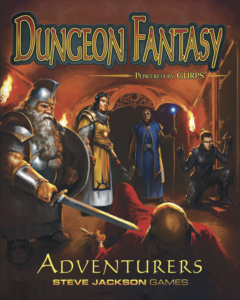
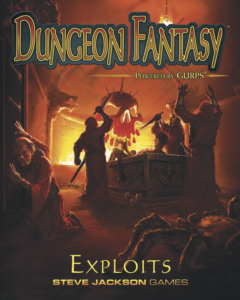
Dungeon Fantasy: Adventurers is the first book in the boxed set, and is likely to be the most perused one since it contains all the information on how to create characters. It’s 128 pages long, and in its physical edition it’s a hardcover. I’m going to be reading from the PDF, and in this post we’ll cover everything that appears before Chapter One.
Cover
The cover which can be seen to the left above, is drawn by Brandon Moore, as are all the interior illustrations in the book. One neat thing about this particular illustration is that it’s one of a matched pair: the cover for Exploits can be seen on the right and shows what’s on the other side of the door.
Quick Rules Reference
The very first thing I see when going past the cover is a single page quick rules reference. If you’re completely new to GURPS, this isn’t going to make much sense yet, but it will be a good place to check mid-game.
First it lists which of the game’s skills are associated with which of its attributes. Next we get a very short summary of how success rolls and difficulty modifiers work. There’s a basic rules summary later on in the introduction, so I’ll combine their descriptions below.
Front Matter
We then get the front matter page with the credits and copyright notices. The book was written by Sean Punch, with additional material contributed by most of the regular GURPS writers and freelancers.
The Actual Introduction
We begin with a basic explanation of what a role playing game is, with the usual definitions of the Game Master (GM), Player Characters and Non-Player Characters (PCs and NPCs), adventures, campaigns and so on. GURPS is a very traditional game, so there are no surprises here, but it’s a well-written and friendly introduction.
Then we get to an good explanation of that Dungeon Fantasy is. They’re not legally allowed to say this is the specific genre of fantasy D&D belongs to, but I can.
According to the book, some of the main assumptions of the Dungeon Fantasy genre are:
-
An medieval-ish world filled with anachronistic social developments like full gender equality, social mobility, and a cash economy.
-
A technological mish-mash whose only rules are “preindustrial” and “no gunpowder”.
-
Casual acceptance of magic and holy miracles.
-
Trade guilds for wizards, thieves, and even assassins.
-
“Adventurer” as a socially-recognized career choice.
The intro proceeds to list the books in the boxed set and what they contain (which we already covered in the previous post).
Basic Rules and Glossary
Next comes a high-level description of the basic rules of the game, along with a glossary. I’ll go into a little more detail here because this will also serve as a handy reference for us.
GURPS uses six-sided dice exclusively, and so it omits the number of sides from the traditional notation you might be familiar with. So “three six-sided dice” is written as “3d”, “four six-sided dice plus two” is 4d+2, and so on.
There are a few types of rolls here, described in the glossary:
A success roll is made on 3d. You want to roll a total that’s equal to or lower than your “effective skill level”, which is your skill level after situational modifiers. Modifiers apply directly to your skill level, which means positive modifiers are bonuses and negative ones are penalties. The difference between your roll and your effective skill level is your margin of success (or failure). Lower rolls are better. The reference sheet has a table with the probabilities of success for each skill level. It’s the expected bell curve, with 10 being 50% and changing quickly for every point higher or lower than that.
A roll of 3 or 4 is a critical success, and a roll of 5 or 6 might be too if your skill level is high enough. A roll of 18 is a critical failure, and a roll of 17 can be either a critical or normal failure depending on your skill level. This means that skill levels over 16 don’t increase your chances of success, but they do make you better able to ignore penalties.
A Quick Contest is when two people in opposition make a success roll and the one with the largest margin of success wins.
A reaction roll is also 3d, and is used to find out what an NPC’s opinion of a PC is when that hasn’t been previously determined by the story. Here, higher is better, and modifiers apply to the total you roll on the dice.
And finally damage rolls use a varied number of dice, depending on the specific attack. Just add them all up. Higher is better! There are more rules around damage in the combat chapters.
You can also have other random rolls, for stuff like a pile of treasure containing 2d x 1000 coins and guarded by 4d skeletons.
The reference sheet in the very first page has a preview of the difficulty modifiers that can apply to a success roll. There is usually a detailed way to figure them out, but you can also use the reference sheet to assess difficulties on the fly.
A trivial non-adventuring task is a +6 or more. Why are you even rolling? A typical task performed outside of an adventuring context gets a +4 or +5, which explains how your typical NPC civilian can get through a workday with a skill of 9 or 10 without running into daily disasters. This goes all the way down to -6 for “memorably difficult adventuring tasks”.
If you don’t want to slap a blanket negative modifier on a task, the reference sheet suggests assessing a -1 penalty for each negative adjective that applies to the task, or a -2 if that word also has an intensifier. Climbing a slimy wall is a -1. Climbing a horribly slimy wall is a -2. If you want to climb a perfectly smooth, horribly slimy wall with a steep negative incline, that’s going to be a -6. Memorably difficult indeed!
Other terms in the glossary should be very familiar to us already, like “adventure”, “campaign”, “GM”, and so on. There are some hidden jokes here already, since one of the meanings given for the term “munchkin” is “An award-winning dungeon fantasy card game by Steve Jackson Games.”
Rounding and Units
In this game, you round costs and weights up, and everything else down. Character point costs are rounded up to the next integer, and if they’re negative that means rounding towards the positives. So 2.1 points becomes 3, and -2.9 becomes -2. In the DFRPG this rarely comes up.
Weights and monetary costs are also rounded up, but you keep the first two decimal places. As for measuring units, the game uses the Imperial system, and this is actually the biggest pet peeve I have with GURPS since I grew up with Metric. The approximate on-the-fly conversions I use are: 1 yard is 1 meter; 1 pound is 0.5kg; 1 pint is 0.5l; 1 mile is 1.6km. This is usually enough for most games.
There are two special units here, the hex (from a battle map) and the turn (an interval of action in combat time). Hexes are 1 yard wide from edge to edge, and are also used as units of area. Turns are 1 second long, and I had something to say about that a while ago.
The Implied Setting
The Dungeon Fantasy RPG has an implied setting, which is used to make certain concepts easier to explain and to be a minimally viable framework for a dungeon-crawling campaign. It’s not a very serious setting, being made of tongue-in-cheek cliches, but it follows all the basic assumptions of the genre that I outlined above, and adds a dusting of detail to make it act as a minimal backdrop to your dungeons.
The medieval-ish world of our implied setting is more specifically “Western European-ish”, though this doesn’t get explicitly mentioned by the book. In better news, it doesn’t equate “European” with “white”, since there is noticeable ethnic diversity among the characters depicted throughout the book.
At its most basic, the world of the PCs consists of their current dungeon and the town they’re in.
The Dungeon is where adventure awaits. It can be literally the same megadungeon for the whole campaign, or might be a new one every adventure.
Town has guilds and temples for the PCs to spend their treasure at, and a Town Watch to keep the peace. Guilds include the Merchant’s Guild who controls the shops, the Thieves’ Guild which is a crime syndicate, and the Wizard’s Guild who deals in magic items and “forbidden” spells. Temples worship “The Gods”, and will bless and heal you if you pay their fees-disguised-as-donations. The overall ruler of all towns is “The King”, and he has the “King’s Men” to intervene in situations where the Town Watch isn’t enough. Despite containing all this, town is fundamentally safe. Adventure happens out there, not in here.
There’s no alignment but you do have opposing forces of supernatural, capital-letter Good and Evil. The latter are ruled by a being known as “The Devil”, who wants your soul. Not every monster you find will be capital-E Evil, but beings such as demons and “undead by choice” tend to be.
You also have Elder Things who exist outside time, space, Good, or Evil, and which tend to cause madness in mortals.
While not very inspired, all of this can very easily be replaced with more detailed stuff, either of your own creation or from a third party. Any setting that keeps to the list of genre assumptions from the introduction can be slotted into DFRPG almost without effort, and there are a ton of those (included, but not limited to, every D&D setting ever released plus Pathfinder’s Golarion).
I think the game kinda expects you to replace its setting when you run a longer and more elaborate campaign, but if you’re only planning a one-shot dungeon romp, the default one is enough.
Next: Chapter 1, with the Basics of character creation.