Let's Read the Dark Sun Creature Catalog: Chathrang
This post is part of a series! Click here to see the rest.
The Lore
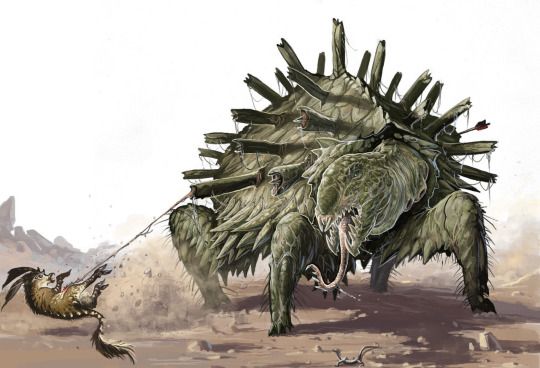
Chathrangs are big carnivorous tortoises with built-in anti-air artillery. The many spiny protusions on their shells are tubes that can spit out sticky envenomed quills, with or without a tether that lets them reel in their catch. Their usual hunting method is to hide in an oasis amid natural reeds or other plants, wait for small birds or large insects to fly overhead, and shoot them.
If no suitable flying critters are present, they’ll go for land-based prey. They tend to become too enthusiastic or desperate at these times, and might try to reel in something they can’t handle. Like a PC, for example.
Chathrangs usually live and travel in groups of about three. They don’t have a lot of combat ability outside of their one neat trick, so it’s common for them to enter symbiotic relationships with other creatures to share prey in exchange for a bit more protection. When hurt, they behave like other tortoises and hide inside their shells.
Charthrangs are impossible to train, but some people keep them around to “milk” their venom. If a battle against their keepers ends up bursting into the charthrang enclosure, the creatures will follow their instincts.
The Numbers
These critters are Medium Natural Beasts with the Reptile tag and a stately ground speed of 4. They’re Level 9 Artillery with 81 HP, so I guess even a monster described as “relatively weak” rates high-Heroic stats in this world.
The creature’s Spiny Shell acts as an aura (1) that deals 5 damage to anyone who starts their turn inside, but they charthrang doesn’t really want PCs to get that close. Instead, it wants to stay far away and shoot its Range 20 spine shots, which do poison damage on a hit. The beast can increase its rate of fire and use a Spine Volley instead, attacking two targets with one action.
Attaching a sticky strand to a spine turns it into the Poisoned Tether attack, which does the same damage and immobilizes the target. While immobilized by this attack, the target cannot be pushed, pulled, or slid by anything other than the Reel In minor action, which pulls it 5 squares. Escape requires either passing a save as normal, or teleporting.
If the charthrang is damaged by an attack, it can retreat into its shell as a reaction. Until the end of its next turn it’s slowed, can’t attack, gains a +5 to AC, and doubles the damage done by its aura.
Encounters and Final Impressions
Aside from the standard encounter disposition mentioned in the lore, chatharangs are also very amenable to reskinning. If you read the Cactus entry and felt that you needed cactus artillery to complement the lurkers, you can just replace Reptile with Plant on the chathrang stat block and call it a day. Describe them as big spherical cacti that move by rolling around and otherwise behave the same.
The mechanics are interesting. Range 20 is a lot! A cluster of three of these machine-gun tortoises can sit very far back behind a line of 2-4 soldiers or brutes and wreak havoc on the PCs by directly targeting their squishies, and reeling them towards Team Monster’s frontline. Multiple charthrangs can stick their tethers to the same PC and alternate their use of Reel In to bring the victim closer that much faster, too.
That is, of course, if the GM plays them smart. This is absolutely not required, as these are simple animals with a reputation for trying to catch things too dangerous for them to handle.
Still… anti-air tortoises. What a world.