Posts
-
Let's Read Threats to the Nentir Vale: Twig Blight
Copyright 2011 Wizards of the Coast. This post is part of a series! Click here to see the others.
D&D Third Edition made many attempts to create new monsters that would grow popular enough to become iconic, and I think these little critters were one of their greatest successes even though they weren’t an intentional attempt.
They first appeared as custom opposition in The Sunless Citadel, the very first official module for Third Edition. They had a very specific origin tied to the overall story arc of that campaign. That origin is mentioned in version, but we also see some lore that talks about them in the Vale.
The Lore
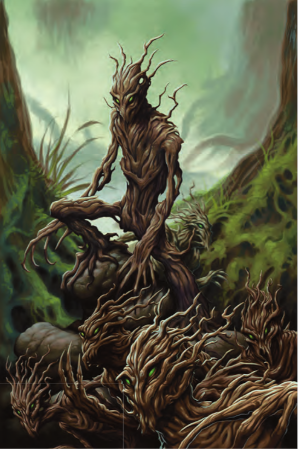
Twig blights look like large woody shrubs or small trees with interlocking branches. They can change shape somewhat to blend in with the surrounding vegetation, and they can also uproot and twist themselves into roughly humanoid shapes in order to hunt or migrate.
Blights need fresh blood to reproduce and grow, using their roots to absorb it from the soil or directly from corpses. New seedlings sprout from their root systems, as many as a dozen at a time. They’re very fragile early on, but mature quickly and after a few days are big enough to start ambushing small creatures.
The first blights originated from the Gulthias Tree, which grew from the stake used to slay ancient vampire who went by that name. Some people speculate that repeating the process to create a similar tree could create new varieties of twig blight, though of course few are unbalanced or evil enough to try.
Our Vale-specific story is about a lonely pig farmer named Fellis, who was the first to discover these creatures in the Vale. A strange new bush appeared overnight in his slaughter shed, and soon it began sprouting seedlings. Fellis loved the little scamps, giving them names and playing them tunes on his flute. His neighbors were very worried about all of this weirdness, but still regularly went there to trade for pig meat.
During that winter, however, severe snow storms tore through the region and made regular travel impossible until the thaw. When Fellis’ neighbors managed to get to his farm again, they saw that the man, his family, his pigs, and even the cat had all been killed. All that was left was a number of pulsating bushes sprouting from their corpses. Several nearby villages banded together to burn out the infestation, but a few individuals managed to escape into the surrounding woods. So now we can add “twig blight infestation” to the list of everyday disasters that can fall upon the people of the Vale.
Twig blights can survive from normal soil nutrients and sunlight like mundane plants, but they vastly prefer to have access to a blood supply. Their numbers increase rapidly when they can find a big source like a slaughterhouse or battlefield, though even a single corpse is enough to let their reproduction cycle continue. When their current blood supply runs dry, they’ll uproot themselves to look for more. If can’t find a new victim or supply quickly, they’ll take root again and wait in ambush.
Twig blights can even be found in dungeons, ruins, caves, and other places never touched by the sun. Without access to light, they become even more bloodthirsty than usual.
Some powerful creatures try to make use of twig blights as unguided boundary guardians by seeding them along that boundary. However, the creatures are fickle and as likely to follow the wind to nearby settlements as they are to stay in place.
Twig Blights are monsters. They have some intelligence and can even speak Elven, but they only use that to set up smarter ambushes. They only see other creatures, sapient or not, as food sources, and only interact with them through violence. You might be able to keep them contained for a while if you supply them with enough blood, like Fellis did, but their reproductive cycle will ensure their population quickly outstrips the supply, at which point they’ll begin hunting for live prey (which means you).
The Numbers
Twig Blights are Small Fey Humanoids with the Plant tag. They have ground and climb Speeds of 5 with Forest Walk, and Darkvision. They have Resist Poison 5 and the non-minions have Vulnerable to Fire 5. Their signature trait is Rooted, which reduces forced movement from pulls, pushes, or slides by 3 squares.
Like their original 3e incarnation, they’re early Heroic opposition.
Twig Blight Seedling
A seedling who just grew big enough to hunt. It’s a Level 1 Minion Skirmisher. Their claw attack lets them shift 2 squares before making the roll, deals poison damage, and has a small damage bonus when the target is granting them combat advantage.
Their tactics are simple: surround and kill.
Twig Blight
The classic model is a Level 2 Lurker with 28 HP. It can turn invisible for a turn with a standard action, and surprise opponents with Blighted Claw attacks that do heavy poison damage and weaken (save ends). Even a miss still does half damage and weakens for a turn.
If the blight can’t become invisible, it can still attack with basic claw attacks that do a typical amount of poison damage.
Twig Blight Swampvine
This is a new variant! It could be that classic blights adapted themselves to a swampy environment… or it could be that someone out there did prove the stake-tree theorem. They’re particularly common in the Witchlight Fens along the Nentir River.
Swampvines are Level 3 Soldiers with 42 HP. They’ll use their minor actions to pull targets close using a Swamp Vine, which also grabs them (escape DC 13). If a grabbed target attacks someone other than the swampvine, they take an automatic 5 poison damage. They can also make basic claw attacks that do poison damage.
Twig Blight Swarm
A big bunch of classic twig blights that decided to stop being subtle. It’s a Large Swarm made up of Small creatures, and a Level 5 Brute with 74 HP. It’s Swarm Attack aura deals 3 damage to those inside, and while it looses its specific vulnerability to fire it’s still vulnerable to close and area attacks like any other swarm.
Its version of Rooted makes it completely immune to being pushed, pulled, or slid, and its Swarm of Claws basic attack deals poison damage.
Final Impressions
I’m sure there are lots of people who will be happy to have official 4e stats for Twig Blights. Their explicitly unnatural origin and their monstrous disposition tends to make them better “guilt-free” low-level opponents than your usual selection of humanoids.
This incarnation of them is also quite tricky for low-level PCs to handle, since a lot of their early powers rely on forced movement for their more interesting effects.
-
Let's Read Threats to the Nentir Vale: Treants
This post is part of a series! Click here to see the others.
Treants appear in the MM1 in a generic form. Here we see not one but two specific treant factions present in the Vale.
The Lore
Before the hillfolk, before the Tigerclaw, before even the elves, the Nentir Vale was covered by a single, vast forest. And in this forest, the treants ruled. They feared no one, not even the mighty dragons, for the entire region was under the protection of Malorunth the Eternal Ash, a gigantic tree who as also a powerful archfey.
One spring evening, however, Malorunth died under mysterious circumstances. The once vigorous tree was now entirely petrified, leaves falling from its brittle branches in droves. With Malorunth dead, its blessing left the Vale, and the dragons who coveted it were quick to capitalize on the opportunity, arriving in large numbers.
The battle that followed between treant and dragon was called the War of Endless Branches, and it’s because of this war that the Nentir Vale looks like it does today. Draconic magic and breath weapons cut a swathe of devastation across the center of the region that created the large open area there, and separated Winterbole Forest to the north from Harken Forest to the south.
The dragons would go on to win the war and move into the “cleared” area. They were powerful, but what really brought them victory was the growing distrust and suspicion among the treants themselves, which caused them to stop working together and turn on each other.
You see, the deciduous treants began to think their coniferous relatives had something to do with the death of Malorunth, and this suspicion festered enough that they began voicing it aloud for everyone to hear. Arguments turned to fights, and soon the treants were more concerned with their brand new civil war than with keeping the dragons out.
This civil war caused the conifers to migrate north to Winterbole forest, where they would eventually begin venerating the archfey of winter known as the Prince of Frost. The deciduous treants stayed in Harken Forest, paying homage to the petrified corpse of Malorunth, which still stands today. They believe the Eternal Ash will be brought back to life if its murder can be avenged.
The war technically still rages, but it does so at a treant’s pace. There’s a battle every century or two, when one of the group manages to organize a Great March to attack the other’s territory. The fact that they must cross the entire Vale to do so makes these marches even harder to organize, and slower to happen. The last one was two hundred years ago, when Harken attacked Winterbole. The next one will probably be a Winterbole attack, but sometimes it happens that the same side will launch two attacks in a row.
Yes, the last battle in this war is older than the fall of Nerath, and there probably are no surviving Nerathi records of it. Maybe there are a few very old elves and eladrin who remember it. And maybe the Frost Witches or Harken’s Heart druids might know, since they live in those forests. But almost no one else has any idea that a new Great March might be in their future.
Winterbole Treants
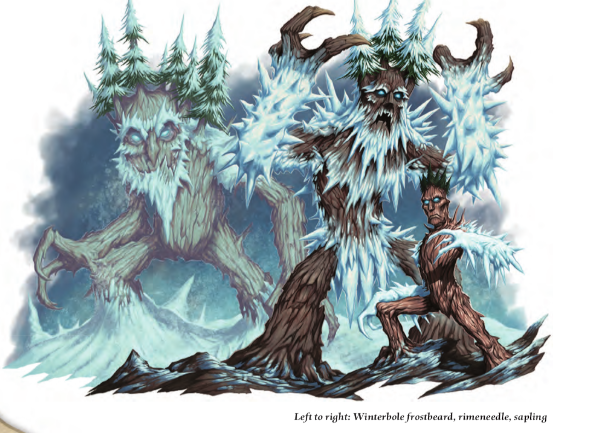
Copyright 2011 Wizards of the Coast. These conifer creatures consider fleshy humanoids to be annoying pests and parasites, and try to keep their territory free of them. This is made more difficult by the fact that their slice of Winterbole Forest has a lot of Arkhosian ruins and Shadowfell crossings in it, so delvers and explorers often seek those out.
They also have an alliance with Bitterstrike, whom we already met. The dragon believes the treants to be her vassals, and they put up with this delusion as long as she holds up her end of the bargain and assists them in the next Great March.
Like all treants, they are Fey Magical Beasts with the Plant and Treant tags. In addition to low-light vision, they have both Forest Walk and Ice Walk, ignoring difficult terrain with either or both of these themes. Needless to say this type of terrain is plentiful in their home ground. They also have Resist Cold 10 - even the minion.
Winterbole Sapling
These Medium saplings are energetic and aggressive, and often team up with Winterbole-aligned Wood Woads in raids against the Tigerclaw and other trespassers. They’re Level 11 Minion Soldiers with a Speed of 6. Their Slams deal a bit of damage and immobilize for a turn, and their Numbing Branches aura (1) deals 3 damage to immobilized enemies that start their turns inside.
This makes for enemies who likes to mob and surround a single target. If even one of them hits, all of their auras will deal damage that round.
Winterbole Rimeneedle
Rimeneedles are the most intelligent of the “lesser” conifers, and tend to act as scouts. They’re Large, and Level 12 Skirmishers with 122 HP. It has a Speed of 8.
Rimeneedles are probably going to start the fight with Winter’s Step, a move action encounter power that lets them teleport 5 squares and make a Close Burst 2 attack on arrival. This deals cold damage, half on a miss. It probably involves forcefully ejecting those rime needles.
Since this is a move action, the treant can immediately follow it up with a basic slam or with Tree Stomp, which lets it shift its speed and move through enemy spaces while doing so. The rimeneedle can make one slam attack against an enemy along this path, and will additionally knock the enemy prone if it hits.
Fortunately as a non-minion treant, it has the Wooden Body weakness, which causes it to ignite and take ongoing 5 fire damage (save ends) from any attack that deals fire damage.
Winterbole Frostbeard
The leaders of the Winterbole treants are the venerable Frostbeards, who can command the winter. They’re rare and seldom seen by others, but they’re out there.
Forstbeards are Level 16 Elite Controllers with the Leader tag and 308 HP. Their size is Huge, their speed is 8, and they’re immune to being knocked prone. Their Deep Roots reduce any forced movement inflicted on them by 2 (which can negate the movement entirely), and when they spend their action point every ally within 10 squares can make a free basic melee attack.
Their opening move is likely a Howling Blizzard, an encounter power that deals heavy cold and thunder damage in an Area Burst 2 within 10 squares, and knocks prone on a hit. The blizzard lingers as a zone that deals 10 cold damage to people who end their turns inside. The frostbeard can move the zone up to 5 squares with a move action, and sustain it with a minor action.
Once the zone is in the battlefield, the frostbeard will likely wade inside it and begin hitting people with Slams, which it can make as part of a Double Attack. If things begin to look dicey, it can call upon the Spirits of the Forest (move action, recharge 6+) to teleport itself and up to 3 nearby allies up to 5 squares, granting them +2 to all defenses for a turn on arrival.
I guess their main weakness, aside from the usual Wooden Body, is that they have three different things they can do with their move action: move the blizzard, use Spirits of the Forest, or make normal moves. If they’re doing one of them, they can’t do the others unless they give up their standard action. Therefore, it’s possible to play “keep-away” with them to make them fight at less than optimal strength. If you stay rooted to one spot, though, they’ll fight you with slams while pulling the blizzard to sit on top of themselves.
Harken Treants
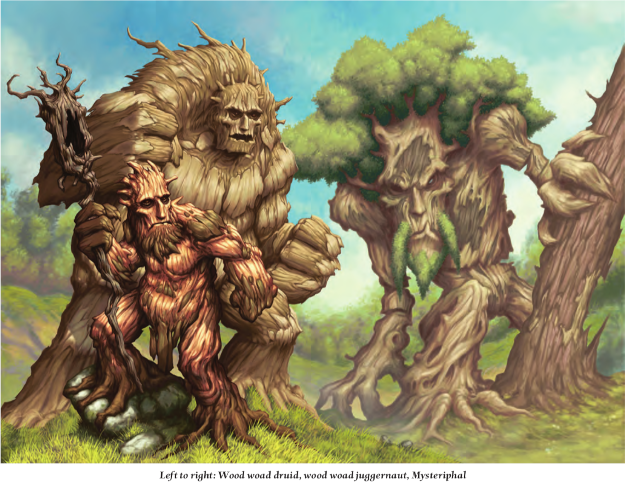
Copyright 2011 Wizards of the Coast. The deciduous treants of the Harken forest are quite standard as far as rules go. They use the standard stat blocks for the Treant and Bramblewood Treant from the Monster Vault. They do often work alongside wood woads, so we have a couple of stat blocks for those in addition to the (by now slightly outdated) basic stats from the Monster Manual 2.
Their leader is the most exceptional thing about them: Mysteriphal is the oldest living creature in the entire Vale. He was there when Malorunth fell, and swore to forever protect his petrified husk. As mentioned above, Mysteriphal believes Malorunth will return to life once his murder is avenged. In our narrative present he’s a huge fire-and-curse scarred thing, any hints of his former kindness and nobility long gone.
Wood Woad Druid
I guess the existence of these guys explains why the Harken treants wouldn’t be allied with the Harken’s Heart druids. They’re Level 14 Skirmishers with the Leader tag and 145 HP.
The druid only has a speed of 5 and no Forest Walk, but it’s immune to the Immobilized, Restrained, and Slowed conditions. It will likely try to approach a squishy PC and use Polymorph Into Plant on them. This targets Fortitude, and does what it says on the tin. It lasts for a turn or until the druid drops to 0 HP, whatever comes first. The polymorphed target is considered stunned, and gains Vulnerable 15 to fire. This recharges whenever the druid misses with it, so he can keep trying until it sticks.
If the polymorph attack doesn’t look like an attractive option, the druid can hit people with his cudgel, using either basic attacks or a darting strike that lets him shift 2 squares before or after the attack.
His leaderly options include Earthen Stride (at-will, move action), which lets the druid and an adjacent ally shift 2 squares; and Nature’s Boon (minor, encounter) which gives a plant ally 25 temporary HP.
Wood Woad Juggernaut
This Level 15 Brute is Large instead of Medium. He has 160 HP and fights mostly with his powerful slams. He will charge if at all possible, since he has Resist All 15 while charging.
Once his preferred opponent is within his melee reach of 2, the juggernaut will try to tag them with Nature’s Reign (recharge 5+), a more damaging strike that also inflicts ongoing 10 damage (save ends), and heals the juggernaut for the same amount whenever the target takes this ongoing damage.
Mysteriphal
The leader of the Harken treants is a Huge specimen, and a Level 20 Solo Controller with 768 HP. This probably makes him the most powerful individual in the whole Vale. Everything about him hints at his tremendous age, from his scarred look to his stats. He ponderously drags himself at a speed of 4 without Forest Walk, but is immune to poison since he has had time to build a tolerance to all of them.
As an Ancient Entity, Mysteriphal automatically downgrades the Dominated and Stunned conditions to Dazed. His long fighting experience gives him Threatening Reach 3, but he’s even more flammable than a typical treant. He takes ongoing 10 damage (save ends) when he takes fire damage, but while on fire his melee attacks also deal an extra 10 fire damage.
Mysteriphal’s powerful Reach 3 slams damage and push the target 1 square, and he can make four of them with a single standard action. If someone in reach deals fire damage to him, he can make a free slam against the offender as a reaction (which will already benefit from that bonus fire damage).
He also has several other tricks he can surprise his opponents with. Instead of slamming he can use a Reverberating Word that attacks all nonplants in a Close Burst 3, deals heavy thunder damage, and dazes for a turn. This is perfect for use with an action point, since it lets him do this and still punch his enemies. It also recharges when Mysteriphal is first bloodied, so that second solo action point also has an easy pre-defined use.
As a minor action he can use a Reach 3 Root Grab to grab a target (DC 25) and pull them up to 2 squares. He can have up to four different creatures grabbed this way. This doesn’t deal damage… unless Mysteriphal is on fire, when it benefits from the bonus. And if you think you’re safe by putting some difficult terrain between Mysteriphal and yourself, the wily old treant can Teleport 4 squares as a move action (recharge 4+) and reach you anyway.
PCs fighting Mysteriphal might want to consider avoiding fire attacks. While they’re still effective, they also make him much more dangerous.
Final Impressions
This is a tragic story all around. Probably only the treants themselves remember why they’re fighting, and barely anyone else would remember they’re fighting at all due to the long quiet periods between Great Marches.
The truth about Malorunth’s death is a mystery literally older than mortal civilization, making it almost impossible to solve. And even if our nearly-Epic PCs manage it, it’s probably still not enough to get the treants to end their war. It might have started over this murder mystery, but after millenia of conflict both sides have plenty of reason to keep hating each other.
-
Let's Read Threats to the Nentir Vale: Tigerclaw Barbarians
Copyright 2011 Wizards of the Coast. This post is part of a series! Click here to see the others.
We’ve heard about these people in several previous entries, and now is the time to take a more detailed look at them.
The Lore
The Tigerclaw people claim direct descent from the Hunter of Winter, a powerful primal spirit in the shape of a sabertooth tiger who roamed the world when it was young. Their stories tell of Hota Swiftstripe, one of their first chieftains, who ran into the Hunter while he was tracking a bear near a glacier. The spirit lashed out with a claw and took out one of Hota’s eyes before he could even blink, but the chieftain proceeded to lure it to a frozen lake.
The tiger’s great weight cracked the ice and caused it to fall in, but Hota fell compassion for such a great hunter and reached out with his spear to help the beast get out. The Hunter of Winter told Hota that from that moment on they were brothers, since Hota bore the Hunter’s mark and had saved its life. Hota himself would be blessed with the blood of the tiger, and so would all his descendants. When Hota returned to his tribe, he was no longer a human, but one of the first razorclaw shifters.
All of Hota’s descendants were shifters as well, so today the Tigerclaw are divided into two sub-groups. The Tigerbloods who occupy important roles such as chieftain, shaman, and several types of elite warrior; and the Tamed, non-shifters who work as gatherers, artisans and rank-and-file warriors. These are not quite castes despite being called such by the book: there is a way for one of the Tamed to become a Tigerblood.
When a Tamed has proven themselves worthy, the tribe’s chieftain invokes a rite of initiation where the candidate must hunt and attempt to subdue a sabertooth tiger. They must not kill it - this is seen as a grave offense punishable by death. Those who succeed are elevated to Tigerblood status. While they do not become shifters themselves, they’re paired with a Tigerblood shifter so that their children are born shifters. There doesn’t seem to be any gender-based role division within the Tigerclaw, or at least the book doesn’t mention any. The important one is the Tigerblood/Tamed distinction.
The Tigerclaw used to live all around the Vale, but were driven north when Nerath began to encroach on their territory. Chief Scargash’s tribe lives in Winterbole Forest in our present, and has been there for 70 years after returning from the frozen wastes north of the forest. Presumably there are other tribes who still live up there. The book says they sometimes kidnap worthy outsiders as mates to keep their numbers up, or adopt orphans from other communities for the same reason. The first alternative is a horrible cliche, so I’d suggest focusing more on the second and saying they also take in willing and worthy adult outsiders instead of kidnapping them.
That said, the Tigerclaw are usually distrustful of outsiders. They remember Nerath and the empires that came before, all of whom tried to impose their ways on their people only to eventually crumble to dust while the Tigerclaw endured. They consider all “creatures” outside their tribe to be hunters competing for territory, whether those creatures are monsters or people. These “competitors” can be negotiated and traded with, but never fully trusted. And if they threaten the tribe, the Tigerclaw think no more of raiding a human or elven settlement than they would of cleaning out a nest of snakes or culling an uppity wolf pack.
Their society also has its own criminals and outlaws, too. Tribe members who slay their kin or steal from the tribe are either put to death or exiled, depending on the severity of the crime. Those who are exiled are known as the Riven. Most of them are quite evil and resort to worship of evil spirits or demons to survive when cut off from the tribe. While some live as lone hunters, others band together in marauder groups who make a living raiding both their former kin and the outsider communities found south of Winterbole.
The largest of these groups is led by a shaman named Shadowfang, who was exiled for worshipping a giant demon lord named Kostchtie. They are based west of the Winter River and frequently go south to raid villages and towns. The Lord Warden of Fallcrest has a standing bounty on Shadowfang’s head. The book doesn’t mention whether the people of the Vale distinguish between Riven and standard Tigerclaw, so you can vary your answer there depending on what sort of story you want to tell.
Their biggest internal conflict right now comes from the fact that Chief Scargash and his shamans are making a serious attempt at opening diplomatic channels to the other sapient inhabitants of Winterbole: the Frost Witches, the Treants, and Bitterstrike. This appears to be working, but it has the more traditionalist of the Tigerblood worried because they fear this will make the Hunter of Winter see them as “soft” and withdraw its gifts. In other words, they’re like fighting and know successful diplomacy will leave them with less excuses to pick fights.
We already saw how Bitterstrike and the Frost Witches see these attempts, and we’ll look at the treants in a bit.
The Numbers
We get several stat blocks for Tigerclaw warriors here, spanning most of the Heroic tier. I’ll look at them in order of level.
The stat blocks are either humans or shifters. Shifters get low-light vision and might have transformation-related abilities that kick in while they’re bloodied.
Tigerclaw Hordling
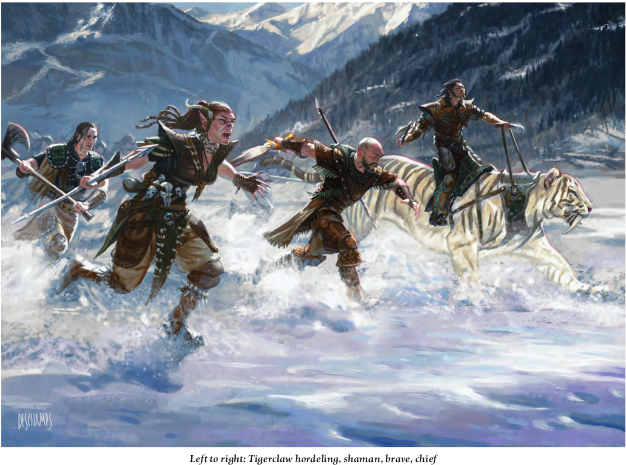
Likely a Tamed warrior of no particular distinction, this human is a Level 3 Minion Skirmisher. They attack with a battleaxe that crits on a 18-20, though the damage increase from the critical is not spectacular since this is still a minion.
Tigerclaw Brave
This human is a skilled warrior, which means they might one day undergo the Tigerblood initiation ritual. They’re a Level 3 Soldier with 49 HP.
Braves fight with a Broadsword in melee and throw Sabertooth Spears at range (they carry 2). The sword makes basic attacks that mark for a turn on a hit. The spear targets Reflex and immobilizes for a turn on a hit. On a miss it deals half damage and slows for a turn. This is not an at-will attack: it recharges when the brave is bloodied.
If a marked enemy adjacent to the brave shifts, they can use a Sabertooth Jab to make a free sword attack against them.
Tigerclaw Scout
This is a shifter, which means they’re definitely a Tigerblood. They’re also a Level 4 Skirmisher with 55 HP.
The scout is an Adept Charger, which means they’re not limited to taking only free actions after a charge. Their Razorclaw Flurry power gives them a +2 bonus to Speed and a +4 to defenses against opportunity attacks while bloodied.
Scouts fight with paired Light Picks, meant to invoke the image of a sabertooth tiger’s fangs. They do an extra die of damage if used on a charge, and can use a power named Sabertooth Strike to attack two different targets at once. This recharges as long as at least one of the attacks misses.
If an enemy ends its movement in a square where it flanks the scout, the scout can use Wild Instinct as a reaction to shift 2 squares.
Tigerclaw Fang-Wielder
This shifter is a Level 5 Brute with 77 HP. They use a heavy war pick, whose attacks to extra damage while they’re bloodied. It can also be used in a Fang of the Sabertooth maneuver (recharge 5+), which does heavy damage, knocks prone, and on a critical hit inflicts 5 ongoing damage (save ends).
When the Fang-Wielder first becomes bloodied, they use a reaction named Winter’s Rage, which is an attack on a Close Burst 1 that damages and knocks prone on a hit, does half damage on a miss, and pushes 1 square as an effect.
Fang-Wielders want to charge right in and actually like getting surrounded by melee PCs, because all of their best traits kick in when they’re bloodied.
Tigerclaw Shaman
These shifters act as spiritual advisors and general spellcasters for the Tigerclaw. They’re Level 5 Controllers with 52 HP. In combat they use a Longspear and some mind-affecting magic.
This includes the Phantom Fangs at-will spell, which on a hit does psychic damage and immobilizes for a turn, and on a miss slows for a turn. It also includes the Concussive Roar encounter power, a minor action that attacks a Close Blast 3 and on a hit pushes targets 3 squares and immobilizes them. On a miss it pushes 1 square instead, but in either case it does no damage.
Sabertooth Tiger
Yes, as implied in the lore the Tigerclaw make use of sabertooth tigers as pets. Tigerblood candidates have to tame a wild tiger as part of their initiation, and I imagine they also breed and raise tigers to accompany hereditary Tigerbloods. An encounter involving Tigerclaw members is also likely to involve these beasties.
Sabertooth Tigers are Large Natural Beasts with the Mount keyword and Level 6 Soldiers with 72 HP. They have a ground speed of 8 and a climb speed of 4. Their Charging Pounce trait works like the scout’s Adept Charger, letting them make any type of action after a charge. And their Tiger Charge trait gives a +2 damage bonus to the charge attacks of their rider.
Their bites do extra damage on a charge, and grab on a hit (escape DC 15). If the tiger has a grabbed victim, it can only bite that victim. It can also use Puncturing Fangs against them. This hits automatically, does some physical damage, and inflicts ongoing 5 damage (save ends).
Tigers are higher level than most of the humanoids in this entry, but this is not a problem because ever since the Monster Vault mount monsters no longer have to be of equal or lower level than their riders. You can safely drop this restriction from all older monsters as well.
Tigers want to charge in, grab someone, and keep using Puncturing Fangs on them, preferrably while their rider attacks.
Scargash, Tigerclaw Chief
Scargash seems to be a fairly typical Tigerclaw chief as far as stats go. You could use the same stats for chiefs of other tribes if any appear in your game. He’s a shifter, of course, and a Level 6 Elite Brute with the Leader tag and 176 HP.
Scargash gains a +2 bonus to all of his defenses while bloodied, and his leadership style expresses itself as an aura (5) named Encircle the Prey, which grants allies +2 to damage on attacks against targets they are flanking.
His War Pick inflicts ongoing damage on a hit and can be used in a Double Attack. If both of those attacks hit the target also suffers a -2 penalty to all defenses.
His encounter power is a Staggering Swipe that damages the target and does half damage on a miss. As an effect, it also slides the target 3 squares to a space adjacent to one or more other enemies. Those enemies take an automatic 10 damage and fall prone as the flung target bowls into them.
Primal Sabertooth Tiger
The kind of majestic mount a Tigerclaw chief would ride into battle. They could be extraordinary mundane specimens, but are likely somehow blessed by the Hunter in Winter either naturally or via Tigerclaw rituals. Primal sabertooths are Huge Natural Beasts with the Mount keyword and Level 8 Elite Soldiers with 178 HP.
They have the same Charging Pounce trait as their smaller relatives, and also have Threatening Reach 2. Their basic attack is a Reach 2 Claw that damages and inflicts 5 ongoing damage. If the target was already taking ongoing damage, this inflicts 10 ongoing damage instead. This means that a second claw attack on the same target will worsen their ongoing damage, or that a first attack will already inflict the worse condition if the target was taking ongoing 5 damage from another source.
The primal tiger’s Bite is a minor action. It does light damage and grabs with escape DC 20. The tiger can pull the victim along when it moves without provoking opportunity attacks from the victim. Only one victim may be grabbed at a time.
Their special attack is Go For the Kill (recharge 5+), which targets Reflex, deals heavy damage, knocks prone, and gives the tiger 5 temporary HP if the attack bloodies the victim.
When the tiger hits 0 HP, it can shift its speed and use Go For The Kill one last time. If this reduces the target to 0 HP, the tiger heals back to 20 HP instead of dying. This ability, called Fierce Spirit, is an encounter power, so the tiger can’t use it again in the same fight.
Final Impressions
The book uses the word “barbarian” a lot, but I’ve avoided doing it here. I suppose they’re barbarians in the D&D class sense, but I wouldn’t want to use the rest of that word’s baggage with them. And if I included the Tigerclaw in a game, I’d definitely remove the bit where they raid other communities for “worthy mates”. It’s still a bad trope no matter how you look at it.
Removing that shitty trope leaves you with a fairly complex people as far as D&D cultures go. They’re not likely to be very friendly to outsider PCs, but they have good reasons for their suspicion. Outsiders can still interact with them in peaceful ways with a bit of work, and they would make a good origin culture for martial or primal PCs.
If Bitterstrike decides to go a-conquering, she’ll want to force Scargash’s tribe to act as her front-line troops. I imagine their traditionalists will welcome this since it will mean an end to diplomacy followed by lots of battles, but most of the tribe would resent serving under the dragon and/or being manipulated by Frost Witches who would surely be the secret instigators of the whole thing. They’re the first troops you fight, but they’re also the weak link you work in order to dismantle the Army of Winter.
Shadowfang’s bunch makes for a much less ambiguous enemy faction, but PCs who like to go for the diplomatic solution would still have plenty to do in a scenario where the people of Winterhaven and Fallcrest had trouble telling them apart from other Tigerclaw and directed their enmity at all of them.
-
Let's Read Threats to the Nentir Vale: Shadowmire
Copyright 2011 Wizards of the Coast. This post is part of a series! Click here to see the others.
Here’s our third dragon!
The Lore
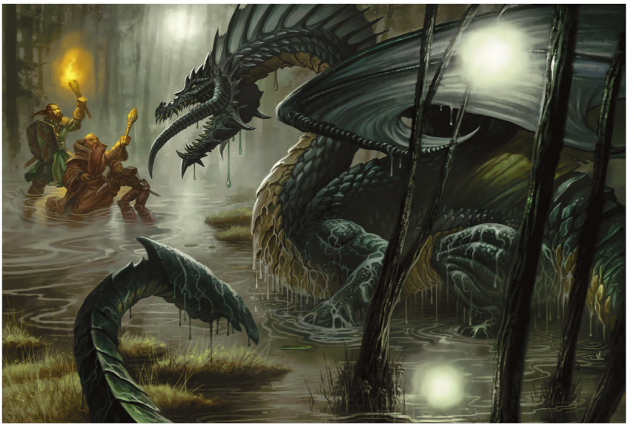
The black dragon Shadowmire has made the Witchlight Fens his home for over two hundred years. He’s the more active and aggressive of the Vale’s current draconic inhabitants, and I guess also the one most like a typical dragon.
Shadowmire claims the entire extent of the Witchlight Fens as his dominion, but though his personal power is terrifying, his power base is not quite up to the task of controlling all of that territory. The dragon rules many of the lizardfolk tribes who live on the area as a terrifying overlord, and while they’re not always capable of preventing others from encroaching into the fens, Shadowmire uses them to punish any groups foolish enough to do so. He likes to brag that the fall of Kalton Manor was his greatest victory, though he was not the sole factor involved in that tragedy.
The dragon’s main goal is to turn his claims into reality, and to grow ever wealthier and more powerful in the process. He patrols the Fens to make its inhabitants fear him, and can sometimes be seen flying over the Nentir River where it passes by the swamp. He can also move more stealthily, even swimming silently where the water is deep enough.
Shadowmire’s lair is under the Cairnwater river, accessible through an underwater entrance at the river bed. Its true location is known only to the dragon himself, but there’s much speculation about it and the treasures it contains. Shadowmire is entirely aware of this and keeps a number of fake lairs throughout the fens, which he uses to misdirect his enemies and lure greedy adventurers to their doom. The dragon increases his hoard by looting those greedy adventurers, and by raiding trade boats that pass through the Nentir river.
Since he’s lived in the Fens for so long, Shadowmire knows practically every one of its secrets, and a good deal about the story of the Vale besides. He also makes some effort to remain aware of the Vale’s current affairs through his network of spies.
Not every inhabitant of the Fens serves the dragon, and some even try to oppose him. I imagine there might be a hag coven or two who have objections to his rule, but the group the book calls out as the most persistent torn on Shadowmire’s side are the Daggerburg Goblins! They regularly venture into the fens and clash with Shadowmire’s lizardfolk servants. I imagine they might be in a true pickle if the dragon decides to retaliate personally, but he doesn’t like leaving the Fens.
The Numbers
Shadowmire’s stats make me think all three dragons were written by different authors, because he’s Huge and a Level 19 Solo Lurker with 712 HP. This makes him the most powerful dragon in the book, even stronger than slumbering Calastryx. I guess this is balanced by the fact that he has the weakest army, as his lizarfolk aren’t very organized and can’t operate very well outside the swamp. This limits how far he can expand.
Despite having a level comparable to that of a “stock” Elder Black Dragon, Shadowmire has a slightly less varied repertoire of attacks. His passive traits are all work the same, as do his bite, Breath Weapon, and Bloodied Breath.
Bite and Breath Weapon do less damage than the ones from the base elder dragon. The difference here is that the Threats writers considered the added ongoing acid damage from both the bite and the breath to be part of the damage formula, while the Monster Vault writers added them on top of that. Both bite and breath do half damage on a miss, too, so a fight against Shadowmire is a grueling battle of attrition.
Shadowmire’s Claw attacks do the same damage as a base elder dragon’s, and pull the target 2 squares. His Tail Sweep works the same but does more base damage.
And finally we get to the star of the show, his custom ability: Swamp Simulacrum. When used, this makes Shadowmire turn invisible for a turn and summons 2 identical duplicates within 10 squares of the original. They last until the end of the encounter or until destroyed. The duplicates are effectively minions with Shadowmire’s defenses, and explode in a burst of acid when destroyed (Close Burst 2, acid damage, half on a miss). This recharges when the dragon is first bloodied.
Final Impressions
Shadowmire is an interest mechanical variation on an elder black dragon, and his lore is workable enough, but I think he’s a bit too high level to fit with that lore. I’d probably make him Level 12 or so. He’s more dangerous and intelligent than Bitterstrike, but is not seen as a living calamity like Calastryx.
-
Let's Read Threats to the Nentir Vale: Scroll Mummy
Copyright 2011 Wizards of the Coast. This post is part of a series! Click here to see the others.
Another more generic entry. I first remember seeing scroll mummies in 3e where they appeared in the Monster Manual III. I wouldn’t be surprised if they date from earlier editions than that. There’s a bit of an AD&D 2nd Edition vibe to them.
The Lore
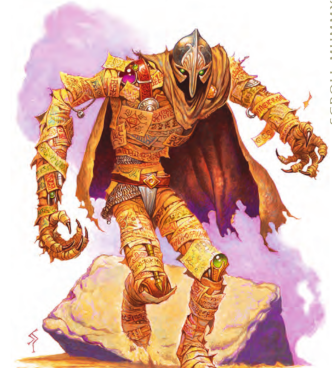
Despite the name, these creatures are constructs, not undead. They’re armatures made from magical detritus (broken magic items, shards of potion vials, and so on) wrapped in spell scrolls. They style of the wrapping makes them resemble mummies, so I guess the name stuck.
They are however still undead-adjacent because each one is powered by a lich’s soul. To activate a scroll mummy, you need to destroy a lich and place its soul vessel inside the finished body of the construct before the lich can reform. The lich’s soul is bound as a power source, and the mummy rises to obey its creator like a typical construct.
Scroll mummies are fairly clever as constructs go, and their construction gives them the ability to cast the spells written on their wrappings. In the Vale, the Mages of Saruun know how to create scroll mummies and love using them to guard their private libraries. Most other people who know the secret of their construction are more explicitly evil mages and priests, many of which worship Vecna.
There is, of course, a complication here: if a scroll mummy is destroyed and the soul vessel survives, the lich it belongs to will reform within 1d10 days. It will likely also be pretty angry at whoever decided to turn it into a glorified battery.
The first scroll mummy ever created was named Grisgol, and its heart was the vessel of the lich Asperdies. Legend has it that Asperdies eventually found a way to break out of his imprisonment and took his revenge on Grisgol’s creators. To this day, wizards who are particular about terminology prefer to call these constructs “grisgols” since they aren’t true mummies.
The Numbers
Grisgols are Large Natural Animates with the Construct keyword, and also Level 15 Elite Soldiers with 276 HP. That puts them at about the same power level or a bit higher than a typical lich. Its basic attack is a Paralyzing Claw, borrowing the power of a lich’s touch. It’s Reach 2, does necrotic damage, and immobilizes for a turn.
Once per round as a minor action, the grisgol can cast a spell from one of the scrolls wrapping it. The GM rolls a d6 to determine the effect. All of them are bursts or blasts with different elemental damage types and riders.
-
Boiling Blood: Close Burst 2 vs. Fortitude, immediate and ongoing fire damage on a hit (save ends).
-
Ice Barrage: Close Blast 5 vs. Reflex, cold damage, half on a miss.
-
Lightning Lure: Close Blast 5 vs. Reflex, lightning damage, pulls 4 squares.
-
Shadowy Tendrils: Close Burst 2 vs. Fortitude, necrotic damage, inflicts necrotic vulnerability (save ends).
-
Thunderforce Pulse: Close Burst 2 vs. Fortitude, thunder and force damage, knocks prone.
-
Wave of Madness: Close Blast 5 vs. Will, psychic damage, target must choose between making a basic attack against an adjacent ally or taking extra psychic damage.
I imagine that in past editions these would be standard spells, but here they’re custom.
When a grisgol is reduced to 0 HP, it collapses and releases a cloud of Choking Dust in a Close Burst 2. This attack does both immediate and ongoing necrotic and poison damage (save ends).
Final Impressions
It’s interesting that Vecna, who spreads lichdom rituals, would also be the source of the recipe for scroll mummies. Maybe it was all a scam from the start, or maybe he feels it’s a waste to simply kill all those “competing” liches who are affiliated with Orcus.
I guess this also gives a plausible reason for some shady wizards to not want to become liches. “A lich? You mean like those things I use to power my guards?”
In addition the treasure these things might be guarding, their own bodies might serve as a plausible source of treasure for an encounter. Maybe one of those broken magic items isn’t so broken after all, and maybe you can bring combat scrolls back into 4e by giving them out as consumables that let PCs use one of the grisgol’s spell attacks once.
-
subscribe via RSS