Posts
-
Let's Read the 4e Monster Manual/Vault: Bearded Devil
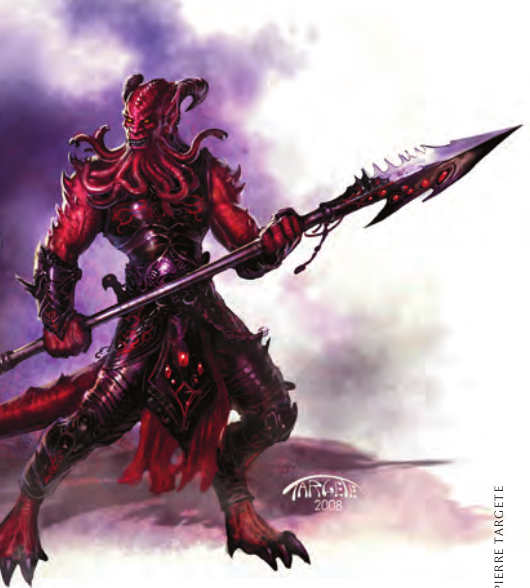
Illustration Copyright 2008 Wizards of the Coast. This is part of a series! Go here to see the other entries.
The Lore
The first devil we’re looking at is actually a bad example of infernal subtlety. Bearded devils, also known as Barbazus, are wrathful creatures who love to fight. They tend to be used both by their hellish superiors and by diabolist summoners as bodyguards and shock troops, jobs which suit them just fine.
Bearded devils are well-armored and fight with glaives enchanted to cause horrible bleeding wounds. Their beards are actually a mass of muscular clawed tendrils which they can use to harass enemies. Though they have claws, they will only use them if they somehow lose their weapons. Barbazus might be fiends but they still have standards.
Like all devils, they’re Evil and speak Supernal.
The Numbers
Barbazus are Medium Immortal Humanoids (devils), and Level 13 Soldiers with 129 HP. They have trained Perception and darkvision, as well as 20 fire resistance. They run at speed 6.
Their basic attack is a Reach 2 glaive, which marks the target for a turn and causes ongoing 5 damage (save ends) on a hit, in addition to what should be level-appropriate damage. They also have a claw attack as described above, which is just a normal physical attack that does less damage than the glaive and doesn’t mark.
When bloodied they enter a Battle Frenzy, which gives them +2 to attacks and +5 to damage. And their Devilish Teamwork gives adjacent allies a +2 bonus to AC.
Oh, and there’s the beard. Its tendrils act like an Aura 1 around the devil, dealing an automatic 5 damage to anyone who starts their turn inside.
The sample encounter is level 13, 3 barbazus and 2 yuan-ti malison sharp-eyes (i.e., yuan-ti artillery).
Final Impressions
There’s nothing extraordinary about bearded devil lore, though I find their looks interesting. Mechanically, they seem to be solid soldiers once you fix their damage. They use reach weapons, so they work well in two-row formations with more of their kind, or with brutes.
-
Let's Read the 4e Monster Manual/Monster Vault: Devils
We’ve only just spend a whole lot of time looking at demons, and now we’re going to spend a whole lot of time looking at devils. If you’re new to D&D in general, you might be wondering what’s the difference between the two types of monster. Don’t the words “demon” and “devil” mean the same thing? Out here in the real world they pretty much do, but D&D has a long and storied tradition of making every synonym of a word into an entirely different monster.
To understand what 4e devils are like, and what makes them different from demons, I must tell you another story about the World Axis, the cosmology of D&D 4th Edition. This time, it’s about the Astral Sea that exists “above” the world.
Just like the Elemental Chaos combined all the separate elemental planes into one glorious mess, so does the Astral Sea combine all the former non-elemental outer planes into a single whole. The old astral plane, which used to be a featureless gray void, is now a literal sea, and if you look into its silvery depths you can see the light of the stars in the world’s firmament. By sailing the Astral Sea you can reach the domains of the gods, which work both like islands and like worlds in themselves.
Now, there was this one god who had a very powerful exarch named Asmodeus. The god was pretty nice all in all, but Asmodeus kept thinking that he was too nice. “Why”, thought Asmodeus, “if I was the big boss here I could do a much better job. Streamline our processes, leverage our synergies, cut away the fat”. And so Asmodeus built himself an army out of similarly dissatisfied servants of this god, and any other astral entity who wanted a piece of the action.
You might be thinking hey, I heard this one before, and you’d be right. The difference between the classic Lucifer story and this one, is that here the rebellion was successful, since the god in question wasn’t omnipotent. He was still powerful, however. His dying curse twisted the rebel’s bodies into forms that exposed their inner wickedness. The rebellious angels and exarchs became devils. The domain of the dead god twisted into itself and became the Nine Hells. Devils don’t belong in the cosmology the way angels or even evil gods do. Devils are wrong.
Still, devils are a lot more “human-ish” in appearance than demons. Most look like exaggerated versions of tieflings, though technically it’s the tieflings who look like dilluted versions of devils. Even those devils with a more monstrous aspect still have a basically humanoid body plan, which is not a guarantee with demons. Infernal society is militaristic and fiercely competitive, with individual status being determined by a combination of official rank and one’s skill at acquiring mortal souls. In other words, devils compete for promotions by trying to impress their managers with their outstanding productivity.
Anyway, that “acquiring mortal souls” bit is a big part of the reason for why devils are wrong. Lots of people here in the real world say that when you’re evil in live you go to Hell after death, but that’s not how it works in the World Axis. Evil people who die here likely go to the realm of the evil god whose credo more closely matches their ethics. To get souls, devils have to go out and steal them. Each soul stolen by Hell diminishes the power of the gods, and adds to that of the devils. The general idea seem to be that removing enough souls from the hands of the gods will weaken then and allow devils to take over.
So even evil gods would have cause to oppose devils, though it turns out several of them (Bane, Gruumsh, Tiamat, Torog and Vecna) are on more or less friendly terms with Hell because they struck deals with Asmodeus in the distant past. Either they believe themselves safe, or think they can outsmart Asmodeus when it’s time for the backstabbing. What actually happens when that time comes is left as an exercise for the GM. Asmodeus is pretty smart, but so are Vecna and Tiamat.
Devils have all kinds of uses for souls, from playthings to currency to raw material for their mightiest inventions and magics. Their methods of acquisition are many, with the most popular ones being infernal bargains and other types of trickery. Given all of the above I imagine they don’t necessarily try to make you become evil, just to sign the contract.
However, violence is not off the table as a means of soul acquisition. This puts a new spin on “kill them and take their stuff”. When devils fight, they do so in a distinctly different way from demons, and their stats bear this out. Demons are elites more often than not, and tend to fight as mobs of individuals with their assorted sharp appendages. In contrast to this, even higher-level devils are usually regulars, fight with well-crafted weapons, and rely a lot more on teamwork and training.
Asmodeus, now a god, rules all devils from Nessus, the deepest of the Nine Hells. Each of his exarchs rules one of the other eight layers, and while they’re a little less popular than the demon lords, their names are still classics: Mammon, Belial, Belzebub, and so on.
I’m not sure these archdevils are statted in any of the monster books; these entries are for their less powerful underlings. We’ll see them starting next post, using the same order I did with demons: we’ll look at the devils from the MM, and their MV counterparts when they appear. This time it appears that all of the devils that made it into the MV also exist on the MM.
All of the devils here seem to have two names. One is just an adjective followed by the word “Devil”, the other something more exotic sounding. Since they’re listed in the Monster Manual’s table of contents by their more prosaic names, I’ll use those as titles, but I’ll also mention the fancier name in each article.
-
Let's Read the 4e Monster Manual/Vault: Destrachan
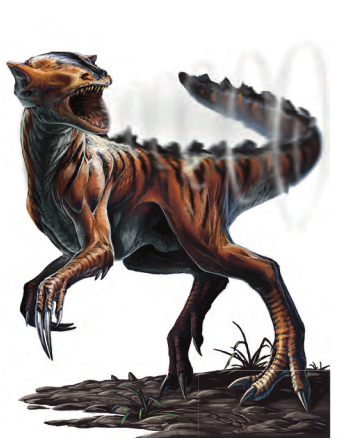
Illustration Copyright 2008 Wizards of the Coast. This is part of a series! Go here to see the other entries.
The first non-demonic monster we’re going to look at in ages is the Destrachan. These aberrant dinosaur things first showed up in the Monster Manual 2 for D&D 3.0, if I’m not mistaken. So, in a way, they’re being promoted. They appear only on the MM.
The Lore
Destrachans are blind sapient predators, roaming dungeons and other underground locations guided by their non-visual senses. When they find something they think they can eat, they kill it dead using bone-shattering bursts of sound. They can learn to mimic sounds they hear often, and will use those to help disguise their approach, which explains why they’re trained in Bluff. I wonder how common it is for a destrachan to mimic the voice of a dying adventurer asking for help.
These creatures have an affinity for other aberrant monsters, and will often team up with them. They’ll also often ally with other underground dwellers and monstrous humanoids such as drow, grimlocks, medusas, trolls… It’s a good bet Eberron’s Droaam has its share of destrachan citizens (if they’re not all daelkyr cultists instead).
The Numbers
We get two varieties of Destrachan here, both Large Aberrant Magical Beasts (blind). They’re also both Evil.
The standard Destrachan is Level 9 Artillery with 80 HP. It has blindsight 10, is immune to gaze attacks and has Resist Thunder 10. It has a ground speed of 6 and a climb speed of 3, so this is yet another Underdark monster who can drop on you from the ceiling.
Its basic melee attack is a weak Reach 1 claw, and its main attack is a Range 10 Sound Pulse that targets Reflex and does thunder damage. It can also go louder and use a Bellowing Blast quite often (recharge 3-6). This targets Fortitude in a Close Blast 5, does the same thunder damage as the pulse, and dazes (save ends).
The monster prefers to stay far away and attack with sound pulses, but it has no reason to not spam Bellowing Blast as often as possible if the PCs manage to close in.
The Destrachan Far Voice is a smarter (Int 10 instead of 7) and stronger variant. It’s Level 15 Artillery with 122 HP. Its blindsight increases to 20, its thunder resistance to 15, and its speed to 8 (climb 4).
It has the same attacks as the classic model, adjusted for the level-up, and a new encounter power named Reverberate. It targets the fortitude of everyone in a Close Burst 2, does a smidge more thunder damage than the Bellowing Blast, and stuns (save ends). On a miss, it still does half damage and dazes for a turn.
Encounters
The entry has two.
-
Level 9: 2 destrachans and a trio of assorted foulspawn form an all-aberrant monster team.
-
Level 15: 1 destrachan far voice, 2 driders, and a trio of assorted drow.
Final Impressions
Destrachans are another of those weird monsters who kinda come out of left field, but I think their 4e versions at least have a clear mechanical role. Their propensity to ally with other creatures gives you an excellent excuse to add some convenient ranged support to monster teams that would otherwise lack it.
-
-
Let's Read the 4e Monster Manual/Vault: Dretch
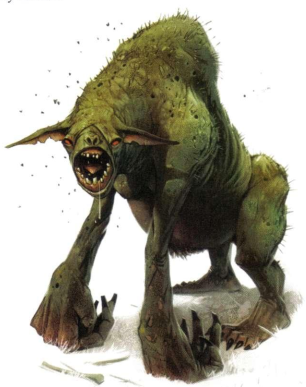
Illustration Copyright 2009 Wizards of the Coast. This is part of a series! Go here to see the other entries.
Dretches are the pond scum of the Abyss. The name “dretch” is likely a contraction of “demon wretch”, because these things are weak, stupid and stinky. Everyone bullies them back home, and more powerful demons love throwing hordes of dretches at new opposition both to gauge their abilities and to enjoy the sight of dretches dying in droves.
I think dretches used to be the souls of Chaotic Evil sinners in previous editions, but that is not the case here. Demons in 4e don’t care about souls, and no one who dies goes to the Abyss. These balls of rage and body odor just spontaneously generate from the corruption of that plane.
In this edition, Dretches first show up in the Monster Manual 2, so we’re getting a bit ahead of ourselves here. This is because they’re also present in the Monster Vault. Since we have the space we’ll cover the MM2 and MV versions each in their own entry.
In both cases, they’re Small Elemental Humanoids (demons) with Int 5 and darkvision. They speak Abyssal but have nothing interesting to say.
Dretch (MM2)
Basic dretches are Level 2 Brutes with 44 HP, which very likely makes them the first demon your PCs will ever encounter in a Heroic campaign. They possess the usual variable resistance 10 (1/encounter). A Sickening Miasma emanates from their bodies in an Aura 1 pattern. Each enemy inside the aura takes 1 damage whenever they take a move or standard action. Multiple miasma auras are cumulative, increasing that damage to a maximum of 5. Beware dretch mobs!
Their basic attack uses their claws, and they can also make an at-will Claw Frenzy that allows them to make that attack against up to two creatures. The Monster Manual 2 still had the damage bug, but these monsters are too low-level to be much affected by it.
When a dretch dies it spills its stinky insides all over the floor. This Vile Death creates a zone of poison on a Close Burst 1 pattern centered on the dretch, which lasts for a turn and does 5 poison damage to any non-demons who enter it or start their turns inside.
Do note that while the Vile Death deals poison damage, the Sickening Miasma deals untyped damage. Being resistent to poison will not save you from dretch funk.
The sample encounter in the MM2 is level 7! 1 level 7 bloodseep demon, 2 level 5 gnaw demons, and eight dretches. Whoever designed this really took that line about waves of dretches in the lore seriously.
Dretch Lackey (MV)
Monster Vault demons are strictly paragon tier or above, so it gives us the Dretch Lackey, a Level 12 Minion Brute.
They lack the MM2’s dretch Vile Death and multiattack ability, but the attack bonus and damage on their claws is appropriate for fighting early Paragon PCs. They do keep the Sickening Miasma, which now does 2 untyped damage per dretch up to a maximum of 10.
Having a huge crowd of Dretch Lackeys seems more appropriate than the medium-large crowd of basic dretches from the MM2’s sample encounter.
Final Impression
I guess I can kinda see why dretches were left out of the first Monster Manual. Sure, they’re the classic low-level demons, but they don’t have much more than tradition going for them. Still, the pull of tradition might be enough - I did wonder where they were when I first looked at the MM entries.
-
Let's Read the 4e Monster Manual/Vault: Babau
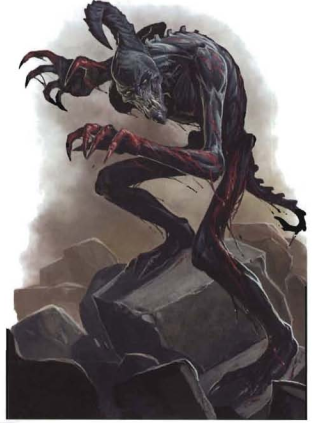
Illustration Copyright 2010 Wizards of the Coast. This is part of a series! Go here to see the other entries.
In fourth edition, the Babau first appears on the Monster Manual 3. We’re viewing them ahead of time because they also appear on the Monster Vault.
The Lore
The general thrust of demons in 4e is that they’re not fond of complex schemes, which are more of a devil thing. Babaus are one of the exceptions to that rule. You see, there’s this demon lord called Graz’zt who is not a former primordial like the other demon lords. Instead, he was an archdevil who got it into his mind to invade the Abyss. Why did he do that? I don’t know. The lore in the MM3 mentions the Blood War, but I didn’t think that was still a thing in this edition. Maybe it’s a vestige of his backstory from Planescape, or maybe the Blood War has a different explanation for its existence here.
Anyway, shortly after getting to the Abyss, Graz’zt was corrupted by the seed of evil and decided to stay around and become a demon lord. Glasya, another archdevil and daughter of Asmodeus, was not pleased by that. She went after him and ran him through with her sword. When the drops of blood from that wound hit the ground of the Abyss, they became babaus, and their number was so great they drove Glasya back to the Hells, and their continued presence helped build Graz’zt’s power base and make his claim to demon lordship stick.
Being the spawn of Graz’zt, babaus are extraordinarily subtle and cunning for demons. This means they like to kidnap people to torture later instead of killing them all right away. They can be found working alongside other demons, even though they’re even less trusted than usual due to their continuing loyalty to their creator.
They look like skeletally thin humanoids with dark gray skin coated in slime, a spine-like tail, and a weird horn that looks like a scorpion stinger growing out of the back of their heads. All of this in addition to the usual demonic claws and fangs.
The Numbers
Since the babau is from the Monster Manual 3, its stats are identical in that book and in the Monster Vault. It’s a Medium Elemental Humanoid (demon), and a Level 13 Skirmisher with 127 HP. They run with Speed 7.
The babau has acid resistance 5, plus variable resistance 20 usable 2/encounter. It’s coated in acidic slime that deals 5 acid damage to anyone who attacks it with a melee attack.
This demon has two basic attacks, a bite and a claw. It can only use one of them per standard action, unless the target is granting combat advantage. Then it can use both. Each attack only does about half the level-appropriate damage for a skirmisher by itself, so the babau should really strive to gain combat advantage when fighting. The bite also does 5 ongoing acid damage, or 10 if the demon is bloodied.
As a minor action, the babau can perform a Murderous Abduction. This teleports an adjacent creature up to 7 squares and then immediately teleports the babau next to it. The victim grants combat advantage to the babau for a turn. This recharges whenever the babau drops someone to 0 HP. I’m guessing it reserves the power for then a PC is close to dropping.
Final Impressions
I’m gonna have to go with “meh” on this one. Their backstory feels kinda shoehorned in. They somehow brought back the Blood War and Graz’zt, both of which I feel are completely unnecessary.
As for the babaus themselves, they seem a bit too hard to use properly, since they absolutely must gain combat advantage to do level-appropriate damage with their attacks. The abduction power makes it seem that they’d be best employed in terrain with obstacles that are hard to overcome without teleportation, but then they can’t teleport back even if they drop the abducted PC. And if the PC doesn’t fall on that first turn, then the demon is now stranded far from its own allies and together with an angry PC.
subscribe via RSS